Fix it or do it over? How to tackle mistakes

Joined
Dec 29, 2008
Messages
697
I have a knife that I was making and in between the micarta scales and the tang I had g-10 liners cut to shape and glued on when I clamped the handle to dry. After the glue dried I was doing my handle shaping on the belt sander and I got the rough shape of the handle done.

Well I encountered a problem , as I ground down the handle more a piece of the g-10 liner must of caught the belt and a piece of it snapped out and flung out from under the micarata scale. Thus leaving a small gap near the butt of the tang. Just a little piece but enough to bother me. The knife is almost done I would hate to heat the glue up bang the pins out and do it over but if that's the best way I will. Or can I fill the gap with epoxy then tape the liner off and paint it? Of that will work what type of epoxy can I paint over that holds the color well?

Part of me thinks that if I make a mistake I should learn how to fix it instead of throwing away materials but the other part of me believes that the fit and finish of a custom knife should have no repairs on it by the time it's finished.
 
Use a piece of the same material and superglue it in place. Grind it down flush and finish it. Paint won't work.
 
Use a piece of the same material and superglue it in place. Grind it down flush and finish it. Paint won't work.

That's a good idea. It's a piece of 3 color camo micarta for the scales and an OD green g-10 liner which is about 1/16" thick. So are you suggesting glueing a piece of the g10 liner in there or a piece of the micarta?
 
I think Bill is saying clean out the resulting hole, cut a small piece of the G10, superglue it into the hole (make it slightly oversize obviously) and sand it smooth carefully. As close a fix to replacing the whole thing as you will get I reckon.
Or, to color epoxy, you can use corn flour and color it with dye or food coloring and mix it with the epoxy to fill colored areas in a pinch.
I have had a similar thing happen. For me, I figured I would always know there was a repair there and couldn't live with that, so I took it apart and replaced it. That was a customer knife though, if it had been for my personal use, I may have done what Bill suggested.
Always go across the tang when sanding, with G10 liners especially. And always with a hard backing.
 
Part of me thinks that if I make a mistake I should learn how to fix it instead of throwing away materials but the other part of me believes that the fit and finish of a custom knife should have no repairs on it by the time it's finished.

I think that fixing mistakes is an essential skill set and being good at it differentiate the masters from the beginners. Of course if the knife will be sold, full disclosure might be in order depending on the nature off the repair.
 
Here is my 2 cents, as a buyer.

What I don't know, I don't know.
What I can't see, I can't see.
But if somewhere down the line I was informed by someone who could see, and did know, that a custom knife I commissioned and paid for had been 'repaired' without my knowledge before I took delivery from the maker I wouldn't be very happy about that. Might not be upset either unless it lowered the value.

That said, without seeing it, I am not sure I would consider what you are talking about a real repair or not.
I probably would if 'patched' could be used to describe the fix.
 
Thanks Flymon for clarifying. I guess my comment applies more to fixing a mistake than a actual "repair" or "patch" like you said.
 
PICTURES! Is it possible to sand the whole thing down, tang and all? Sanding out the mistake would change the shape of the handle but also solve the problem.
 
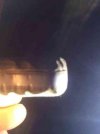
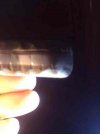
Here's some pictures and after looking at it again it looks like a chunk of the micarta came off not the liner.ImageUploadedByTapatalk1388174380.458703.jpgImageUploadedByTapatalk1388174388.390551.jpg
 
PICTURES! Is it possible to sand the whole thing down, tang and all? Sanding out the mistake would change the shape of the handle but also solve the problem.

That was my original idea but it's pretty deep . And if I change the handle that much then the blade won't match in my opinion
 
Its hard to tell, but it looks like your micarta slab may not have been flat.
I've got some black canvas micarta that I received flat, but after sitting around for a couple of months, is now significantly bowed.
If that's the case, even if you do a repair, the tension built into it may eventually tear it apart again.
Pictures grainy though, so I could be seeing things.
 
I would do it over. If you sell it and it fails you'll have to do it over anyway if you want your customers to trust you. Integrity never comes cheap. I know it hurts to do it over but it's a learning experience.

I spent hours hand sanding a knife when a crack appeared at a pin. And the advice to me was do it over. You'll be glad you did.


View attachment 403212
 
I would do it over. If you sell it and it fails you'll have to do it over anyway if you want your customers to trust you. Integrity never comes cheap. I know it hurts to do it over but it's a learning experience.

I spent hours hand sanding a knife when a crack appeared at a pin. And the advice to me was do it over. You'll be glad you did.


View attachment 403212

Very valid point. Like I originally thought I am extremely far far away from considering myself a decent knife maker. I have so much learning to do and a lot of skills to refine. So as much as it sucks to rip the handles off and do it again but that is the ultimate right thing to do. Because one day if I sell any of my knives I would feel horrible selling a knife that leaves the shop with a repair before it's even been used. It's only going to gain peoples trust and confidence in my ability to make knives that people will one day purchase.
Thanks for all the advice guys I appreciate it. This is going to be a pain in the butt . After I pull the scales off and put new handles on I'll post before and after pictures and I'll be interested in hearing opinions on if it was a good idea or not.

Semper Fidelis
 
I think you messed up in glue up and scale prep. I would take it off if and do over. Sometimes that is the best solution and takes less time then trying to fix it.
 
It looks like it failed to adhere, and wasn't dead flat to start with... G10 likes to be ROUGH when glued up. 120 or rougher actually. Otherwise it will pop off like nobody's business. Use a flat piece of granite/glass/etc with sandpaper laid on top. Rub the piece back and forth until you get 100% contact. Then you know its dead flat. Never try to overcome any uneven surface with clamp pressure. Always 100% contact between surfaces. My guess is you clamped it tight, forced it down, and it held until the epoxy got warm... If I'm way off base, my apologies. Usually though linear pieces of micarta (at least professionally made micarta) don't pull out like that. Also, there is such a thing as too much clamping force. It causes a 'glue-starved' union which will also eventually fail.

You may not consider yourself 'a decent knifemaker' but that shouldn't stop you from striving for perfection. Adjust the skill level of your design to oje you can accomplish 100% perfection at, especially if its going out the door...
 
It looks like it failed to adhere, and wasn't dead flat to start with... G10 likes to be ROUGH when glued up. 120 or rougher actually. Otherwise it will pop off like nobody's business. Use a flat piece of granite/glass/etc with sandpaper laid on top. Rub the piece back and forth until you get 100% contact. Then you know its dead flat. Never try to overcome any uneven surface with clamp pressure. Always 100% contact between surfaces. My guess is you clamped it tight, forced it down, and it held until the epoxy got warm... If I'm way off base, my apologies. Usually though linear pieces of micarta (at least professionally made micarta) don't pull out like that. Also, there is such a thing as too much clamping force. It causes a 'glue-starved' union which will also eventually fail.

You may not consider yourself 'a decent knifemaker' but that shouldn't stop you from striving for perfection. Adjust the skill level of your design to oje you can accomplish 100% perfection at, especially if its going out the door...

Now that I think of it I don't think I sanded the inside very well before glueing. Silly mistake I guess. And I did tighten the clamps down like crazy because I was trying to get rid of all the small gaps. That makes a lot of sense. I'm going to remove the handles and try again. For my adhesive I have been using gorilla glue. Not the 2 part epoxy just the squeeze bottle stuff. Can this be an issue as well? The other stuff I have is called double bubble epoxy. But I have yet to use it on a handle
 
Another reason to adopt processes that allow you to *finish* each component before final glue up also.


If it was a chip out from finish grinding, you could have simply replaced the G10 layer. If it was an issue with things not being flat, it would have been brutally obvious when you tried doing your handle work with temporary pins.
 
Learn from the mistake and I think you should mark it up as educational time spent. A do over is necessary in this case, actually the time it took to post would have been the same as a redo
 
I would steer clear of gorilla glue. Its fine for around the home, but a good two part slow cure epoxy is worlds better, easier to work with, and stronger.

The seeming favorite and what I have been using for about a year is West Systems. G-flex from them is great and not very pricey. You can get pump heads for their larger quantities, 105 resin and whichever hardener you prefer, which is very nice to use if you do a lot of epoxy gluing.
 
Back
Top