Fixer-Uppers

Joined
Mar 26, 2003
Messages
6,800
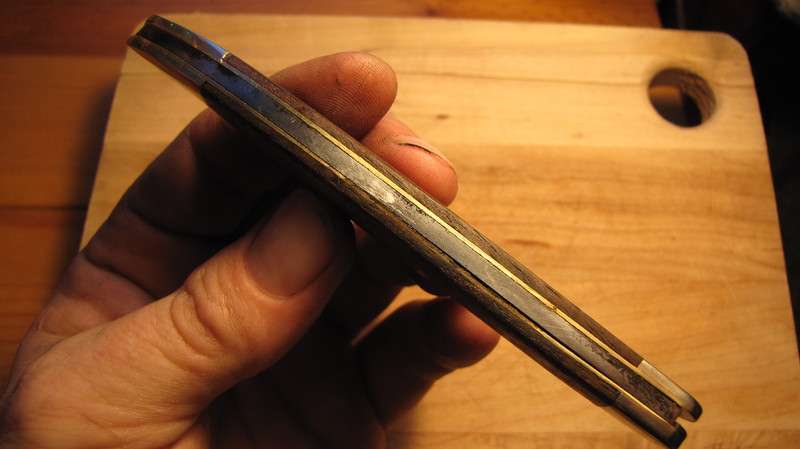
I found this Camillus fishing knife in an old shed. I have some nice black walnut I want to use as scales to bring it back to life. The liners are a little bent-- so I'm not sure how I'm going to straighten them out. Any other project knives out there, fellow forumites?:)

img10650.jpg


img10710.jpg


img1068o.jpg


img1069r.jpg
 
If you're referring to that straight line crink across the middle of both liners, that's supposed to be there. A very old assembly trick -- they smack it there to slightly cup the liners. When the scales are then pinned on, the cup flexes mostly flat but retains a bit of spring, making the liners "seal" to the scales without gaps and without any glue being used.
 
originally had yellow celluloid scales... mine is pictured below and the scales have started to pull away and gas out (alot of pitting on the metal surfaces so mine will eventually become a rehandle job too, really cool pattern though)
good luck with the rehandle
regards
gene
CAMIFL.jpg
 
Fisherman's What!? ;):D

The tip of the blade on mine is rubbing on the liner opposite the lock, so it seems a little out of wack or twisted. The blade isn't bent anywhere. It will be a fun project! I'll post pictures when done.
 
when opened, on mine at least it's kinda off too but doesnt rub the liner, i noticed the bend on yours, near the bottom bolster? dunno if that'll screw you up or not, ive only rescaled one slipjoint so far... didnt go too bad though
best of luck
gene
 
I'm currently working on a small winchester folder for my dad, thinking of a turquoise inlay, cause he's from new mexico. Oak wood, have one handle mostly shaped, will probably have the other one by Wednesday or Thursday.
 
If you're referring to that straight line crink across the middle of both liners, that's supposed to be there. A very old assembly trick -- they smack it there to slightly cup the liners. When the scales are then pinned on, the cup flexes mostly flat but retains a bit of spring, making the liners "seal" to the scales without gaps and without any glue being used.

Dwight, that's a pretty neat trick, I love hearing of old world processes like that. Thanks for that cool bit of info:thumbup::)

Paul
 
I'm currently working on a small winchester folder for my dad, thinking of a turquoise inlay, cause he's from new mexico. Oak wood, have one handle mostly shaped, will probably have the other one by Wednesday or Thursday.

Sounds cool!

If you're referring to that straight line crink across the middle of both liners, that's supposed to be there. A very old assembly trick -- they smack it there to slightly cup the liners. When the scales are then pinned on, the cup flexes mostly flat but retains a bit of spring, making the liners "seal" to the scales without gaps and without any glue being used.

That is cool! Thanx!
 
AAAAND........ Done!

img1073l0.jpg


img1074t.jpg


img10750.jpg


img1076b.jpg


The handle lined up pretty good after adding the scales! It's not perfect but it will make a nice user now.:)
 
That looks great! I love fishing knives. Have a handful. Nice work. :thumbup:
 
I love that little curve in the blade or whaqtever it might be called. :D

Would look even better with orange handles.
 
and you got it back to being usable again:thumbup:
of all my knives this one is the one that my son said looks scary:eek:
i'm hoping to rehandle mine sooner than later!
again great job!
gene
 
Did you completely disassemble and repin or did you just add scales somehow? I have a Fight'n Rooster toenail that has ugly celloloid pulling away, and has some other issues as well. It is definitely a project, but I have no clue where to start.

Great looking repair/replacement, that is way cool!

Thanks!
 
It's really cool because before this I have never owned a Texas toothpick of any kind!

Did you completely disassemble and repin or did you just add scales somehow? I have a Fight'n Rooster toenail that has ugly celloloid pulling away, and has some other issues as well. It is definitely a project, but I have no clue where to start.

Great looking repair/replacement, that is way cool!

Thanks!

This project was facilitated through the magic of 5 minute epoxy.:)
I sanded what was left of the pins flat. I guess I could of carefully drilled out the old scale pins and added new ones, but that epoxy is STRONG stuff!!!!
 
I just sanded the wood to fit the spaces (carefully) with a belt sander. I glued them on and clamped them down tight to try and get some of the flexes out of the liners. After a couple of hours I sanded down the scales. I did the edges with a dremel tool and the slack of the belt sander. When it got close to the bolsters I switched to 400 grit and took it all the way down. I tried to be really light over the writing on the bottom bolster. Polished it up on a buffing wheel and added some oil to the wood.

Again, thanks for the compliments!
 
Last edited:
Thanks for taking the time to explain how you did that. It is much appreciated.
 
Back
Top