Fixing the tracking on a KMG

Josh Rider

Stuff maker
Joined
Sep 2, 2014
Messages
2,428
I’ve been having issues with the tracking of my KMG for a while now.
It was getting incredibly difficult to maintain focus while my belt shifted to one side or the other.
Grinding a knife became so annoying that I finally decided to put my KMG up for sale. I was willing to take a hit and be done with the thing. This was just the tip of the iceberg to several other problems the machine came with.

Getting the direct drive from Matt Gregory was a huge upgrade and if anyone is still running their original pulley system kmg, I highly recommend this upgrade.

I won’t get in to the other problems I had, but this recent belt drift was just oppressing and something had to be done.

As I was thinking on why the tracking was getting so out of wack, I recalled an old thread that mentioned something about the tracking arm needing to be parallel or close to parallel to the tool arm. I wish I could remember who brought it up to give them credit.

I finally decided to remove the air shock under the tracking arm and bolt it to the side instead of underneath the tracking arm. It made a HUGE difference.
Tracking is so precise now with no belt drift.

So if your grinder is giving you tracking or belt drift problems, this may be of some help to you.

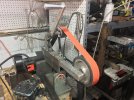
Here are some before and after pics.
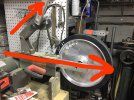
F916B2F8-69AC-4386-BB54-88A9B278720A.jpeg

39605B95-92BA-46DA-A1F5-0B8E5A6EEF3D.jpeg

In this pic the air shock has been moved to side.
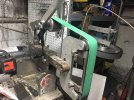
01B01C21-F631-4023-9E4A-F404071205F5.jpeg

Cheap belts are still a little wonky, but the blaze have been perfect so far.
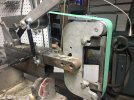
63596C9E-5861-4A3F-8A2A-8134970C6DD7.jpeg
 
Josh, I like your side mounted gas piston shock. Is that a 4 inch tracking wheel or a stock 3 1/2 wheel? I bought an after market tracking wheel off e-bay from Jackstraw in a four inch size and it seemed to track belts with less vibration. I also tightened the tension on the tracking arm mounting bolts a little bit after lubricating them and now use a 40 lb gas piston. I tweak everything every six months and am happy with my heavily modified KMG. Mine is very similar to yours except that I am one of the few guys that still use a belt drive and a jackshaft. You make nice knives and that is all that matters. Larry
ofqB79qm.jpg
 
I am one of the few Italians who use a KMG ... perhaps I think the only one to have an original one. I use it in its original status, that is with pulley system and with spring as shock absorber. I can not complain about any real problems. I have other belt sanders with direct drive connection, certainly have less vibration but I have to admit that my KMG with the belt well aligned between the two pulleys and with well balanced wheels does not give me any problem. However, in my opinion, the real goal of KMG, is the possibility of being able to make changes to the belt sender with great ease.
 
Larry, I have the original tracking wheel.
If I ever replace the wheels, jackstraw is who I’d use as well. I’ve bought some small wheels from him before.

I think you’d like the direct drive upgrade, but you’re making beautiful knives on your machine so I see why you would choose to keep it the same.

Mnife, I didn’t have the same experience as you with easy changes. I don’t get a lot of time in the shop as it is and coming up with different ways to fine tune a machine like this took me a lot of time even when other people helped.
On a positive note though, it’s working well for now so I’m happy for that.
 
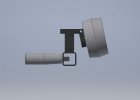
I just wanted to show how it's the axis of the tracking hinge that you need to remain parallel, or close to it. There are a number of things that change when this axis gets further from parallel with the direction of the belt. I'd been thinking about it since we spoke.

Here's some pictures to try and illustrate why it's important, with a exaggerated crown on the wheel to help visualize. When the axis of the hinge is parallel, adjustment in or out varies the distance the crown apex is from the arm, in almost linear fashion. This is what gives you the ability to move the belt in or out.

Capture.JPG Capture2.JPG


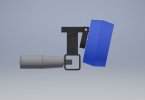
As you get away from that towards 45 degrees, this linear positioning of the crown morphs into a radial movement that A) reduces the actual travel and B) begins taking the crown rotation out of parallel with the direction of the belt. Note how the wheel appears "twisted" in this image verses above.

Capture3.JPG

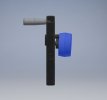
Last, (maybe least?) belt tension on this hinge is what keeps it against the adjustment screw, and as the hinge axis is rotated upwards, the belt tension goes from being a radial (in relation to the hinge) force to an axial force, reducing the amount of force transmitted from the belt through the wheel and onto the adjustment screw.

Capture4.JPG


So the single biggest improvement to tracking anyone can make to any grinder that utilizes this hinged tracking wheel method on the tension arm, is to in whatever way possible, get that axis parallel, as close as possible. Some people may even be able to do this just by how they position their tool arm, and wonder why today things track well and tomorrow they don't, because today their hinge is parallel and tomorrow it's 30 degrees off.
 
My grinder I have the top platen wheel and top of the tracking wheel in an almost level line from each other, and my tracking arm is parallel when running. My tracking is very very consistent to the point with when i run in reverse I have to adjust none to very little. The bottom platen wheel and the bottom of the drive wheel are almost parallel as well.
 
Well shucks - I'd read the tracking arm needed to be parallel with the run of belt to top platen wheel also, and my setup normally runs that way. You've done a GREAT job of explaining why that is. I'd not considered the axis of the tracking wheel hinge, due to your good drawings - it's crystal clear. Thanks.

Marc - seems like we have a similar setup, and I LOVE to run my grinder in reverse for sharpening.
 
Back
Top