Flat grind

I grind all my slipjoint blades flat and its a good question. Not sure how much help I can be but I will type a few things that help me.

A sharp center line scribed in with a surface gauge. Sharp new belt. Slow speed and I use a glass platen. I think the glass platen helps more than a lot people may think.

I will grind a 45 degree bevel or so right up to my center line then walk the flat up to the spine. I end up with about .008 to .004 before sharpening with a 20 degree bevel.

Ken
 
Thanks Ken..
I just been making knives about a year and new at putting the right angles on them..I really haven't got into the flat grinds or the hollow grind yet..
 
You might want to order the Harvey Dean flat grinding video.
 
Oh yeah, I forgot one of the most important things, practice practice, grind, grind, practice!:eek:

Ken
 
I find hollow grinding much easier than flat grinding. I hollow grind every knife I make - some of them just get flat ground afterward. Flat grinding became much easier to me after learning how to hollow grind. It's easier to stay even on a wheel because you can get a good groove for the wheel to fall back into - in my opinion this helps you develop the right stature and holding habbits with a little more ease.

Hollow grinding first allows me to spend very little time on the platen hogging stock and I can focus on making the grind as good as my skill allows. That being said, I have to do a lot of hand sanding afterward because my flat grinds still suck.
 
Here is one I cobbled together from 2" angle iron. It was easy to make and works better than I do. I adjust the work platform on the Delta sander to the angle I want and go at it. The work platform was too small to use without extending the bottom of the jig. I'm just getting started and so far this works pretty well for me.

tn_DSCF0505.jpg
 
I flat grind all my blades. To respect the center line and bevel line is the most important thing for me. To apply light and even pressure to the platen and to keep the blade sticked and fully contacted to the belt is very important. Try not to rush and keep it slow: Slow is faster!!! Also don't be perfectionist about the bevel lines, you can always correct some minimal errors on the hand sanding, but if you over do the grinding; even a tiny depression or a deep scratch on the bevel can cost you hours if not days of hand rubbing and change in the blade geometry to compensate the fault...
 
The technique to flat grinding is to make the initial grind up to your scribe lines, and simply press the blade flat into your grinder. Use edge first, because the grinder sucks that part in. It will automatically increase the angle as the bevel moves closer and closer to the other end of the blade, while the edge stays at the scribe line. It's pretty automatic and very consistent.
 
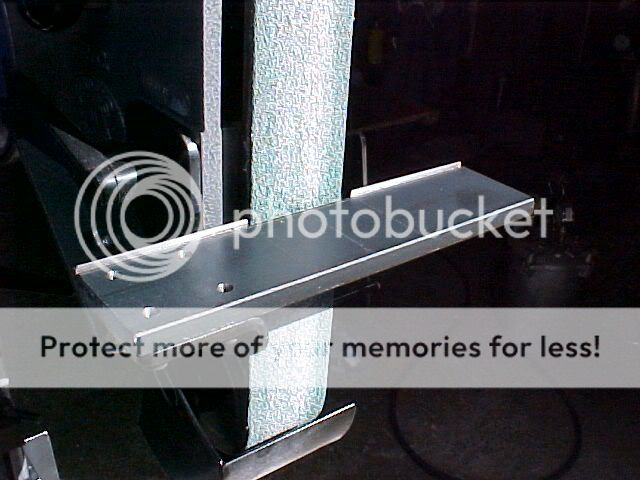
I modded my platen by adding a small fence then I just slide it in or out as required plus I use a new belt on each side.
Richard
MVC-012F.jpg
 
i grind by eye when i'm not making a chisel grind blade. i tried scribing a line but found myself not paying much attention to the line. like ken said, just practice.
 
Fred Rowe has come out with a Bubble Jig that takes most of the guesswork out of it I suggest you contact Fred.
 
Long term a jig wont get you where you want to be. You want to simply grab any blade no matter blade thickness, height or shape and just grind away. IN MY EXPERIENCE a jig will only slow you down and lengthen the learning curve.

Sorry fellas, just my experience. Kit told me starting out, you want to grab and grind......grab another, and grind. Fussing with jigs can work but where the original poster wants to be isnt dealing with jigs.

Marking all the flats with dykem layout die to show where your grinding and not moving that grind line UP untill its flat and where youw ant it is the second step after marking the center and grinding to the center lines with about a 45 degree angle.

USe 36 grit belts and grind side to side slow but even and let the belt do the work. NOT pressure and speed.

Clean up with 60 grt and really get about 1/3rd where you want to be with 120 grit.

This is where I heat treat.

Go back to 60 grit to 400 grit.

Its just practice and burnt fingers to get where you want to be Roger:thumbup::D:thumbup:
 
Long term a jig wont get you where you want to be. You want to simply grab any blade no matter blade thickness, height or shape and just grind away. IN MY EXPERIENCE a jig will only slow you down and lengthen the learning curve.

Sorry fellas, just my experience. Kit told me starting out, you want to grab and grind......grab another, and grind. Fussing with jigs can work but where the original poster wants to be isnt dealing with jigs.

Marking all the flats with dykem layout die to show where your grinding and not moving that grind line UP untill its flat and where youw ant it is the second step after marking the center and grinding to the center lines with about a 45 degree angle.

USe 36 grit belts and grind side to side slow but even and let the belt do the work. NOT pressure and speed.

Clean up with 60 grt and really get about 1/3rd where you want to be with 120 grit.

This is where I heat treat.

Go back to 60 grit to 400 grit.

Its just practice and burnt fingers to get where you want to be Roger:thumbup::D:thumbup:

I believe your hearts in the right place but the thing is we are not all the Same

Every ones different, we don't all possess the same skill level or have the same hand eye coordination. We don't all hit the ball like Tiger Woods or drive like number 3. :D
Each of us has their own goals when we are working on a knife, some are in it for the money, others in it for the fun.:)


Knifemakers are a different breed on the whole. Thats why we produce such a wide array of beautiful edged tools.

We don't learn the same way,:confused: some of us are right brained, some are left, a few are gifted with both. They make good fighter pilots.:eek:

The point is there is not just one way of doing anything and grinding a blade is no different. Not everyone wants to be at the same place; and that is good.

I know I quote him often but:

"Without deviation from the norm, progress is not possible.
F.Z.

Happy grinding, Fred
 
Right you are Fred. My advice as a whole is you guys have to try with what you have, where your at skill and tool wise and just go for it. MY first knife was a 7" bladed 3/16" thick small ish chopper using a $35 4" wood sander and files and it was dead flat :thumbup:

Read every advice given from where YOUR sitting and let all the guys who give our advice help you get to where YOU can get to so to speak. No right or wrong way............just the way you used at that time :thumbup:
 
Back
Top