
Flint striker knives

Joined
Jun 11, 2006
Messages
8,651
I have a few events I'm looking at attending this year which have fairly good turnouts. I will have to double check but I think I will beable to set up a demo at my booth. And if that's the case I would like to forge a simple blade for people. That all being said I think a flint striker knife would be the ticket. But I have a few questions concerning this. First off is steel selection, I need a steel that's easy to work as I'm not going to have a bunch of power equipment out there. Also it needs to be easy to heat treat and not need a long drawn out temper cycle. And last but not least it needs to be great at throwing sparks with flint. After weighing all this I have been considering Aldo's 1084, but I have never used it. Another thing is the quench, i don't really want to hassle with a quench tank of oil and would like to use water. Don't want to worry about spilling oil everywhere. So if anyone has any advise I would love to hear it. I figure it's time to get ready and get some practice in. Also if you have any other ideas for simple things I could demo I would love to hear it.
Thank You - Jarod Todd

This is the style of knife I'm thinking about making.
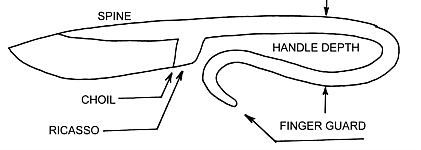
knife2.gif
 
First, while it seems like a good idea, using a knife to strike a rock isn't as wise as it seems. Remember that there is a sharp blade being held backwards while swinging through the air .....
It is far better, and simpler, to make dedicated strikers. They look like a lyre.


As far as a "field quench" use water. Forge with a low alloy steel, preferably low in Mn.

Use the slack bucket as the quench tank. Warm it a bit with some hot iron.
Do an interrupted quench. Plunge edge first in quickly ( Fast count "one-two-three") , then out for the same count, in for three again, out and then let it cool in the air. It will harden enough for most uses and auto-temper t some degree. Some trial runs at home will give you the speed and count needed. So0me folks only plunge half the blade in on the first quench plunge. The main trick is to have it around 900F after the first plunge, and still above 500-600F after the second. This allows it to slowly drop into the Ms and slowly drop toward the Mf. The warmer than normal temps in this range and the slower cooling rate auto-temper the blade considerably. Timed right, you can get a hard edge and still soft spine.
 
I think adding the usefulness of a striker to a knife is a great idea. Not so concerned about the whole you have a backwards knife and you're flying it through the air. On the list of concerns you would have if forced to use this method I would say that's about 1 millionth down the line.
 
If needing to make a fire in an emergency I would agree. But this is a feature designed into the knife and planned in advance. You would have a flint, and tinder box to go along with that. It would be far better to make a proper striking steel and put it in the fire kit.
 
From what I read - an "ideal" striker would be 1095, where the higher carbon content allows for better sparks. Ref: http://www.bladeforums.com/forums/showthread.php/756482-Tempering-steel-for-a-striker

As part of the heat treat, a good striker would be heated to a higher temperature, allowing for more grain growth, and would not be tempered. This would allow more small fracturing of the steel, which results in the great sparks.

The problem is that these same characteristics make for an inferior blade. So it's inherently a compromise. Unless you are able to temper it in different parts...
( below here is all just theory on my part )
If you have a coal forge that allows precise heating:
Harden the blade like normal, temper as normal.
Wrap the blade with a wet rag to keep it cool.
Heat the handle to a high temperature (1550 F ?) to allow grain growth.
Quench the handle. Leave it fully hardened.
This way, the handle could be used for sparking. The spine also, but less so.

Or fully harden it, and draw temper from the spine, keeping the handle cool. That might be easier. Wouldn't have the same grain growth.

Just an idea.
 
In my experience on this site, Stacy's advise is often best. i think a simple knife made from Aldo's 1084 or possible W1 would work best.
 
"...Harden the blade like normal, temper as normal.
Wrap the blade with a wet rag to keep it cool.
Heat the handle to a high temperature (1550 F ?) to allow grain growth.
Quench the handle. Leave it fully hardened.
This way, the handle could be used for sparking. The spine also, but less so.
..."

That procedure for making a harder handle and softer blade won't work. The second choice would work as far as hardening ... but having a knife made in the shape shown with a full hard tang would mean it breaking off at the tang with the first hard use or maybe even when striking sparks.

1095/W2 work well. Fully harden and temper at 300°F.
 
Last edited:
Yeah I wondered about using a knife as a flint striker. Did more reading last night and I had read about people wanting the striker screaming hard which is not that great for a knife. But I like the idea about just making a striker. Gives me something else to make as well.
 
I agree with Stacy that the combo is asking for somebody to get cut-I've seen a guy nail himself trying to strike sparks with the spine of his knife.
When I make chakmak (the little edge burnisher/flint strikers that come with a khukuri) I make them from O-1, usually-but I have made them from 5160, 1095 and 1075 with equally good spark, as long as they're left hard.
 
An additional advantage to making a striker as the project is you can put twists in the ends and roll the tips. It can be plain old W1 or W2 and water quenched right there. You can make twenty or more ready to sell strikers in a demo day easily ... instead of a couple of ugly unfinished knives. If you make up a bunch of fire kits and put them in little cloth bags, you can sell the kits for $10-$15 as fast as you finish the strikers. I would make a batch of complete kits at home prior to the demo and have them ready to sell.
 
So I have been looking around for barstock for the striker project. Was thinking about somthing in the size range of say 1/8 to 1/4" thick and 3/8-1/2" wide. This will allow me to draw out and taper the ends then curl and bend. McMaster has this size in W1 but I'm wondering if this is the best place to aquire said stock.
 
Probably the best stock for strikers is garage door spring. There might be some busted ones at recycling or a garage door company. A full coil of that will last you forever and a day. I think most of it is 5160 or there abouts.
 
I'm all for reusing found steel but most of the time it's not worth the effort to use it when bar stock is so cheep.
 
When I used to make them, I used W1 1/4" and 3/8" square stock from Fastenal. It is really fast and easy to do them from square stock.
 
Back
Top