
-
The BladeForums.com 2024 Traditional Knife is available! Price is $250 ea (shipped within CONUS).
Order here: https://www.bladeforums.com/help/2024-traditional/
You are using an out of date browser. It may not display this or other websites correctly.
You should upgrade or use an alternative browser.
You should upgrade or use an alternative browser.
Flitz and semichrom msds info
- Thread starter alabamaomi
- Start date


- Joined
- Jan 15, 2015
- Messages
- 446
Here is an example of a particle analysis on some aluminum oxide abrasive. You will see that the bulk of the particles (by number) are sub-micron; HOWEVER, those few 10-20 micron particles in the small peak to the right account for most of the volume and I would expect most of the polishing effect.
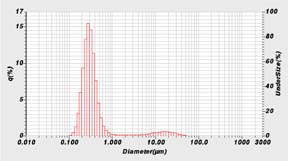
I am very skeptical of any grit rating assigned to commercial abrasive (as opposed to those graded and priced for scientific purposes).
I am very skeptical of any grit rating assigned to commercial abrasive (as opposed to those graded and priced for scientific purposes).

- Joined
- Apr 12, 2009
- Messages
- 13,674
The more I fiddle with the Flitz, the more obvious it becomes to me that it's a lot less aggressive than the Simichrome, in terms of it's working speed up to a high polish. Aside from stropping the CV Sod Buster before, I've also used it to clean up some verdigris on the brass guard of my Western L48A fixed blade AND stropped the edge with it. I also tried it on a stainless spoon I'd cleaned up a while back using some emery cloth, wet/dry sandpaper and even a green Scotch-Brite; after having done that at the time, it was left with a nice 'brushed satin' finish. Using the Flitz on that spoon (applied & buffed with a microfiber towel), the brushed satin is a bit 'brighter', but it's a subtle change from before. Definitely slower to polish, but I am liking Flitz's light touch on a strop, leaving very crisp edges.
David
David

- Joined
- Jun 4, 2010
- Messages
- 6,642
The Flitz, being 3 micron, we can expect to work a bit slower and more importantly, to need more stone work prior to stropping. The Simichrome being 10 micron will extend its reach noticeably I would expect.
I have not worked with either, how different are the binders? Does one tack up faster or start out tackier than the other? I would expect the Simichrome to haze over fairly quickly, this will anchor it more and even if it were the same particle distribution it would work faster.
I have not worked with either, how different are the binders? Does one tack up faster or start out tackier than the other? I would expect the Simichrome to haze over fairly quickly, this will anchor it more and even if it were the same particle distribution it would work faster.
- Joined
- Apr 12, 2009
- Messages
- 13,674
The Flitz, being 3 micron, we can expect to work a bit slower and more importantly, to need more stone work prior to stropping. The Simichrome being 10 micron will extend its reach noticeably I would expect.
I have not worked with either, how different are the binders? Does one tack up faster or start out tackier than the other? I would expect the Simichrome to haze over fairly quickly, this will anchor it more and even if it were the same particle distribution it would work faster.
Re: the binders of each...
Both seem pretty similar to me, in that regard. Both sort of a slightly 'soupy' paste when first coming from the tube (little bit of ammonia smell with both), and they both dry/haze within a minute or so. The biggest question to me, is the speed at which each will finish at a high polish. Both seem capable of getting there; but if each mfr's info is accurate regarding the grit size, then I'd start to assume Simichrome's grit is working much more aggressively starting out (due to size/shape/hardness, who knows) while still being somehow capable of the same high polish produced by other 'finer' grit polishes. Perhaps Flitz's own differences in hardness or shape of the grit, aside from size, might explain why the Flitz is slower in achieving essentially the same result (in terms of polish alone).
David
Last edited:
- Joined
- Jun 4, 2010
- Messages
- 6,642
Too many variables to start. Maybe I'll pick up a bunch of these and take a look under magnification. Is good to have what the manufacturer believes is in the product, but is unlikely they do QC based on particle size.
In my experience, most blends will eventually produce a finish closer to the end of the range that has the highest percentage by mass. Seems counter-intuitive but the larger particles do seem to self regulate to some extent, assuming the binder will allow it. Might be the Simichrome has a bunch of 8-10 and a large or at least significant percentage of the abrasive volume actually much finer. The larger materials start out proud but get pushed into the surface of the strop and interfere less as it goes.
This is how my Washboard compound works. Even with a very hard and somewhat tacky binder, the larger particles will tone down fairly rapidly but will do a lot of work initially. Once they get driven into the binder and upper layers of paper, they influence less and less. There is still a bump after rubbing the binder off, what's left will be that much finer but be far more limited in the amount of work it can do per unit of time and the level of set-up needed to get a good outcome.
Using both on a piece of hardwood will tell you pretty quickly what the "true" abrasive character is by looking at the scratch pattern, the larger grit will have nowhere to hide.
In my experience, most blends will eventually produce a finish closer to the end of the range that has the highest percentage by mass. Seems counter-intuitive but the larger particles do seem to self regulate to some extent, assuming the binder will allow it. Might be the Simichrome has a bunch of 8-10 and a large or at least significant percentage of the abrasive volume actually much finer. The larger materials start out proud but get pushed into the surface of the strop and interfere less as it goes.
This is how my Washboard compound works. Even with a very hard and somewhat tacky binder, the larger particles will tone down fairly rapidly but will do a lot of work initially. Once they get driven into the binder and upper layers of paper, they influence less and less. There is still a bump after rubbing the binder off, what's left will be that much finer but be far more limited in the amount of work it can do per unit of time and the level of set-up needed to get a good outcome.
Using both on a piece of hardwood will tell you pretty quickly what the "true" abrasive character is by looking at the scratch pattern, the larger grit will have nowhere to hide.
- Joined
- Apr 12, 2009
- Messages
- 13,674
Re: the binders compared, between Flitz and Simichrome...
One thing I'd done in the past with Simichrome, was to squeeze a bit from the tube onto a paper towel and just let it dry out. Did this with the goal of seeing what's left after the liquid suspension dries, to gauge the character or feel of the grit left. With the Simichrome, it dried essentially to a loose (pink) & very fine powder-like consistency.
I did the same with the Flitz yesterday, and I let it sit overnight. Curious thing, it dried to a very gummy consistency (light blue in color). I'd noticed in the MSDS for Flitz, they listed 'fatty acids' and emulsifiers as some of the ingredients, and I wondered why it was in there. In seeing how it behaves after drying, it would seem to do a very effective job in making the compound cling or stick to whichever substrate it's applied. I even tried to scrub the dry product off the paper towel, onto a piece of hard maple I'd previously used for a leather strop, and most of the 'gummy' Flitz wouldn't even come off the paper towel, save for a microscopic amount being rubbed into the grain of the wood (left some black streaks when tested with a blade). For use on a strop, I can now see that Flitz will 'dig in it's heels' on the substrate and stay there a while.
I applied some additional fresh Flitz to the hard maple, and it behaves more aggressively on the wood, as would be expected, and as compared to use on a softer strop like leather or denim. The biggest contrast with Flitz, in comparison to Simichrome, is in the aggressiveness displayed when each is used with a soft rag for ordinary polishing tasks. The Simichrome behaved more aggressively, working much faster in removing metal and bringing up the high shine.
David
One thing I'd done in the past with Simichrome, was to squeeze a bit from the tube onto a paper towel and just let it dry out. Did this with the goal of seeing what's left after the liquid suspension dries, to gauge the character or feel of the grit left. With the Simichrome, it dried essentially to a loose (pink) & very fine powder-like consistency.
I did the same with the Flitz yesterday, and I let it sit overnight. Curious thing, it dried to a very gummy consistency (light blue in color). I'd noticed in the MSDS for Flitz, they listed 'fatty acids' and emulsifiers as some of the ingredients, and I wondered why it was in there. In seeing how it behaves after drying, it would seem to do a very effective job in making the compound cling or stick to whichever substrate it's applied. I even tried to scrub the dry product off the paper towel, onto a piece of hard maple I'd previously used for a leather strop, and most of the 'gummy' Flitz wouldn't even come off the paper towel, save for a microscopic amount being rubbed into the grain of the wood (left some black streaks when tested with a blade). For use on a strop, I can now see that Flitz will 'dig in it's heels' on the substrate and stay there a while.
I applied some additional fresh Flitz to the hard maple, and it behaves more aggressively on the wood, as would be expected, and as compared to use on a softer strop like leather or denim. The biggest contrast with Flitz, in comparison to Simichrome, is in the aggressiveness displayed when each is used with a soft rag for ordinary polishing tasks. The Simichrome behaved more aggressively, working much faster in removing metal and bringing up the high shine.
David
Last edited:
- Joined
- Jun 4, 2010
- Messages
- 6,642
David, how much more aggressive than Flitz was the Simichrome when applied to the hard maple, if at all?
The fatty emulsifiers are likely stearin, a thinner version of what most compound binder is made from. Since it isn't a suspension in ammonia, it will take a long time to dry/migrate out. It also forms a thin layer, not much, but thicker than the powdery layer made by the Simichrome. At that scale it will make a difference and really tone down the Flitz.
I need to buy some of this stuff...
The fatty emulsifiers are likely stearin, a thinner version of what most compound binder is made from. Since it isn't a suspension in ammonia, it will take a long time to dry/migrate out. It also forms a thin layer, not much, but thicker than the powdery layer made by the Simichrome. At that scale it will make a difference and really tone down the Flitz.
I need to buy some of this stuff...
- Joined
- Apr 12, 2009
- Messages
- 13,674
When I've used the Simichrome on wood, it's behaved as I would've expected with any compound, being more aggressive (faster) than when used on a softer substrate. Still brings up a very high shine, and fast.
The MSDS for Flitz does list up to 5% 'ammonia solution' in the product (don't know how much is in Simichrome, by comparison); it can be smelled when using each of them.
Edit:
Looking up the MSDS for Simichrome, it shows up to 13% of 'ammonium oleate' and only 1% 'Fatty Acid Diethanolamide'. The aluminum oxide apparently only makes up about 27% of the mix, by the MSDS. The bulk of the rest of the listed 'hazardous ingredients' are 'white spirit' and 'kerosene' (11% each).
David
The MSDS for Flitz does list up to 5% 'ammonia solution' in the product (don't know how much is in Simichrome, by comparison); it can be smelled when using each of them.
Edit:
Looking up the MSDS for Simichrome, it shows up to 13% of 'ammonium oleate' and only 1% 'Fatty Acid Diethanolamide'. The aluminum oxide apparently only makes up about 27% of the mix, by the MSDS. The bulk of the rest of the listed 'hazardous ingredients' are 'white spirit' and 'kerosene' (11% each).
David
David, how much more aggressive than Flitz was the Simichrome when applied to the hard maple, if at all?
The fatty emulsifiers are likely stearin, a thinner version of what most compound binder is made from. Since it isn't a suspension in ammonia, it will take a long time to dry/migrate out. It also forms a thin layer, not much, but thicker than the powdery layer made by the Simichrome. At that scale it will make a difference and really tone down the Flitz.
I need to buy some of this stuff...
Last edited:
Yeah, Flitz does have an interesting odor. It reminds me of old cigarette lighters for some reason. They call it non-toxic, but then again, they also call it non-abrasive.
http://www.flitz.com/faqs/
As far as Quick-Glo, would Lava Soap work in a similar capacity? It also has pumice.
http://www.flitz.com/faqs/
As far as Quick-Glo, would Lava Soap work in a similar capacity? It also has pumice.
Last edited:
- Joined
- Apr 12, 2009
- Messages
- 13,674
Yeah, Flitz does have an interesting odor. It reminds me of old cigarette lighters for some reason. They call it non-toxic, but then again, they also call it non-abrasive.
http://www.flitz.com/faqs/
As far as Quick-Glo, would Lava Soap work in a similar capacity? It also has pumice.
If it's pumice only (from volcanic glass, a.k.a. silica-based), it's true polishing effect on hardened steel would likely be limited. On softer metals or materials, it should work OK.
The 'non-abrasive' description gets thrown around pretty loosely by mfrs of polishing products, if only because the scratches produced won't ordinarily be seen by naked eye (hence the 'polished' appearance). If they really were completely non-abrasive, they wouldn't do any polishing at all. The 'non-toxic' claims are based entirely on using the product 'as intended'; in other words, it won't harm you if you lick your knife blade after you've shined it up (used 'as intended'), but don't go eating the paste out of the tube (used 'NOT as intended'). Interestingly, the MSDS for Flitz (linked below) even lists 'abrasive polishing minerals (Al[sub]2[/sub]O[sub]3[/sub])' as part of the ingredients. Not to mention, the potentially hazardous (toxic) ingredients listed in the MSDS (ammonia, petroleum solvents, etc). So even they know better...

http://www.flitz.com/content/MSDS - Flitz Metal Plastic Fiberglass Polish-Paste_16pt.pdf
Something curious I couldn't help but notice, on the Quick-Glo site:
"Stainless is considered a hard metal, and the oxidation or tarnish is difficult to remove and frustrating to keep off."
The 'oxidation' on stainless steel is a chromium oxide layer, and it's essentially clear (invisible). Abrading or polishing it off will make the free chromium in the underlying stainless immediately re-oxidize upon exposure to air. It's what makes stainless steel 'stainless' in the first place.
David
Last edited:
- Joined
- Apr 12, 2009
- Messages
- 13,674
How would you polish/clean up electroplated silver?
I'd look for dedicated 'silver polishes' (or 'cleaners' for silver) and pay close attention to those which specifically say they're OK for use on plated surfaces. If you see warnings on the labels about that, avoid them.
In searching the web for such info, I came across the site below, which rates many products for such use ('Silver Polish Abrasion Ratings', from least harmful to most); it's an interesting read:
http://www.hermansilver.com/silver-polish-abrasion-ratings.htm
David
Last edited:

Bill DeShivs
Knifemaker / Craftsman / Service Provider
- Joined
- Jun 6, 2000
- Messages
- 12,962
Double post.
Last edited:
Bill DeShivs
Knifemaker / Craftsman / Service Provider
- Joined
- Jun 6, 2000
- Messages
- 12,962
How would you polish/clean up electroplated silver?
Cleaning tarnish from silver/silver plate is easily done with Tarn-X. It's available at most grocery stores in the cleaning aisle. Clean silver usually looks very dull. It has to be polished.
POLISHING Silver is easily done with Simichrome. Of course, if the plating is already thin, you can polish through it, but that will happen with any polish. Simichrome used gently is the cat's rear end for silver or silver plate. It doesn't take much. A tube of Simichrome lasts me 5-6 years, and I'm in the restoration business.
Though I'm no expert on silver like Mr. Herman, I do have considerable training in the jewelry industry. Mr. Herman certainly likes tools!
- Joined
- Apr 12, 2009
- Messages
- 13,674
Cleaning tarnish from silver/silver plate is easily done with Tarn-X. It's available at most grocery stores in the cleaning aisle. Clean silver usually looks very dull. It has to be polished.
POLISHING Silver is easily done with Simichrome. Of course, if the plating is already thin, you can polish through it, but that will happen with any polish. Simichrome used gently is the cat's rear end for silver or silver plate. It doesn't take much. A tube of Simichrome lasts me 5-6 years, and I'm in the restoration business.
Though I'm no expert on silver like Mr. Herman, I do have considerable training in the jewelry industry. Mr. Herman certainly likes tools!
My first thought was Tarn-X as well. But, after looking at the Herman site, he recommended avoiding it (quoted below), as well as avoiding Flitz & Simichrome polishes on plated silver. So, I'm not so confident in the Tarn-X as before...

"Chemical Tarnish Removers (These are just a few of the products that will absolutely ruin the original finish on solid silver and silver-plate. They also allow tarnish to form more quickly.) Read about these dips here.
Ellanar Dip Instant Silver Cleaner
Empire's Instant Tarnish Remover
Goddard's Silver Dip
Hagerty Silver Dip
Medallion Care Tarnish Treatment
Midas Silver Tarnish-Off
ShineBrite Silver Dip
SilverMate
Tarn-X
Weiman Instant Tarnish Remover
Wright's Instant Tarnish Remover
"
David
Last edited:

pjwoolw
Sharpening guy
- Joined
- Nov 12, 2012
- Messages
- 407
As far as Quick-Glo, would Lava Soap work in a similar capacity? It also has pumice.
My post was meant to be on the sarcastic side. I'm just starting to use the Quick-Glow on other endeavors but it is an interesting product. Very effective so far. As far as these polishes in relation to sharpening I'll stick with CBN and Diamond from Ken Schwartz.