Folders In The Woods

I agree with just about everyone. However, I cater my EDC kit to what I would need in both environments. I try to keep it small and light but able to handle the wilderness or the city. Right now it's a RAT-3 (my new baby) and a Vic Farmer. That covers just about any blade contingency that I can think of.
 
The frontiersmen on the early American West said that they could often tell a greenhorn by how few knives he carried and by how small his main knife was. Those guys were walking cutlery displays, usually packing on them 2 - 3 knives and often a hatchet or tomahawk.

I can't help but wonder what your source for this is?
 
I can't help but wonder what your source for this is?

+1 on wondering about mrostov's post, although I believe frontiersman (trappers, explorers during fur trade)carried several knives I have never heard the reference to size. I was under the impression the most encountered knife was of the butcher variety or handmade of virtually the same size.
 
For what it's worth, Tunis mentions an axe and a rifle as being the two main tools for survival among frontiersmen, and none of his illustrations show anybody wearing more than one knife.


Tunis, E. (1961). Frontier Living. Cleveland: World Publishing Co.
 
I'm not trying to imply we should all head out into the bush with nothing but a LM or SAK.... :D

Why not? It's all the other stuff that will save your butt--- a cutting tool is just one part of a survival kit. I EDC a Boker Trance or a Benchmade Griptilian and there's always an SAK Classic on my keychain. If you're going for a day hike or an overnighter, a folder is perfectly fine. I might like a fixed blade if I'm going farther (like Alaska) or solo, but something like the Griptilian, an SAK Trekker or a multi-tool wouldn't leave me feeling naked.

Having to go for days with no other shelter or gear is where a large knife/saw/axe would come into play. I'll bet that 99% of the folk on the trail have nothing more than a basic SAK. Having the rest of your "essentials" will keep you alive and signal for help. Water, fire starters, extra clothing, extra food, lighting, first aid, signal aids, and navigation tools are every bit as important as your cutting tools.

It's lack of leaving an itinerary with others and no navigation goodies that get most people in trouble-- no map, no compass, they get lost and/or injured and no one knows where they are. Until someone finds their car at a trailhead, SAR doesn't have a place to start looking. Like I've said, if I turn an ankle or something, I want SAR to find me warm and dry under my tarp with a toothpick in my lips and a cup of hot coffee in my hand.
 
Why not? It's all the other stuff that will save your butt--- a cutting tool is just one part of a survival kit. I EDC a Boker Trance or a Benchmade Griptilian and there's always an SAK Classic on my keychain. If you're going for a day hike or an overnighter, a folder is perfectly fine. I might like a fixed blade if I'm going farther (like Alaska) or solo, but something like the Griptilian, an SAK Trekker or a multi-tool wouldn't leave me feeling naked.

Having to go for days with no other shelter or gear is where a large knife/saw/axe would come into play. I'll bet that 99% of the folk on the trail have nothing more than a basic SAK. Having the rest of your "essentials" will keep you alive and signal for help. Water, fire starters, extra clothing, extra food, lighting, first aid, signal aids, and navigation tools are every bit as important as your cutting tools.

It's lack of leaving an itinerary with others and no navigation goodies that get most people in trouble-- no map, no compass, they get lost and/or injured and no one knows where they are. Until someone finds their car at a trailhead, SAR doesn't have a place to start looking. Like I've said, if I turn an ankle or something, I want SAR to find me warm and dry under my tarp with a toothpick in my lips and a cup of hot coffee in my hand.
......I couldn't agree with you more Dale. It doesn't take a multitude of big blades to "survive" a visit into the back country. I've done just fine with a SAK and folding "Sven" saw on plenty of outings over the last 70 years. If I was to adventure into the bush for any length of time or get away from an established trail then I might want some other combination of tools. However, a sharp blade is only one of the essential 10 items necessary for wilderness travel; preparation as Dale says, is the KEY !....and as Dale also makes clear, if one is lost, no blade alone will insure survival. It's the fire making tools, the extra food and water, the dry warm clothes, map and compass and the knowledge of how to use them, shelter and as importantly, the itinerary left with a loved one, that will count most. I could argue that on these hot sunny days, a good sunscreen is more important than a fixed blade on a day hike over an established trail. Anyone who has even once wandered above the tree line in snow knows that a simple pair of sunglasses is far more valuable than a fixed blade on a day hike.

While it may have been true that "the frontiersmen on the early American West said that they could often tell a greenhorn by how few knives he carried and by how small his main knife was. Those guys were walking cutlery displays, usually packing on them 2 - 3 knives and often a hatchet or tomahawk." Today, GENERALLY, many experienced back country travelers can spot a "rookie" by the number and size of the knives he/she carries into the bush.

That doesn't mean I would even think of disparaging another's choice ......or don't sometimes myself hike with more blades than really necessary, but if I am going to carry a 'load" for any length of time and distance, then what goes into the pack is just what will get the job done. However, I'm not implying my choices are right for anyone else. I say, "as long as your choices work for you that's all thant counts; the most important thing is that you carry the '10 Essentials'*, have fun.....and stay safe." :)

- regards
 
I have both an SAK and a LM crunch as EDC knives, and while the SAK is a lockblade, it's not really up to major abuse, IMO. So I always take a fixed blade, which means I guess I have 4 cutting blades at any given time (I also EDC an Al Mar folder) but that's not redundant seeming to me, because it's the other tools on the LM and SAK that really count if I've got a fixed blade knife.
 
The frontiersmen on the early American West said that they could often tell a greenhorn by how few knives he carried and by how small his main knife was. Those guys were walking cutlery displays, usually packing on them 2 - 3 knives and often a hatchet or tomahawk.
I can't help but wonder what your source for this is?

Have you ever studied the mountain men of the fur trade era? These are guys that actually lived it full time, not played it on the weekend or for a survival show. About 1/3 of them died in their first 24 months on the frontier.

Always carried: Large knife (good for wilderness chores and served as a fighting weapon/sidearm)

Always carried: Patch knife (smallish knife for cutting rifle patches and smaller cutting chores)

Often carried: Skinning knife (on person or with several others in gear on horse or pack animal - made good trade items also)

Often carried: Hatchet/Tomahawk

The school of thought mandating only one smallish knife for a 'real' woodsman is a relatively recent phenomenon, dating from the genteel woodsman culture starting after the closing of the frontier at the end of the 19th Century.

Especially in the days before revolvers became common and cartridge weapons began to dominate, largish knives (9" blade, plus or minus a couple inches) were very common on the frontier.

It wasn't just in the mountains either. It was noted by chroniclers of the early 19th Century that in the rough and tumble river culture of the pre-Civil War western frontier, wher ethe rivers were the main trade and transportation highways, literally every man had a razor sharp large knife, a 9" blade being about average, and they knew how to use it and frequently did. People cut each other up and killed each other on a regular basis with them, and even today Texas still has anti-Bowie knife laws on the books because of it, though many of these knives often resembled butcher knives than the classic 'Bowie' knife.

This tradition goes back to the seax of the Saxons where carrying a long knife was the sign of a free man. Many, many knives of the early frontier looked a LOT like a modern 9" butcher knife from your kitchen. A common trade knife or skinning knife for everyday utility use was usually about 6" in blade length. The patch knife commonly carried with a man's rifle kit was often a lot smaller, with a 2" to 4" blade.

You can have the Ray Mears types talk till the sun goes down about how all you need is a 3" - 4" knife, and yes, you can get by with one with much extra effort. BUT, when you really need to live out there, a larger blade or a hatchet as your primary blade in addition to the smaller blade often makes life a lot easier. For example, want to make a shelter? I can usually make one several times faster with a good 9" blade than someone else can with even the best 4" blade.

The prejudice against large knives by many 'wilderness' types is kind of interesting since they make many tasks a lot easier. I think it has more to do with modern, pre-conceived notions and looks than anything else. It's odd that a 9" butcher knife is judged just fine for the kitchen, but somehow it just isn't good for the woods where you have many similar cutting tasks. It's almost a near religious orthodoxy with some.


********

 
As great as multi-tools are, you generally can`t use the plyers and the knife (just an example) at the same time. So the EDC or another small folder isn`t just another layer of preparedness, it`s an extra tool for an extra job.
 
I always love big knife versus little knife debates. I don't really see the advantages in a 9 inch blade, but then again, I think hatchets are much more important than big knives if you already have a little knife.

what's *really* interesting is the most recent analysis of history, which reads to me pretty much thus:

because revolvers weren't around, big knives were carried as weapons on frontiers, therefore are better woodcraft/survival knives.

- I won't argue that in one very particular case- making a shelter that involves lots of chopping- a big blade will walk all over a 3-4, or even 5 inch woodcraft.

That's a seriously limited argument and I could make just as strong a case that no big blade can ever compare to the ability of a smaller blade at working with game. Both are extremely isolated examples of specific variations (small game as food instead of food as a broad category- one type of shelter that requires chopping versus shelter as a broad category) of what *should* be broad categories.

Incidentally, there's a LOT more to the seax, they aren't strictly speaking saxon, the langseax isn't a seax, some blades are no more than 2 inches, etc. etc. I wouldn't try to use it as a basis for the development of the long knife as a sidearm worldwide. Not least of the reasons being that it was just as common to have an axe to carry to the levy call as a langseax. And seax could as easily be a woman's 3 inch bladed eating knife as a 10 inch blade "free to vote card" or something.

*I* think environment matters more than just about anything else when choosing a knife for a "lifestyle" decision on woodcraft. I don't live in a jungle, or even in the southeast imitation of jungle. I don't need a machete. I don't live in the woods, though I travel through them and we have plenty of trees around the creeks and whatnot, so an axe is very functional. And so on.

Not trying to pick on anyone, but man, these extreme binary views are silly.
 
this debate will never end because this is mostly personal preference. I prefer 7-9 inch fixed blade when I go out in primitive areas, and use it constantly. However I do not at any point carry my BK-7 down a nature trail or in marked camping areas. I hear constantly that the RAT-3 I always carry, is capable of everything I need to do. I do agree with that, but fire building and shelter building is made a hell of a lot easier with a larger blade.
 
what's *really* interesting is the most recent analysis of history, which reads to me pretty much thus:

because revolvers weren't around, big knives were carried as weapons on frontiers, therefore are better woodcraft/survival knives.

That is kind of twisting and mis-stating what I said just to meet the 'don't need a big knife' argument.

For example, you glossed over the fact that I stated that you can take a 9" knife and generally get a shelter done in a fraction of the time that you can with a 4" knife.

This is simply a fact that no one can ignore. Big knives are also better for wide variety of tasks, from butchering large animals, to making tent pegs, you name it. Need a digging stick? With a 9" blade it's generally a few whacks and you're ready to roll.

A hatchet is better in some ways but not as good as others, such as in light brush, cutting down green tree branches, etc. A large knife is often easier to carry than a hatchet also. A machete is great also. I have an 18" machete that I'll sometimes use, such as in the desert. The problem with a machete is that they are just a bit too big sometimes for conveniently carrying around, but when you need them and it's serious, they are both a superb tool and a good weapon. A khukuri with a 9" to 10" blade is awesome in a variety of climates.

Well, if one's main wilderness task is carving bowls and such, then your 4" knife is all you often need. But, there is a reason that people who actually live in the bush in the far north and, as a result, do a lot of hunting to stay fed, tend to carry larger knives.

Actually, the MacPhersons have shown quite well that you don't 'need' even a steel knife at all. Just use a sharpened rock. However, there is a reason that the Indians switched to iron tools as fast as frigging possible.

A lot people I noticed get their 4" knife and then expend a lot of effort to do something, and they think that they have demonstrated vast skill, when in fact all they have done is wasted a lot of vital calories that could have been saved by using a better tool to make the job easier.
 
In response to the OP

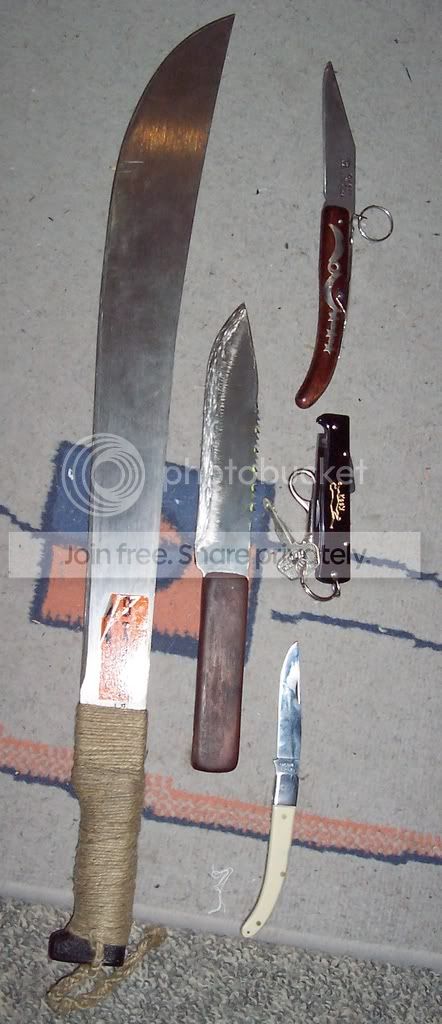
Im going bush tomorrow , taking these :


bushknives.jpg


the folders are my EDC

the fixed blades are my usual bush carry when we are heading into areas where folk dont usualy go , the machete makes cutting a path easier , I have put an edge on it that has more acute than normal angle , it will be dealing with reeds and rushes , black berry and vines more than anything heavy , I like the reach of it and it does grassy reedy vieny stuff easier than my folders do .....

The smaller fixed blade is for more delicate close up work than I can easily do with a 20 inch machete blade , bit of a difference between 20 inches and 20 cms ... its noticable :) this time , Im bringing it more for doing fish with than anything , tho it sees service hunting , and when Im feeling chicken and want something to hold crab / yabbie nippers down while I deal with them , its good with green coconuts etc ... things my folders are a bit narrow / small for and my machete is too use comfortably

This is why I take my fixed blades with me .

Its my personal preferance to do so , it makes my life easy and fun :)
 
Have you ever studied the mountain men of the fur trade era?

Studied, no but I have read some books about them and have not run across decriptions like you posted. You sound very knowlegeable about the subject but my question really hasn't been answered: what is your source for this particular information?
 
That is kind of twisting and mis-stating what I said just to meet the 'don't need a big knife' argument.

For example, you glossed over the fact that I stated that you can take a 9" knife and generally get a shelter done in a fraction of the time that you can with a 4" knife.

This is simply a fact that no one can ignore. Big knives are also better for wide variety of tasks, from butchering large animals, to making tent pegs, you name it.

I have read some but am not an expert of history so I can't agree or disagree with much of what you say. However, I have field dressed and butchered many deer. While it is not the largest animal one might butcher in a survival situation I think it is probably the most likely large animal. I have always felt that a knife of any design over 5 inches was a hinderance not a help. Most of my relatives for 2 generations have used a folder under 4 1/2 inches for field dressing and 5 inch boning knives for butchering.


A lot people I noticed get their 4" knife and then expend a lot of effort to do something, and they think that they have demonstrated vast skill, when in fact all they have done is wasted a lot of vital calories that could have been saved by using a better tool to make the job easier.

Funny to read that as that was the reason I carry a saw while hunting. Less weight and less effort to cut larger green wood for shelter. I always thought it would be a whole lot safer if I was injured too. Not disagreeing with you per se though.
 
A smaller knife is definatly easier to field dress than a bigger one.A buck 110 is about as big as i like for that type of duty.
 
I always carry a fixed blade and usually two EDC folders, when hiking hunting or just doing work in the bush. Fixed blades do the heavy work, which for the most part is cutting back brush and making kindling for the fire, and butchering during hunting season.

Folders are used for the most part doing small tasks, and for fixing up a sandwich.

Having more than one knife makes things easier, and adds a back-up incase a knife breaks or gets lost.
 
I have to say that using a large knife for anything but chopping or fighting is quite cumbersome to me. I've tried loads of time to use my 7" KA-BAR to do small chores and it just doesn't work for me. Small knives are easier to handle and can be used like a big knife if handled properly, IMO. I'm not opposed to large knives in combat, but in the wilderness I'd rather have a stout 3-4" fixed blade. That's just me though. :p
 
well..my current edc is bm mini rukus,lm wave,oh trekker
the reason for the heavier duty folder you can't baton a sak or lm I believe the right heavy duty folder can stand in for a bigger blade I always have these on me or similar knives

(heavy duty folder,multi tool,sak or three blade folder)

I live in the pacific northwest,geocaching,hiking,fishing,kayaking any outing for me could end in a survival experience.
If I had to plan for my survival experience i'd have a chainsaw,hammer,nails,wood for shelter and firewood a smoking jacket and my slippers:p

Before the anti-folder mafia puts a hit on me i do carry fixed blades on my survival pack Grohman #4 and #1,gerber pack saw i've never seen the reason or the need for anything bigger
tyrantblade
 
Back
Top