folders, solidworks, and waterjets

Joined
Dec 1, 2010
Messages
161
Hey so as i've been reading around i'm hearing that its best to oversize folder parts and springs by like .01-.05 and to spot holes before getting them waterjet cut. Is it possible to just line up everything and have it function right in solidworks, get the pieces cut and have it work in real life without needing a bunch of finishing work around the spring?

I'm ok with doing finishing work, but its nice to do less of it and have a repeatably good folder that can just be cut and beveled.

Also this is for slipjoints


Oh and lastly how do large scale production slipjoints work? id imagine that they do something that requires little hands on stuff when it comes to the lockup, or is that just a factor of having really good dies?

Thanks for everyone being helpful on these forums btw! learning a lot and once i actually get some time to sit down, do some designs, get them cut/made, ill post oodles of pictures.

Bonus question, does anyone use a laser engraver to make quick mock ups in wood or acrylic before sending them out to get cut from steel? Would this be a good method for making sure the walk and talk is ok from an as printed state?
 
You could just make everything in Solidworks but unless you put tolerances (ranges for each cut out) on it your machinist/waterjet technician is going to hate you. In solidworks you don't actually need to model the holes larger or have weird spacing, just make it like you regularly would in solidworks with the pins and holes all perfectly lining up. You can gauge the sizes of the actual holes using tolerances. In solidworks you have a callout option that will let you put tolerances for holes and such right in the drawing. So for example. If you have a hole, and a pin that fits into the hole, you give a minimum tolerance for the hole that is the maximum tolerance for the pin. This prevents your hole from being made to small for the pin even if the pin is made to the largest possible diameter for your tolerance. It might be a good idea to look up Geometric Dimensions and Tolerancing fore more detailed information. Also as far as finishing goes you can put callout tolerances for that as well, though your waterjet cutter might have a pre-made list of finishes to chose from.
 
You could just make everything in Solidworks but unless you put tolerances (ranges for each cut out) on it your machinist/waterjet technician is going to hate you. In solidworks you don't actually need to model the holes larger or have weird spacing, just make it like you regularly would in solidworks with the pins and holes all perfectly lining up. You can gauge the sizes of the actual holes using tolerances. In solidworks you have a callout option that will let you put tolerances for holes and such right in the drawing. So for example. If you have a hole, and a pin that fits into the hole, you give a minimum tolerance for the hole that is the maximum tolerance for the pin. This prevents your hole from being made to small for the pin even if the pin is made to the largest possible diameter for your tolerance. It might be a good idea to look up Geometric Dimensions and Tolerancing fore more detailed information. Also as far as finishing goes you can put callout tolerances for that as well, though your waterjet cutter might have a pre-made list of finishes to chose from.


would that be the smart dimension tool? or is it a different cammand thats actually called the callout option? and thank you! so basically just place tolerences and talk to the technician to make sure they do it right?
 
You can add tolerances using the smart dimension tool but there is another callout tool that attaches boxes as seen in this link: http://help.solidworks.com/2012/English/SolidWorks/sldworks/Geometric_Tolerancing.htm

Here's another link showing it just using the regular smart dimension tool but I prefer the first option: http://help.solidworks.com/2012/English/SolidWorks/sldworks/Hole_Callouts.htm

Ask your technician what tolerances they would like to have in the drawings because there are many many types of tolerances and they just might need ones for holes, lengths, and surface finishes. You could design and define an entire part using nothing but Geometric Dimensions and Tolerances.
 
Pretty much, the risk of not having good tolerances on your drawings is that your technician uses his best judgement and you are given parts that won't fit together without further machining. If you are going to pay to have parts cut might as well have them cut made so you don't have to go back and hand file or drill things to fit properly.
 
Hey so as i've been reading around i'm hearing that its best to oversize folder parts and springs by like .01-.05 and to spot holes before getting them waterjet cut. Is it possible to just line up everything and have it function right in solidworks, get the pieces cut and have it work in real life without needing a bunch of finishing work around the spring?

The WJ is not going to cut highly precision parts.
If you model the parts in SW and try to cut them net, they may be oversized in some areas and undersized in others. WJ cut edges have a taper as well (meaning the edges of your part won't be perpendicular with your flats in any precision way.) The best way is to WJ oversized and machine to net.

I don't WJ holes, just profiles, and like .05 oversize. I hold such a part in softjaws and do the holes first. What happens next depends on the part, but sometimes I can machine a bunch in that set up and other times I have to take the part off and use the holes to screw down the part and do the perimeter. Either way the perimeter will then be correct with respect to the position of the holes.

Mass produced parts for classic designs are often done with ruler dies, which can cut very precise parts. Such tooling a really big investment. Thicker parts that have to be pretty exact part-to-part, such as those found in guns, often see time on EDM. Other than that, it's CNC milling.
 
Waterjet and laser are for low precision parts and roughing. It generally takes machining to achieve the level of precision necessary for slick wobble-free motion.

Mass produced parts used to be fine blanked, which is a high precision form of stamping. While this is still done, CNC machining and creep feed grinding are become more commonplace.

IE: Pivot holes, which should be very round, taper free, and within .001" of the pivot pin, are generally reamed. Some people then lap them. Drilling is inadequate and WJ is way inadequate.
 
I usually don't have holes WJ either, but I had a set that were"accidentally" cut. The holes were cut within .015 of finished size plus they had a tit from entering and exiting. I was able to fixture them on the mill, plunge the holes out with undersize endmills and everything came out great. It's still way risky. As for the lock-bar face I have it cut dead on and clean-up with a file. You have to work with the WJ guy and sneak-up on the parts a little more each time to reduce finish work. Also the type of machine makes a difference, some have a pivoting head to reduce draft.
 
I was going to send them off to great lakes waterjet and i think he has a tilting head, as for reamers im right in the assumption that id want to use carbide ones, the hss ones that i often see in these knife supply places would be good for a hole or 2. Are end mills going to give a nicer cut for the holes?

Soft jaw drilling is when you have a sorta loose vice with rubber covering the teeth of the vice so as to prevent it from marring as well as allowing the piece to "auto center" the holes, or is that way off? How would you set something like that up, just plug it into a vice and loosen it a touch?

Oh and any good ways of filing while keeping things square?
 
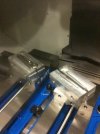
A softjaw is often a pair of aluminum blocks that mount to each side of the jaws of a vise on a mill.

The shape of the part (perimeter) is machined into the aluminum from the top when the jaws are almost all the way closed together with the little space between the jaws about the middle of the part (usually about half the part's perimeter is machined into one jaw, while the rest is in the other jaw).
When you drop the part into the cavity and close the vise, it locates and clamps the part in place. Done right, it can be a precision workholding technique.

Example:
Here are a couple sets out of the vises. (One has a part in it for an example).
 

Attachments

  • photo.jpg
    photo.jpg
    33.2 KB · Views: 35
Everything said here is correct. My best friend is my water jet operator so over the years I have picked up on what works and what doesn't with WJ. Like everybody said make your part over/under size and then machine it to tolerance. Also remember that WJ parts WILL have a draft angle around 1 degree. I like to make handles "bookmatched" to make sure the draft falls symmetrically on two parts that must mate together. The quality of edge finish is all up to the operator.

On a scale of 1-5 I get the exterior profiles and holes cut at a 2 setting and the lockbar/lock face cut at a 5. This minimizes the finishing needed for proper lock geometry at those crucial and hard to reach areas. Remember most WJ guys are cutting mild steel and aluminum all day on the fastest settings they can get away with to make it profitable. They may be using a cheap garnet that will make cutting titanium/hardened stainless difficult. As knife makers we have exotic materials and very exacting expectations.

I recommend bring a large bottle of fine whiskey to ease any business related tensions. This is by far the best advice I ever learned. Maybe it's just a deep south thing but everybody here seems to appreciate a little "southern hospitality" in my business transactions.
 
Back
Top