For My Next Trick I'll...

John Cahoon

JWC Custom Knives
Knifemaker / Craftsman / Service Provider
Joined
Apr 13, 2017
Messages
2,213
I always try to challenge myself trying something different on each new knife. I'm at a point where I can come off the grinder with 220 grit with pretty good plunges, pretty flat bevels and swedges and start hand sanding at 220. Not every time but often depending on the blade shape.

I want to try a semi spear or long clip point with a Loveless style long bevel on the spine starting maybe 1" forward of the primary bevels, maybe 10-15 degrees? On this one I'm not trying to have the bevels meet, but want to leave a flat area between them, narrowing towards the tip.
My preference is to blend in the transition i.e no plunge like feature on the spine if you see what I mean. I tried one months ago and it's still the only blade I've not finished due to uneven lines where the bevels meet among other issues.

Should I do all 4 bevels in an even fashion rather than finish the edge side before starting the spine side? I'm also concerned about burning tips so I've started backing off the pressure as I approach with each pass. Any tips or tricks?

As always thanks in advance I really appreciate all the help I've received here.
 
I always finish the primary grind before the edge but you will have to figure out what works for you .. When you are doing the tips, slow your grinder down and dip often!
 
When I did blades with a swedge or false edge I used to do the primary bevels first then the swedge. This is a tricky way to do it. It can give you perfectly fine results but it takes more of a touch to get smooth and symmetrical bevels that meet nicely at the tip. I have found it is much easier to grind the top bevels in first. All it requires is putting a chamfer on the top that is symmetrical on both sides. Then just grind in your primary bevels as normal. This way there is more meat at the tip when you put in the top bevels and less concern about over heating the tip, aside from your normal care to avoid over heating.
 
Last edited:
Thanks guys, doing the top first makes sense to me. I saw one recently here that I liked but it's probably not kosher to put someone else's photo in a thread without permission and now I can't remember where I saw it or who it was. If it works out I'll post it up in What's Going On superthread but it'll be a while.
 
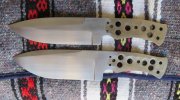
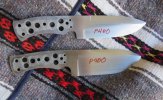
Well, I did get these two in progress. Grinding the top bevel first worked just fine but hard to tell if it made it any easier or better, just different. They pretty much matched my drawings and came off the grinder at 220 grit flat and facet free so I started hand sanding at 220 WOO HOO!!

One of these days I'll stir up the courage to try one with a true dagger like centerline, but not this day!

I've had issues with tang design/shapes comments in other threads so please do not hesitate to critique that aspect or any other, my skin is very thick. I'd also like to hear the good, bad and ugly regarding the bevels. Anything I can improve there?

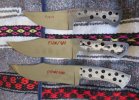
I added the 3rd photo with two full tang bowies and the thingamajig just because I had them.(persian-esque..what blade shape should I call it?) so feel free to tell me what you think of those as well. All are pre HT 440c.4 bevel1.JPG 4 bevels.JPG bowie persian.JPG
 
Always block sand the flat parts last.
It keeps lines sharp.
 
Wow, Bill, great tip. I never would have thought of that on my own. If I saw it on the Nick W video's (probably) I must have forgot. This tip led to a google search and Stacy recommended that wider 1.5-2" sanding blocks are more stable too. My go to one's only .5x.2x4" +\- steel block but I did make a 2" one a while ago. The small one holds a 1/16th sheet real well but probably rocks and tilts all over. Another finding was to hold the wide block at an angle to keep it touching the tang as long as possible. I'll try these tips next at P600 crosswise and P1200 lengthwise and see what happens.

Please don't hesitate to help a guy out with more tips and comments!!
 
Back
Top