Force Patina?

well that sucks... if its actual lemon juice from concentrate, how wouldn't it have citric acid?

I don't know. I learned about it when I was being taught how to prepare ceviche. Ceviche is a fish dish that uses citric acid to cook the fish. They told us specifically that you had to juice lemons for the fish preparation because "Real Lemon" juice didn't have the required citric acid to cook the fish.
 
If citric acid is the active ingredient that causes the patina, I don't think the "real lemon" juice will work for you. The "real lemon" juice doesn't have any citric acid in it.

That's a trip!

The citric acid in Flamming hot Cheetos gives me the scoots ... that's rough stuff.

The real deal has no trace ......
 
Here is my forced patina CV Sodbuster.
I used spicy brown mustard to make the spotted pattern. I left it on for about an hour and then cleaned that off and lightly flitzed the blade. The darkest spots had the thinnest coat of mustard.
Then I soaked a paper towel in balsamic vinegar and wrapped that around the blade and left it for an hour or so. Follow that up with a pretty good Flitz hand polish to lighten the stain a little and your good to go.

I am going to try a mustard "hamon" on another one I have, just have not got around to it yet.

4551081003_6248097427_b.jpg
 
I goofed around with an Ontario RAT 3 in D2 that I stripped of finish and gave it some Strider-esque tiger stripes with French's yellow mustard.

It worked surprisingly well.

I hated the looks though and sanded it off so no pics, but by all means, try it.
 
I just used concentrated lemon juice.
If it's really lemon juice (as opposed to "Real Lemon" as a name, which could mean anything), then it's full of acidic lemony goodness.:thumbup:
Les Stroud talks of the lemon juice for "cooking" fish, and he just said use lemon juice. Real lemon juice.
 
You can always just use lemons.
On a different knife I stuck it in some lemons, cut other lemons to place all around it, and squeezed some lemons over it from time to time to add more lemon.
It worked, but left a more "stripey" sort of finish.
 
With a patina, different acidic foods will produce different qualities in the patina. Basically, from what I understand, is that you need two key things... some sort of acid, and oxygen. If you fully coat your blade in mustard or fully immerse it in vinegar, it will barely do anything. You have to have a light coating, or repeatedly apply whatever you are using if it is very liquid, because the steel needs to oxidize to properly form a patina.

I soaked my Izula in brown mustard for like 5 hours in a plastic bag with ZERO visible formed patina. After I took it out of the bag, I wiped off all the mustard, spackled on a thin layer and let it dry in the air, the patina formed very quickly and it was dark and splotchy and awesome.

The good thing about it is that when you try it, if you don't like it, you can always sand it down, shine it up, and give it another go. You can also let it form completely naturally if you want, but it doesn't come as easy for all steels.

JGON
 
This is what 24-hours inside of a potato does on Case CV steel. It's hard to tell from the photos but it has a rather neat looking bluish tint to it. Though, the reason I did it is for the rust-resistance qualities, and I found that a vinegar pataina works better with it. I just didn't have a camera to take pictures of that.

potatopatina1.jpg

potatopatina2.jpg

potatopatina3.jpg

potatopatina4.jpg
 
Lime!

GEC_toe.jpg


condor.jpg


You can get good satifying patina in about 30mins.
Thing with lime is, that you need to rub it in. Wet the blade at first, but after that, start using lime soaked rug or paper and wipe/rub the blade constantly. Every now and then, wipe clean with limeless paper and repeat.
Be warned though, it seems to shrink wood a bit.
 
Last edited:
Lime!
You can good satifying patina in about 30mins.
Thing with lime is, that you need to rub it in. Wet the blade at first, but after that, start using lime soaked rug or paper and wipe/rub the blade constantly. Every now and then, wipe clean with limeless paper and repeat.
Be warned though, it seems to shrink wood a bit.

thanks for the heads up, but the handles are g10 :thumbup:

great info fellas! lots of great info... sounds like soaking won't work so i'm gonna start playing with stuff and post pics of my results :D
 
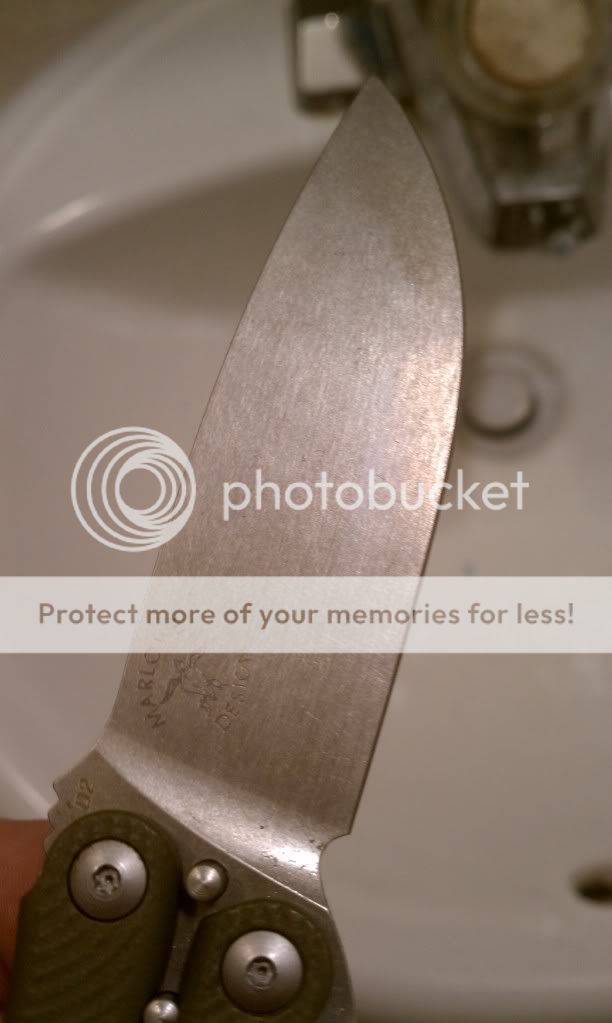
CPM D2 in warm red wine vinegar:
IMG_6103.jpg


IMG_6096.jpg


Still looks about the same, seems to hold up very well:thumbup:
 
CPM D2 in warm red wine vinegar:
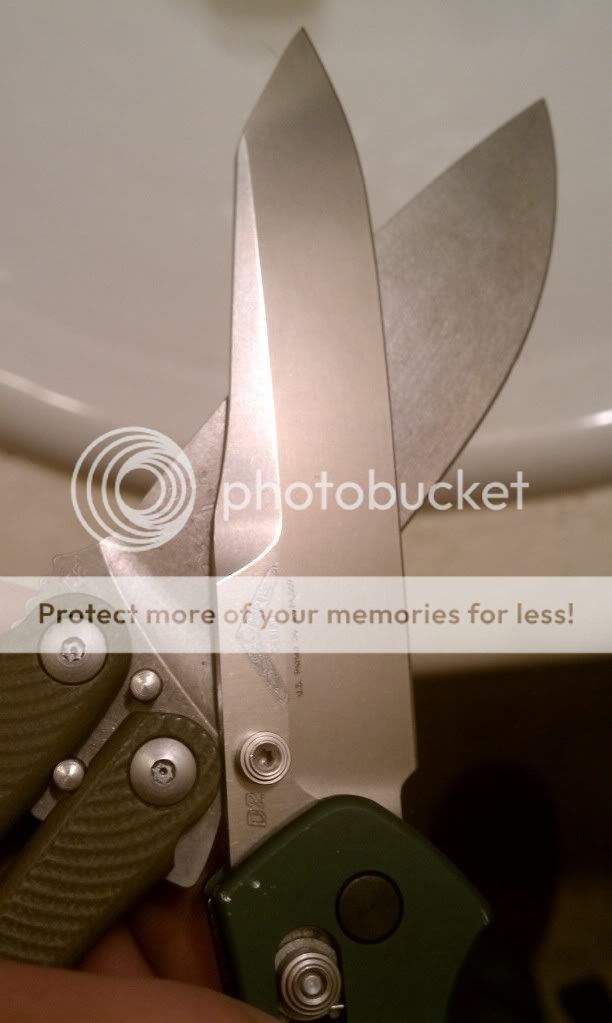
That looks good and even:thumbup: How long did you soak it?
And did you take the blade out, or just stick the blade in it with handle still on?


I have used D2 for years, and never had any show much of a patina at all.
I have the same CPM D2 Military that I may put to use, and may try what you did.
 
I think I let is soak for less than an hour, don't quite remember. The handle was on, but everything was degreased before I soaked it (I think this is important for an even finish). The other parts are a lot more stainless so it shouldn't matter much.

Cleaned it with soap and water before I lubed it up.

Quick sharpening and it was ready to go.

Mine had a few grey areas before the patina because I'd cut rhubarb with it and forgot to clean the blade.
 
i swear that the 53 is much much darker than the 940...

i've been playing with it all day... mustard, lemon juice, apple sauce, ground beef [haha more food prep than patina forcing but hey, couldn't hurt my efforts could it?] and i feel like i've gotten a LITTLE more color but not much
:mad:
 
Back
Top