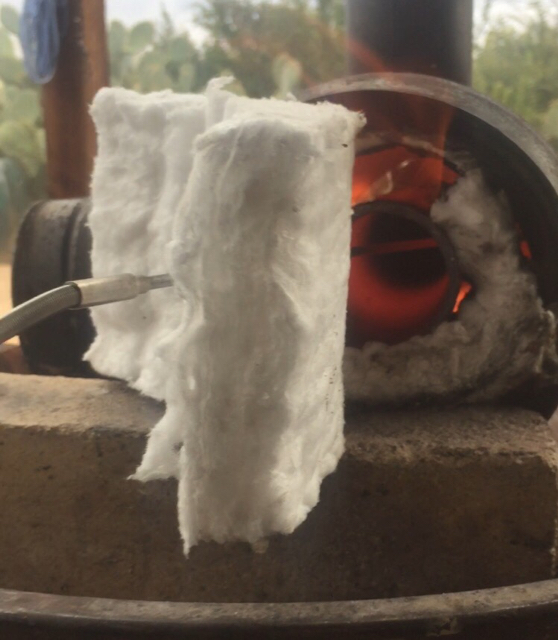
Forge ability to control heat for a soak

HSC ///

Gold Member
Joined
Nov 7, 2012
Messages
4,737
I know this has been discussed before and the common acceptance is that you can't control the heat in a forge accurately enough to soak a given steel.

I accepted this thinking too since I didn't know how to do it ( control the temp accurately ).

However I just spent 4 days with Tai Goo In Tucson and I want to tell you that I watched him control the temp of his VERY simply built forge with an inexpensive burner to within a few degrees of change and over more than ten minutes.

I took pics and video taped this. The only thing that wasn't verified was the accuracy and repeatability of the temperature gauge.

Anyone else able to accurately control a soak time in a forge?


Sent from my iPhone using Tapatalk
 
Last edited:
Yes. According to the temperature gauge, easily within +/- 5*F for as long as needed.

Darcy:)
 
Following this thread because I'm interested in this too... torn between buying an oven or building a forge that can accurately control temperature.
 
I would love to see more vids of Tia Goo at work, they are always inspiring to watch how he uses such minimalistic tools to create such beautiful works of functional art.

Does he still HT the same way he does in this vid below, using his charcoal forge and a muffle to even out the heat?

*edited to add: Heat treat starts at around 31:10 min

[video=youtube;R4hDZSOwF7Y]https://www.youtube.com/watch?v=R4hDZSOwF7Y&t=1620s[/video]

~Paul

My YT Channel Lsubslimed
... (It's been a few years since my last upload)
 
Last edited:
I would love to see more vids of Tia Goo at work, they are always inspiring to watch how he uses such minimalistic tools to create such beautiful works of functional art.

Does he still HT the same way he does in this vid below, using his charcoal forge and a muffle to even out the heat?

*edited to add: Heat treat starts at around

That same forge is there but we used a small propane one for the small blades we worked on. Yes he uses the muffle and the heat was amazingly evenly distributed. :-)

83a261404cf2a5bbc2745768124b28e8.jpg


Sent from my iPhone using Tapatalk
 
Last edited:
Tai is a good chap, but he marches to a differet ukulele player than most folks.
He also uses procedures and materials that aren't the standard practices.He has learned how to do this, but it isn't necessarily the best practice. Look at the image shown of uncoated mineral fiber blankets being used for one example.

That aside, many folks with a forge hold to +/- a few degrees. The plans and info are regularly discussed here. There is a sticky with the plans on my two-stage PID controlled forge in the stickys. Many have built it and clones that work almost as well as a HT oven.
 
I saw the late John White use a small version of a Fogg forge that held the temp within 3 degrees for the time required to soak a big W2 blade with a hamon. It was made out of something the size of like a 30 pound propane bottle like you would use on an RV IIRC.
 
If the forge is PID controlled, the PID is the readout. Some have a read-only TC and readout. Depending on the TC and the shielding, these vary in accuracy. Others use hand-held TCs and laser guns, which are not very accurate at all. Some folks just guess at their forge temp. Even a very good readout and high quality TC are only accurate to +/- 5 degrees at 1500F.
 
Auberins sells the equipment needed to measure temp, or set up pid control.

http://www.auberins.com

When I used a forge, I could get 10 min of a soak with +/- 5f. It would creep up or down after that, and correcting it could cause wider swings.
 
Specific to using something like a muffle in a coal forge, how would you monitor the blade temp to within a few degrees, and how would you get that kind of control? Would the TC be measuring the temp of the bottom of the pipe where the blade is resting or the blade itself? As coal is consumed, does controlling airflow provide fast enough combustion control to keep the temp in a small range, or does the coal fire have to be large enough to remain stable for 10 minutes after you're gotten the airflow to stabilize at your chosen temp?

I think this concept is great, I'm just trying to figure out how it works when the muffle is conductive iron and the blade is resting on it, as well as the problem of measuring temp at the blade.
 
Specific to using something like a muffle in a coal forge, how would you monitor the blade temp to within a few degrees, and how would you get that kind of control? Would the TC be measuring the temp of the bottom of the pipe where the blade is resting or the blade itself? As coal is consumed, does controlling airflow provide fast enough combustion control to keep the temp in a small range, or does the coal fire have to be large enough to remain stable for 10 minutes after you're gotten the airflow to stabilize at your chosen temp?

I think this concept is great, I'm just trying to figure out how it works when the muffle is conductive iron and the blade is resting on it, as well as the problem of measuring temp at the blade.

you are asking important questions that are difficult to answer here and require you to experience some on your own, finding your own way.

I can't speak to a coal forge, We were using a propane forge with a fine flow adjustment.

monitoring was simply done with a standard thermocouple, getting that control requires experience and trial and error.
the T/C was measuring the air in the muffle.

I would suggest you try the muffle concept with a T/C and see what you can get independent of working with a blade.
 
you are asking important questions that are difficult to answer here and require you to experience some on your own, finding your own way.

I can't speak to a coal forge, We were using a propane forge with a fine flow adjustment.

monitoring was simply done with a standard thermocouple, getting that control requires experience and trial and error.
the T/C was measuring the air in the muffle.

I would suggest you try the muffle concept with a T/C and see what you can get independent of working with a blade.

Clearly anyone adopting new equipment needs to come up with their own regimen for doing it. I was just trying to understand the claims being made in terms of equipment and results.

It strikes me that if you are measuring air temp within the muffle, it might be a mistake to assume that the blade is heating to that air temp if it is in contact with the iron tube, which is lying in the fire. A layer of refractory clay on the bottom of the muffle would prevent metal to metal conduction and put the blade closer to the TC temperature, since both the air and clay/firebrick are going to change temperature much more slowly than the metal pipe.
 
It's important to remember air is a very poor conductor of heat at 1500f.
 
Clearly anyone adopting new equipment needs to come up with their own regimen for doing it. I was just trying to understand the claims being made in terms of equipment and results.

It strikes me that if you are measuring air temp within the muffle, it might be a mistake to assume that the blade is heating to that air temp if it is in contact with the iron tube, which is lying in the fire. A layer of refractory clay on the bottom of the muffle would prevent metal to metal conduction and put the blade closer to the TC temperature, since both the air and clay/firebrick are going to change temperature much more slowly than the metal pipe.

What is the impact of metal to metal conduction?

I don't know. If it's a mistake or not....what I do know is what I saw, and what was measured and what was heat treated and what was tested.

I saw a blade heat evenly inside a muffle and held to that temp for a 10 min soak. And we did this twice.

I like to question things as well, but in knifemaking to me there are so many skills to learn. So if an expert with decades of experience shows me something or tells me something, that's usually good enough for me.

If it's of value to me and in this case it is, I will go off and attempt it on my own and replicate it. I have many things to learn and limited time and I choose not to overthink or overanalyze.

And frankly I don't see how this measurement is any different in a heat treat oven?

The point of this thread was to see if there are others who are able to control the temperature in their forge accurately and repeatably enough.

I believe based on what I learned and experienced that I now can, and I definitely will go off and attempt to prove it to myself

Regards
 
It's important to remember air is a very poor conductor of heat at 1500f.

Exactly. Ceramics are also relatively poor conductors, which is why neither is going to oscillate in temperature as much as metal does.

If the goal of the muffle is solely to make observation of decalescence, then resting the blade directly on the metal tube is good way to transfer heat quickly.

But if the goal is to maintain a steady blade temperature for a longish soak, then insulating the blade from the tube might make sense because it connects the TC measure of temp to what is actually heating the blade, as well as damping heat source temp changes.
 
I saw a blade heat evenly inside a muffle and held to that temp for a 10 min soak. And we did this twice.
Not arguing - I'm asking: If you were measuring the air temp in the muffle, how do you know what the blade temp was during those 10 minutes? The air wasn't heating the blade, the iron tube was through conduction.

If that isn't what was happening, then I'm misunderstanding the set up being discussed and would like to know what the actual set up was.


The difference between the muffle and a heat treat oven is that the iron tube is the equivalent of the heating coils in an electric oven. You wouldn't put the blade directly in contact with the heating coils in an oven, so I'm asking what makes measuring air temp the equivalent of measuring the temperature of the blade since it is being conduction heated at a greater rate and efficiency than the air is.
 
Ok. We are measuring the air temp in the muffle with a suspended thermo couple.

To me the air was heating the blade. The blade was in the muffle spine down vertically. The blade heated up evenly

How does anyone know what the temperature of a blade is ?


Sent from my iPhone using Tapatalk
 
Not arguing - I'm asking: If you were measuring the air temp in the muffle, how do you know what the blade temp was during those 10 minutes? The air wasn't heating the blade, the iron tube was through conduction.

If that isn't what was happening, then I'm misunderstanding the set up being discussed and would like to know what the actual set up was.
Personally I can very well maintain an even temperature inside stainless tube .Blade is touching the tube only with spine and with practice I'm become pretty experienced with the that to keep a constant color I want on blade .
 
Back
Top