Forge and Flux question

Joined
May 30, 2011
Messages
152
I've not forge welded in a gas forge, only coal, where the flux melts away and goes down to clinker-ville. I'm thinking of buying a 2lb bag of bubble alumina to coat the floor of my gas forge. I understand it will make the need to patch and repair flux damage less often.

My question is what happens to the flux over time? Does it pool and glass up on the bottom? Do you need to scrape it out after it cools or take care of it somehow while the forge is hot, or just re-coat with more bubble alumina as it gets eaten up?

The other option is probably a hard firebrick floor. Is the bubble alumina better than a hard firebrick?
 
It just sinks into the refractory and fuses into borax glass. A good layer of bubble alumina will take care of it for a long time.

Many makers have switched to hydrocarbon fluxing with super results - no flux trapped between layers, clean welds; and best of all - no flying lava when you set the weld.
Most use kerosene or brake cleaner. Read up on it with a search on it with the BF custom search engine. It is in the sticky list at the top of the Shop Talk page.
 
Stacy, As always thanks for the advice and clear explanations. I will try the alumina floor.

I've read some comments here about using kerosene but without much detail or research. I will add the topic to my list.

It's sure worth it if has less splatter. Luck of the draw this Saturday had me holding two pieces to weld for a striker and I was up close and personal with flung lava. I had serious reverse raccoon eyes after I took off the safety glasses.
 
Also read up on dry welding. I like to use this method. Weld up the seams of your billet with a tig or mig welder if you have one. This eliminates any problem with O2, as there is none. I only have to rebuild my forges every 3-4 years. I do use flux from time to time and the alumina floor or just satinite or Mizzou will work also. I made a trough in the bottom to catch the excess flux. Then at the end of the day you can scoop out much of the flux.

There are also some who use no flux on open welding. This requires meticulous cleaning of the layers and a good control of your atmosphere. Many swear by the method.
 
Well, its taken a while to get all the materials and find the time, but my gas forge is almost done. Just in time for the summer because the last few weeks out in the florida sun in front of a coal forge have been h-o-t.

Its coming out almost like I expected with a few minor adjustments for the realities of materials and unskilled labor. Its funny how just about finishing this one, I know what I "really" want to do for the next one.

Thanks to everyone for the advice, feedback and support.

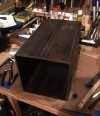
Shell:IMG_1159.jpg Wool:Screenshot 2016-06-09 13.24.04.jpg

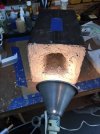
Front:IMG_1170.jpg
(before sanding)

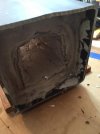
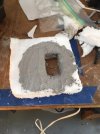
Rear:IMG_1175.jpg Back panel:IMG_1174.jpg

The shell is a piece of 8"od box tube that is 14" long. Rather than go fully round, i went with a doghouse shape for the chamber since I could round the bottom a bit further when i added the satanite and bubble alumina floor.

First, I put 1.5" of 8# ceramic wool into the shell using the pattern in the graphic. The wool was cut just over 12" wide and when installing it in the shell I left an inch clearance in the back and about 1/2" in the front. I then coated it with two layers of refractory (pic shown, 48hrs to dry between coats) and allowed it to dry a few days. It is applied flush to the front.

At this point, I sanded the chamber smooth and cleaned up the back. I had pre-applied some satanite a few days earlier to the piece that will be the back panel of wool (pic shown) so i wouldn't have to reach in through the front to coat it. I now applied a full coat of satanite to the back area and the panel, then inserted the panel into the rear. Once dry, I will cure it, apply the bubble alumina to the floor and then a wash of metrikote. The chamber is just about 3 3/4" round, 12" deep, and will have a 3" flat floor after I apply the bubble alumina. The rear port is 3" wide and almost 2" high. Internal volume is about 155 cubic inches.

I use a free standing tool rest but still pending is to use some angle iron to add a small front porch to this or to hold two bricks.

I will post further pics in a few days after I cure it and tune the burner this weekend.
 
Bubble alumina is cheap and extremely effective. I've been welding in my forge for quite a while now and the borax just sits on top. Great stuff.
 
Most use kerosene or brake cleaner. Read up on it with a search on it with the BF custom search engine. It is in the sticky list at the top of the Shop Talk page.

Many brake cleaners have extremely serious warnings about compounds released when heated. I hope formulation has changed recently- you'll want to find out for sure.
 
Dry welding is where it's at, I switched from flux to dry and never looked back. That's not to say I don't ever use flux but for doing Damascus and San-mai I don't. Also there is no need to weld up every layer to keep the oxygen out. If you tune your forge right then there is no extra oxygen in the forge to react with the steel. When I was ready to ditch the borax I was going to go to hydrocarbon but did not have any on hand at the time. Then some one told me that I did not need any hydrocarbon or flux. Just heat and weld. Make sure every surface is ground and clean. I don't clean it after grinding I just make sure there is no grit on it. I also try and peep my finger oils off the surface. I don't know if that makes a difference or not but my welds stick every time so if it ain't broke. Here is a small sample of the dry welded things I have done recently.

W2 core, 15n20 and wrought iron
Photo%20Apr%2027%2C%2010%2050%2030%20AM.jpg


15n20/1075 very tight twist Damascus
Photo%20Mar%2016%2C%2011%2043%2052%20PM.jpg


303 stainless with a W2 core
Photo%20May%2005%2C%205%2054%2010%20PM.jpg


So give it a try and you will love it
 
Thanks JT. This looks very interesting and I've been reading up on using kerosene after Stacy had mentioned it. I put a bubble alumina floor in anyway and the idea of patching or relining the forge once in a while is not a big deal to me.

The wrought iron with thin 15n20 on each side of a thicker core is what I want to do. Now I just need to get your package of steel and decide what core to use that will keep the HT simple.
 
Remember if welding wrought iron you want to run a tad hotter then normal. That being said I do all my forge welding between 2000° and 2300°. Your package sound be there any day as thy where all shipped out Thursday and fryday.
 
Back
Top