Just to be clear,
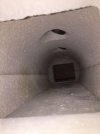
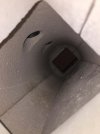
The ins-wool/kaowool is just rolled in the chamber. You want one piece and a good fit, if possible. It is then coated with the satanite, which makes it have a hard coating. Some folks use "rigidizer" to make the wool firmer on large forge builds. On smaller forges, there is normally no need. Once the satanite is applied to about 1/4" thick, you cure it and then fire it. After that (and any patching of cracks) you coat with a thin layer of ITC-100 and fire again to cure the ITC.
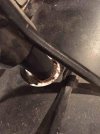
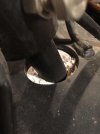
The burners should extend into the refractory liner, but not out into the chamber. As Charles said, about 1/4" to 1/2" back from the chamber is good. When shaping and putting the satanite on the ports in the refractory, have them make a smooth bell shape that flairs into the chamber, instead of just straight channels with sharp edges at the chamber wall. The ports should be just a tad larger than the burner pipe. A waxed or greased wooden dowel held in the burner clamps is a good way to align and size the ports when making them. Smoothness of the surfaces is also important on the port and chamber walls junction area. Any turbulence created in the hot gasses as they enter the chamber will affect the sound and efficiency of the forge.
Once the forge is up and running, loosen the bolts on the burner clamps and slide the burner in and out a tad to "hear" the difference. It will sound smoother at the sweet spot.
If you use oversize pipe sleeves for your burner guides/clamps, make a sleeve of metal to keep the burner tube from being too wobbly. Another good idea is to pack the guide pipe with kaowool to make a tight seal and keep the burner snug.