Forge Building Input

Joined
Aug 30, 2007
Messages
509
I was able to score 2 pieces of schedule 40 steel pipe. One piece is 6" round by 17" long and the other is 8" round by 31" long.

I want to build a blown propane forge with only one burner, 1" of insulation and appropriate reflective coating/sealer. Right now I am planning on closing off the back of the forge totally. My plan is to use the forge for forging blades and heat treating. Right now I do not plan on making damascus.

The members here have been gracious in helping with questions in the past soooo... here are the current couple that I have if ya'll don't mind lending your expertise:

1. I am probably going to use the 8" piece of pipe. How long can I go to get even heat with one burner. Is 31" long out of the question? I was hoping to get at least 24".
2. What is the best cheap insulation and reflective coating/sealer and where can I get it at the best price.

Thanks for your help!
 
You might be interested in going vertical:
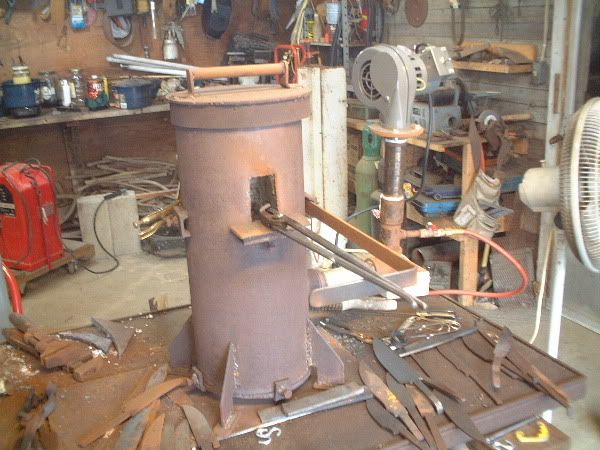
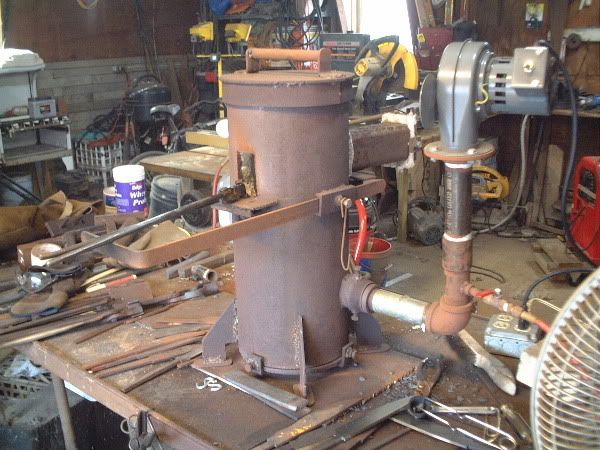
Only one burner and a small blower and I forge down 1 inch thick steel into 10 inch blades with no problem:

DSCF0012.jpg


DSCF0010.jpg
 
karl
Man that is a nice looking forge. What is the diameter of your forge? I notice a piece of square tube sticking of the back, what is it for? Can you heat treat basic steel (1095, O1, W2) in 10" blades? On the top of the burner pipe, close the the forge side wall it appears that there is a piece of red tubing coming off, what is this for? Thanks for helping! I am very thankful that you guys are all helpful. For a new guy like me this is really an adventure. I really have the knife bug and want to start forging and want to build a forge once and get it right, I hope. Thanks!
 
Wow, I had to look at that close! No, that red tubing is the handle of my hand truck that holds the 100# propane tank.
There is a hole on each side of the forge, so that you can pass your blade through and heat up whatever part you choose. I ran it for about a year with both ports open until I had a brain storm that I was losing 1/2 of the heat out the other hole! So, I just clamped a square tube to the hole and closed it off on the end, which still allows me to pass my steel through the forge without losing heat in the steel.
I think that is about 8 inches in diameter, but with a layer of wool all the way around, that dimension reduces. You can still heat up way more steel than you can forge down.
I have no problem heating up my blades after forging when I do thermal cycling/normalizing cycles.
I'm sure you could heat treat with a little practice.
I personally use an oven, but would not be afraid to use the forge if I had to.
 
Yes Karl tell us more or let me guess. It looks like you just welded a piece of in this case square tubing to the rear door of you forge with the other end closed at least that is what you said. this then lets you pass a longer piece of steel completely through the forge into the pipe so that you can heat a blade or bar up that is longer than you forge is in diameter without losing heat out the back. I assume that there is no insulation in the tube? very cool er hot idea
 
Yes Karl tell us more or let me guess. It looks like you just welded a piece of in this case square tubing to the rear door of you forge with the other end closed at least that is what you said. this then lets you pass a longer piece of steel completely through the forge into the pipe so that you can heat a blade or bar up that is longer than you forge is in diameter without losing heat out the back. I assume that there is no insulation in the tube? very cool er hot idea

Bill got it right, except for the welding part - it's not welded on. I DID weld a little plate on the bottom of the tube that is clamped to the ledge right under the opening so I can remove it if necessary.
Correct, it is not insulated. As well, on the end, I have a cap that has a bolt attachment that I can remove and even pass through the tube if I want.
This cut my fuel use by about 30% and raised my forge temp at the same pressure.
Also, note the piece of channel I have welded to the side that holds the tong support. that's self explanatory. But, the reason I have that ledge at the forge openings is that I also have a similar piece of channel welded underneath them with a bolt in them. this was originally for a piece of stock that was to have a small fan attached to it. This was to blow the flame to the side away from the blower motor, which can get a little hot from radiant heat from the forge. Right now I just use that pedistal fan to blow from the side.
that make sense?
 
Smitty,

I get most of my forge making supplies from Darren Ellis in Knoxville. His prices are about the best there are and his customer service is top drawer. http://refractory.elliscustomknifeworks.com/

You can also check Larry Zoeller's web site. He's in Louisville

http://www.zoellerforge.com/

I'll echo Karl and suggest you use your 8" pipe to build a vertical forge. The heat is more even than a horizontal forge and if you want to heat a long piece just stroke it through the opening on the other side. I've got a vertical and a horizontal forge and use the vertical 90% of the time. I'm building a smaller version now to use just for heat treating.

Ken
 
Ken K
Agree, I like the vertical design and Karl's set up, I am going to start fabbing it this weekend.

Can you tell us what you are planning for the smaller heat treat forge? I do have the 6" piece of pipe that I could use for the same purpose if it will work. Can you share design info and set up thoughts. Thanks
 
note in the bottom picture that the fitting for the flame tube is NOT right in the center of the forge body, but rather off-set. This causes the obvious swirling vortex of the heat as it rises and gets good combustion that way. It is not directed straight across the forge cavity.
 
Smitty, with a vertical forge, I believe you get a more complete burn.
The only downside to a vertical is dificulty in heating small piecesnot held by tongs or on a handle. No place to lay them down. bruce
 
The only downside to a vertical is dificulty in heating small piecesnot held by tongs or on a handle. No place to lay them down. bruce

I have seen folks make a rack that looks like a minature ladder to hold objects
in a vert Fogg-type forge. The ends sticking out of both openings. (I quess
that would not work if you only had one opening)
 
Hello Karl,

I am about to build a forge and really like the looks of yours. Can I ask a couple of questions?
What is the lenght of the forge?
What is the size of the blower?
Are you happy with the design and components, or would you change something now that you've run it awhile?
Thanks,
Mark
 
Hello Karl,

I am about to build a forge and really like the looks of yours. Can I ask a couple of questions?
What is the lenght of the forge?
What is the size of the blower?
Are you happy with the design and components, or would you change something now that you've run it awhile?
Thanks,
Mark


That's a 75 CFM blower that I run about 1/2 closed. It's plenty of air, but I would not go smaller.
The forge is about 20 inches tall.
I can't think of anything I would change.
 
Ken K
Agree, I like the vertical design and Karl's set up, I am going to start fabbing it this weekend.

Can you tell us what you are planning for the smaller heat treat forge? I do have the 6" piece of pipe that I could use for the same purpose if it will work. Can you share design info and set up thoughts. Thanks

What I have in mind is a vertical forge that operates at around 1500 F. Nothing out of the ordinary in design. I'll use a couple of 30 pound freon bottles spliced together to wind up with an internal volume of around 700 cubic inches. I built a small forced air burner based on Darren Ellis' design except for using 1" black pipe instead of the 2" and the burner nozzle is 1/2" black pipe. I'll use a hair dryer for a blower and control the air flow with a 1" gate valve. Hopefully, the small burner in combination with the large volume of the forge will help keep the temp down to the target range. I'll also use just one layer of 1" inswool with an eye towards having a large (~7.5") heat zone and reduce the insulation effect slightly in hopes of running a little cooler. With forced air burners and vertical forges the production of high temps isn't usually a problem. The trick seems to be to get them to run in my target range without having to choke them almost to death.

Admittedly, this idea may be due to wild flights of stupid as the result of being dropped on my head when I was a baby but I think it might work. In any case, I'm using assorted parts gathered up from dusty corners of the shop so it's not like I'm spending money hand over fist. I can always find a use for the stuff if the idea doesn't pan out. The forge will still be good so I stick a bigger burner in it if the little one doesn't work and soldier on smartly.

Ken
 
I have seen folks make a rack that looks like a minature ladder to hold objects
in a vert Fogg-type forge. The ends sticking out of both openings. (I quess
that would not work if you only had one opening)

Smitty,

The Fogg-type forge Tom mentions is probably the classic design for a vertical forge. Here's the directions for building one http://www.dfoggknives.com/forge.htm

This might give you some ideas for building your own version.

K
 
I'm building a vertical now.Figure I'll use the same burner and swap from one to the other. IG great forge @ a low cost.
Got my supplies from Darrin Ellis,his operation is top notch.A nice guy also.
 
What I have in mind is a vertical forge that operates at around 1500 F.

Hey Ken,

That's a pretty low temp if you're planning on using the forge for forging, rather than just heat treating... all the steels I would usually use specify higher forging temps than that. Just a thought... maybe someone with more experience will chime in here (ahem! Karl...:D)...
 
Back
Top