Forge welding and face punches!

Status
Not open for further replies.
Joined
Feb 2, 2010
Messages
20
So, I came inside from the shop the other night and my wife happened to see my black eye. I then proceeded to tell her that I tried forge welding AGAIN, and failed AGAIN! I need some help from some guys who know. I have tried to forge weld an old lawn mower blade without cleaning the surface. I did use plenty of borax though. And I got to non-magnetic. Needless to say, I was not successful. That attempt was a couple of weeks ago. Then about a week ago, I read or saw somewhere that the two surfaces to be welded together need to be nice and clean in order for the weld to take. So, I cut and grinder two railroad spikes so they would fit together pretty well (overlapping- can't think of the term right now). I then tack welded them together, leaving plenty of room for the borax to seep in between them, and so I could get them to heat evenly. Got them up to non-magnetic, and still no weld. I have no idea what I'm donig wrong here. PLEASE HELP!

Thanks in advance to everyone- you guys are great!
Dave
 
Well where to begin. First non magnetic is way to cool. It about 1427f and you need to be at least 2250f preferably 2350f. 1450f is austenizing not welding and used for heat treatment. Next lawnmower blades can be just about anything. Same with spikes. For me the cleaner and flatter the material the better. You need to check out dekers website. He has a great tutorial on how to forge weld pattern welded steel. I will come back later when I am not trying to type on my droid.
 
If the mating surface is clean and tight, no need to leave any room for the flux to flow, but you need your surfaces as clean as possible regardless. Forge or mill scale and any sort of oxidation is an inhibitor of the weld, and you're *WAY* too cold. Metal needs to be bright yellow, in some cases even white hot.

When in doubt, leave it in longer. Worst case, you'll melt some metal and see a spark show, but atleast you'll know when it's too hot, which'll give you a much better understanding of when it's hot enough.

Bear in mind that most forging of non-knife/tool steel is done at yellow heat, and welding requires usual more than just yellow. Its only with specialized steels that overheating and things like grain growth become more of a concern. That's why an understanding of how to compenate for those issues becomes necessary for things like pattern welding. The high temps are unavoidable.
 
Here is a thread I did a bit ago. http://www.bladeforums.com/forums/showthread.php/923625-Forge-Welding-Temps-pics-added-more-to-come It covers what I learned from dry welding and pattern definition. I have gone to almost 100% dry welding. That is when I weld up all the seams to prevent any oxidation at all. No flux needed. But you need to allow for the added weld material. Also it works best if you have perfectly flat and clean surfaces. Javand covered much of what I was going to post so I wont rehash it. Good luck and let us know if we can provide some moral support.
 
Gentalmen, I greatly appreciate your help and advice. Javand, you mentioned the beautiful "spark show" if I get the steel too hot. My concern is ruining my stock by burning the carbon out of the steel via overheating. If it was going to be a drive hook or something like that, I wouldn't worry so much, but, with the final product being a knife, I'm worried about the steel not having a consistant carbon content. Then when it comes to ht, the blade wouldn't have consistant hardness, right? BTW, I have a fair amount of old broken truck springs (5160 I believe) that I plan on trying my hand at making some pattern welded blades with. Is overheating something I really need to be concerned with?
Thanks again,
Dave
 
Dave, I have made hundreds of damascus billits. The only ones that failed because of excess heat were the ones I burned and they were in a coal forge. With the high alloy steels you do need to make sure you do not overheat. However with the simple carbon steel, 5160 included, there is little worry about overheating. If you read the post I referenced you saw there could be a problem with pattern diffusion. But as I mentioned, even when using the higher temps, all my billets fully hardened. Give it a try. I would recommend using all high carbon steel, ie 5160 and 15n20.

Good luck and stop hitting yourself in the eye. :-)
 
w Dave ( and others),
As you now know, the temp was barely half what it needs to be for welding. The surfaces can be pretty bad condition as long as they mate well and get to 2300-2400F. Some folks clamp the pieces in a vise, and stick/mig/tig weld around the whole seam. Then they "dry weld" the billet in the forge with no flux at all.

Another thing to know is that welding is not a process of force. Drawing out the steel later on is, but the actual weld is done with fairly gentle blows. As the weld "sets", increase the force. You will "hear" the joint set, and the sound will become more solid. When it is solid sounding, then work it harder and at lower temperature. If you pound with all your might at 2300F, the steel will not weld, and may mush apart or crumble.

What I will add is that "Burning the carbon out of the steel" is pretty much a myth. The layer of de-carb is pretty shallow unless the steel is held in an oxidizing atmosphere for an extended ( hours and days, not minutes) period of time. This layer will be ground off after forging out the billet. It is measured in hundredths of an inch, not tenths.
By adjusting the flame to be neutral or reducing and working in efficient heats, welding is pretty basic, and de-carb is not an issue.

Some things that helps determine when the steel is ready to set the weld are:
1) Look at the borax flux - It should be runny and thin. It looks like melted butter to me.
2) Use a length of coat hanger wire to check the steel. When you think the steel is ready to weld, stick the wire in the forge and if it sticks to the steel when pushed against it in the flux area...the steel is ready to weld. This is almost fool proof. As the ancient Chinese blacksmith said -"No stickie-No weldie."
3) If the steel starts sparking - like a sparkler from the 4th of July- it is too hot.....but only by 50°. It needs to be hot to weld. Few welds fail because they were too hot....many fail because they are not hot enough. A few sparks won't ruin the billet,BTW.
4) Brush off the steel with a steel wire brush after each heat, and before re-fluxing. Also wipe off the anvil face with a rag or gloved hand after each heat.
5) Work in short weld heats. The steel drops temp fast at 2300F, set the weld, brush off, re-flux, and put back in the forge. All forge welding is done at yellow/yellow-red heat and when the temp drops down to red, it is time to set back in the forge.Continue to do this in short heats until you have fully set the weld from all sides. By then the sound should be lower and more solid as the hammer hits. At this point increase the blows and forge the steel down into the red zone.

So, to summit up:
Weld between 2250F and 2350F
Set the weld gently at full welding heat
Solidify the weld fully, increasing the blows as it gets more solid
Work the heats longer and down into the 1800F area.
Draw out the weld at 1800F to 2200F
Grind the de-carb layer off the billet. This is usually about .010-.030". You should see the sparks suddenly start when grinding as you clear the de-carb layer. The sparks indicate carbon in the steel you are grinding. If the steel is low carbon steel, there will be less (or no) sparks than if it is high carbon blade steel.
Forge the welded billet into a blade at 1700F to 2200F - NOTE: Forging a welded joint/billet to shape below 1600F can cause the steel to de-laminate.
Grind the blade to the final shape, removing the de-carb from the forging to shape steps. This is usually about .010". Again, you will see the sparks shower off the grinding belt as the de-carb disappears.

 
Well where to begin. First non magnetic is way to cool. It about 1427f and you need to be at least 2250f preferably 2350f. 1450f is austenizing not welding and used for heat treatment. Next lawnmower blades can be just about anything. Same with spikes. For me the cleaner and flatter the material the better. You need to check out dekers website. He has a great tutorial on how to forge weld pattern welded steel. I will come back later when I am not trying to type on my droid.

Did I hear my name? :)

Thanks for the kind words Chuck. I wish I had the time to make the site great, but for now I'm settling for "ok, and maybe helpful to a few folks".

Go check out my website on pattern welding. It will tell you lots of stuff that will hopefully get you welding. If you still have issues, email me directly and I'll help you out and get you going.

-d
 
OK Dave - about time to give it up on the face punch and black eye. You were wearing your OSHA-approved eye protection at all times - right??? Seriously, if it hits hard enough to give you a shiner, it hits hard enough to give you a lifetime of misery too - be careful out there guy!

Great advice above. I would only add that you should seriously consider buying a known steel even for practice (insert shameless plug for Aldo here). It is dirt cheap in the long run and you might already be aware that mild steel welds differently than high carbon or something in between (e.g. lawn mower blade). Besides, just say you forge down a winner out of that first billet and want to finish/HT the resulting blade, your heat treat protocol is going to be a total crap shoot until you know the actual chemistry of your components.

Probably just a long way of saying that your time is probably worth more than your steel ...

Regards.
 
Bldsmth's post is one of the most consice I've seen, better than I would have written. Only thing I would add is if it is a decent sized billet to bring the temp up and wait and make sure it is at temp all the way through, not just the outside. When learning, especially with coal, the temptation is to go like heck with the air blast "to get it good and hot!" - the outside could be sparkling like 4th of July while it still isn't ready to weld.
 
Good point Steve.

A stack of steel bars several inches wide and thick can take a good while to heat all the way through. That is where having the forge fully pre-heated, plus giving the billet time to heat up to the center is important.
One problem with newer smiths trying their first welds is they run the forge at full blast. There is no need for the forge to be at 2800F when the weld is to be done at 2350F. What happens is the steel burns and sparks, and the flux burns off, before the center is at welding heat( Sometimes they even melt the ends of the billet). They pull the billet out because it APPEARS to be ready, and weld it up......but when drawing it out, or worse, when grinding the bevels.....discover the center welds are delaminated, because they were never welded through.


Great story:
A local preacher was visiting a blacksmith. He watched the smith shape some steel into a beautiful cross by forge welding four RR spikes together. He asked if he could try it himself. The smith outfitted him with a leather apron, gloves, and a hammer. They heated the spikes in the forge, and when all was ready, he told the preacher to take them out and weld them together. The preacher tried, and the spikes just fell apart when quenched. The parson asked if there was something he wasn't doing that the smith usually does. The smith replied, "Well, I cuss at the steel when I weld it." The preacher blushed and said he had not cussed since he was 16, and didn't even know any cuss words anymore. The smith laughed and said, "Keep trying to learn forge welding.......I'm sure a lot of them will come back to you!"
 
Ok guys, I'm finally back. It has been a crazy few days and I just haven't had time to get on here to read all of your posts. I appreciate all the help you guys are giving me. I haven't even got the chance to fire up the forge in 2 or 3 days. I also had to get 4 stitches in my most used finger (guess which one) today due to cutting it on a sharp piece of steel while fixing my garage door. But enough about that....

Deker, I'll check out your site as soon as I'm done posting, and thanks in advance.
Andy, of course I was wearing my OSHA approved eyewear:D, along with all of my other PPE. Just like my uncle told me, you only get one set of eyes. I'll also check out buying some known steel even to practice with.
Chuck, thank you for clearing up that surface decarb myth for me. That makes me feel a lot better about overheating the steel.
Bladsmith and Andy, thank you for the coathanger tip. I'm definitley going to try that. And in case you or anyone else was wondering, I have a coal forge. That being said, I'll try to get a nice big mound of coal built up and preheated, that way I can let it soak and heat up evenly before kicking on the blower. However, due to my forge being coal, I can't adjust it to have a reducing atmosphere to prevent it from scaleing up really bad. So, after removing the billet from the forge and brushing it to remove the scale, should I reflux and the try to weld? And how do I know if the middle of the billet is at welding temp, if I can only check the outside via coathanger method?
Thanks again guys.
 
Thank You Stacy for your POST,
As I am starting out making Damascus a lot of what you said is what I have been taught. Add to this little bits of insight that will help me in my next billets.

w Dave ( and others),
As you now know, the temp was barely half what it needs to be for welding. The surfaces can be pretty bad condition as long as they mate well and get to 2300-2400F. Some folks clamp the pieces in a vise, and stick/mig/tig weld around the whole seam. Then they "dry weld" the billet in the forge with no flux at all.

Another thing to know is that welding is not a process of force. Drawing out the steel later on is, but the actual weld is done with fairly gentle blows. As the weld "sets", increase the force. You will "hear" the joint set, and the sound will become more solid. When it is solid sounding, then work it harder and at lower temperature. If you pound with all your might at 2300F, the steel will not weld, and may mush apart or crumble.

What I will add is that "Burning the carbon out of the steel" is pretty much a myth. The layer of de-carb is pretty shallow unless the steel is held in an oxidizing atmosphere for an extended ( hours and days, not minutes) period of time. This layer will be ground off after forging out the billet. It is measured in hundredths of an inch, not tenths.
By adjusting the flame to be neutral or reducing and working in efficient heats, welding is pretty basic, and de-carb is not an issue.

Some things that helps determine when the steel is ready to set the weld are:
1) Look at the borax flux - It should be runny and thin. It looks like melted butter to me.
2) Use a length of coat hanger wire to check the steel. When you think the steel is ready to weld, stick the wire in the forge and if it sticks to the steel when pushed against it in the flux area...the steel is ready to weld. This is almost fool proof. As the ancient Chinese blacksmith said -"No stickie-No weldie."
3) If the steel starts sparking - like a sparkler from the 4th of July- it is too hot.....but only by 50°. It needs to be hot to weld. Few welds fail because they were too hot....many fail because they are not hot enough. A few sparks won't ruin the billet,BTW.
4) Brush off the steel with a steel wire brush after each heat, and before re-fluxing. Also wipe off the anvil face with a rag or gloved hand after each heat.
5) Work in short weld heats. The steel drops temp fast at 2300F, set the weld, brush off, re-flux, and put back in the forge. All forge welding is done at yellow/yellow-red heat and when the temp drops down to red, it is time to set back in the forge.Continue to do this in short heats until you have fully set the weld from all sides. By then the sound should be lower and more solid as the hammer hits. At this point increase the blows and forge the steel down into the red zone.

So, to summit up:
Weld between 2250F and 2350F
Set the weld gently at full welding heat
Solidify the weld fully, increasing the blows as it gets more solid
Work the heats longer and down into the 1800F area.
Draw out the weld at 1800F to 2200F
Grind the de-carb layer off the billet. This is usually about .010-.030". You should see the sparks suddenly start when grinding as you clear the de-carb layer. The sparks indicate carbon in the steel you are grinding. If the steel is low carbon steel, there will be less (or no) sparks than if it is high carbon blade steel.
Forge the welded billet into a blade at 1700F to 2200F - NOTE: Forging a welded joint/billet to shape below 1600F can cause the steel to de-laminate.
Grind the blade to the final shape, removing the de-carb from the forging to shape steps. This is usually about .010". Again, you will see the sparks shower off the grinding belt as the de-carb disappears.
 
A reducing atmosphere is possible in a coal forge. Tai Goo taught me a long time ago. You need to make a beehive and hollow out the center. Make sure you have a good supply of coke and feed as necessary. Aldo cover the top with green coal as it begins to burn off. Ii can be difficult to explain in the written form.


A little clarification on the coat hanger. If you already know this please do not take offence. Make sure the hanger tip is at the same temp as the billet. I have witnessed someone sticking a cold hanger into the forge to see if it would stick. It won't until it is at temp. When you pull it out brush and hammer. No need to re flux until it is going back into the forge.

Stop beating yourself up. It's hard to work with missing parts.

Have fun
 
Stacy, you are a true didact right down to your predilection for parables. Good posts.

Dave, so you are welding in a coal forge. That's a bit tougher to learn with pattern welding. Your method may depend on your type of coal. If you have good soft coal, you can build it into a hollow fire for welding, which allows you to see the billet better in the fire. Otherwise, you'll have to heat it in more of a charcoal style, i.e. a large solid bank of coals. Let's assume the latter for now.

You'll come to know how big of a welding fire your forge can hold given the size of your blower. This may be a circle of coals as small as 4" or as large as 10". If the mass of your coals exceeds the ability of your blower to supply enough air to get to welding heat, the heat will taper off sharply except for at the center. If your fire is too big, it will inhibit the ability for the center to develop a good sized welding-heated area. So, it's a good idea to keep a watering can next to your forge and keep wetting a circle around the edge of your fire to limit it's growth to the extent necessary. This will save fuel as well.

Next, you need your fire to be deep. I don't know what sort of forge pan it is, but it helps if it has a deeper portion at the center (i.e. a "duck's nest") to hold a fair volume of coals under the work. Otherwise your fire and the surrounding coal will have to be loaded taller in the pan. At any rate, you need to have at least an inch, and two is better, of hot coal under your work to protect it from direct contact with the air blast, and to help it evenly heat. Of course the work should be surrounded by hot coals for a few inches on each side, and it needs to have an inch or even a bit more of hot coals on top of it.

This is how to keep a reducing atmosphere around your work. Hot solid fuel. In this way too, the work will heat more evenly. You need to start your fire with a low blast, building your fire to the size you want, watering to keep it from getting too large. Then bury your work in it. When the work and the fire are a good red heat, bring the work out and flux it. With the work back in the forge, bring the fire slowly up to yellow. The fire should not heat up so quickly that you have a yellow fire with an orange workpiece in it. They should heat together.

Watch for sparks. It's very easy to burn your steel in a coal forge. With the billet buried in the fire correctly, it can be hard to see. I keep a couple pokers by the forge, with one I can poke into the fire to create small windows to look at the billet. Check the length of your welding heat, and don't have one part deeper in the fire than the other. You could have a nice welding heat on one part while the other end is already melting. Turn the billet if it's heating very unevenly, or to check the bottom before bringing out to weld. Keep these windows closed when not using!

It's true that mild steel welds generally at a higher heat than high carbon, but it's still good to practice with. I don't mean make a mild billet or anything, I recommend just using a piece of mild flat bar. Say 1/4"x1xlong enough to hold and work without tongs. Heat, flux and weld as described above, just folding the last inch or two of bar back on itself (fold the bar first, brush off, then re-heat for welding). This is called a faggot weld and is IMO the easiest and quickest way to determine if you have your basic welding skills together. All one piece, no tack weld or tongs-dropping necessary. Almost any old scrap steel will work. Rebar will even usually work, but it can be unpredictable in content and sometimes will sabotage your efforts.

Start your welds immediately with mild hammer blows, like a quick series of pats really. You should be able to feel the steel sticking together.

Good luck!
 
Last edited:
Wow, good write ups guys! Dave, don't be discouraged. You're tackling some of the more difficult aspects of forging with your coal/coke forge. Bill Moran (the father of the modern day renascence of damascus steel) did his work in such a forge. I read that he'd spend considerable time coaking up enough coal (like a whole day) so he'd have enough coke on hand to accomplish all his welding of repeated layers and folds. Keep at it. It's a noble undertaking. You'll develop your recipe, even if sometimes spiced with saucy vernacular. ;)
 
OK, Great news guys! As of approximately 5:30pm on may 20th, I have successfully compleated my first forge weld/ Damascus billet! I am very pleased to report this and could not have done it without the help from all of you. No more beating myself up! Yaaaay!
Chuck, thank you for the clarification on the coathanger trick. I did try it today, and it didn't work. I then contemplated the idea that it too may need to be at welding temp, but I could see my steel was there and didn't want to risk melting it, so, I didn't try it again.
Salem, thank you for the tips on welding in a coal forge. I happen to be using Anthracite in my forge due to it burning nice and hot, clean (important because I live in town), and a long time. That stuff seems to last forever. And it doesn't like to stick together very well unless it is forming a giant clinker in the bottom of my firepot. BTW, my forge is probably 3 or 4 inches deep with a flat bottom, and my blower can sustain a 12-15 inch wide x 6 inch deep fire that will stay hot enough to melt anything I have put into it yet. It's the first forge I've ever had but it seems to do very well. I'll try to post some pics of my forge that I took last week.

My first "billet" that I got started on today was really just a test to see if I could get it to forge weld without it delaminating or melting. So far it was a success, but, I've only ground the scale off of one side so far. I'll try to post some pics of my progress this evening if I get to it. I guess it's also worth mentioning that the steel used was 5160 as the core, lawnmower blade, then circular saw blade on either side. Like I said, it was just some scraps I had laying around to test my new knowledge you guys have given me so graciously, so it may not have been the ideal choice if I actually attempt to forge it out to a blade. We will just see how it goes.
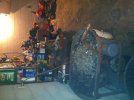
IMG_0036.jpg
This is my work area including the forge in the foreground.
 
That's good to hear that you have that decent looking and good running railroad forge. Very cool as well that you are beginning to have some success welding! I remember some of my first welding attempts, I got VERY frustrated.
 
Status
Not open for further replies.
Back
Top