I've made about 40 stock removal knives, but have only forged three. I hammered out two more tonight, one from a file, and one from bar stock. My knives come from the forge looking all goofy shaped, with decent bevels and distal taper, but not so hot on the ricasso and top line. I have generally trued up the profile on the grinder and have made a good looking knife or two. I'm curious to see some well forged knives, straight from the forge, before they hit the grinder. How close to shape should a good smith actually be able to forge?

-
The BladeForums.com 2024 Traditional Knife is available! Price is $250 ea (shipped within CONUS).
Order here: https://www.bladeforums.com/help/2024-traditional/
You are using an out of date browser. It may not display this or other websites correctly.
You should upgrade or use an alternative browser.
You should upgrade or use an alternative browser.
Forged knife raw pics?
- Thread starter Jason Fry
- Start date

- Joined
- Sep 14, 2006
- Messages
- 4,409
I've made about 40 stock removal knives, but have only forged three. I hammered out two more tonight, one from a file, and one from bar stock. My knives come from the forge looking all goofy shaped, with decent bevels and distal taper, but not so hot on the ricasso and top line. I have generally trued up the profile on the grinder and have made a good looking knife or two. I'm curious to see some well forged knives, straight from the forge, before they hit the grinder. How close to shape should a good smith actually be able to forge?
There are some very much better smiths on this forum than I am, but I do attempt to form and shape the blade as much as I can on the anvil. This includes blade shape, thickness, tang shape, etc. I want to do a minimum of grinding to finish the knife.
Andy

- Joined
- Nov 20, 2008
- Messages
- 1,855
- Joined
- Dec 20, 2008
- Messages
- 1,937
I looked and I dont have any on file.. gonna have to take some... Stephen Fowler has a WIP on his facebook

- Joined
- Oct 2, 2006
- Messages
- 3,238
you should allow enough extra meat that you can grind off your decarb completely(in my book that's at least an extra 10-15 thousandths if you forge on the cool side of things, 5 thousandths if you forge hot enough to scale metal off faster than it can decarb
(it well still decarb in heat treating)
-Page
(it well still decarb in heat treating)
-Page
- Joined
- Oct 2, 2007
- Messages
- 199
tai goo can get them pretty good:

I always try to forge as close to shape as I can get, I hate grinding.
I always try to forge as close to shape as I can get, I hate grinding.

- Joined
- Oct 30, 2002
- Messages
- 3,974
I think I remember seeing that knife of Tai's on the board. Holy crap! He's good with the hammer!
--nathan
--nathan

- Joined
- Feb 28, 2006
- Messages
- 3,494
Here are a few links....
http://www.bladeforums.com/forums/showpost.php?p=6654086&postcount=185
http://www.bladeforums.com/forums/showthread.php?t=598875
http://www.bladeforums.com/forums/showthread.php?t=526045&highlight=nick+forge&page=3 (scroll down)
http://www.bladeforums.com/forums/showthread.php?t=579026
http://www.bladeforums.com/forums/showthread.php?t=573359
http://www.bladeforums.com/forums/showthread.php?t=619608
http://www.bladeforums.com/forums/showthread.php?t=617423
http://www.bladeforums.com/forums/showthread.php?t=594566
http://www.bladeforums.com/forums/showpost.php?p=6654086&postcount=185
http://www.bladeforums.com/forums/showthread.php?t=598875
http://www.bladeforums.com/forums/showthread.php?t=526045&highlight=nick+forge&page=3 (scroll down)
http://www.bladeforums.com/forums/showthread.php?t=579026
http://www.bladeforums.com/forums/showthread.php?t=573359
http://www.bladeforums.com/forums/showthread.php?t=619608
http://www.bladeforums.com/forums/showthread.php?t=617423
http://www.bladeforums.com/forums/showthread.php?t=594566
- Joined
- Dec 20, 2008
- Messages
- 1,937
tai goo can get them pretty good:Wheres the hammer marks!

- Joined
- Aug 6, 2007
- Messages
- 5,060
Does Lively forge those exactly to that shape, or does he clean them up with a file? Those bevels sure are crisp if they're not filed!
Yes, All of Tim's knives are forged as you see, no file cleanup on the bevels, just cleanup of the silhouette. Forged to shape like and keeping the bevels crisp like that is QUITE tricky.
Here are some of mine with forged bevels.


- Joined
- Oct 2, 2006
- Messages
- 3,238
Once you file/grind and sharpen your edge it will always be decarb free, I don't think anybody can forge and HT a knife without having to sharpen it after unless it's a wall hanger.
take a look at a cross section with a 2 percent nital etch, you would be amazed how deep decarb can run
-page
- Joined
- Jan 12, 2009
- Messages
- 3,198
I don't have anything of value to add, but in viewing the pictures of "off the anvil" forgings, I must say there are some tremendously talented folks here... :thumbup:
I might be able to get my forgings that smooth if I had enough time. Maybe.
Robert
I might be able to get my forgings that smooth if I had enough time. Maybe.
Robert
- Joined
- Jan 16, 2006
- Messages
- 1,246
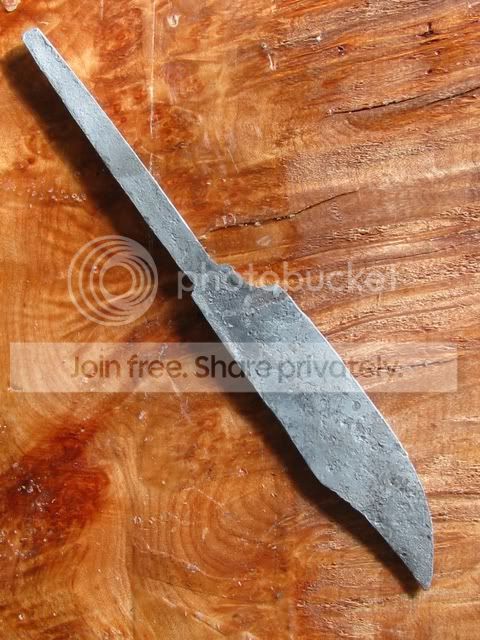
This is a mini-bowie I did for a demo on Primal Fires. All I did was file the edge, square the shoulders and refine the tang distal taper.
Last edited:
Wow guys... I've got a long way to go... and I want to be like Ray Richard when I grow up 
Maybe I'm not forging hot enough, or maybe I'm hitting too hard, but my blades always want to twist when I hit on anything but the flats . Can you refine the profile with the hammer without messing up the bevels or distal taper? What about the tip/point? Are they getting these shapes based on a preform, or are there tricks to managing the profile that I don't know about?
Maybe I'm not forging hot enough, or maybe I'm hitting too hard, but my blades always want to twist when I hit on anything but the flats . Can you refine the profile with the hammer without messing up the bevels or distal taper? What about the tip/point? Are they getting these shapes based on a preform, or are there tricks to managing the profile that I don't know about?

Stacy E. Apelt - Bladesmith
ilmarinen - MODERATOR
Moderator
Knifemaker / Craftsman / Service Provider
- Joined
- Aug 20, 2004
- Messages
- 38,709
The enemies of a smooth blade surface on brute-de-forge blades are heat and scale. Forge too hot and the surface gets a lot of scale and decarb. Forge too cold and you tend to hit too hard, leaving little dings everywhere. Start at the upper level of the steels temp (2100F for 1084) and quit at the bottom ( 1600F for 1084). As you approach the finished shape, switch to lighter and smooth faced hammer, forging with lighter strokes. You can forge down to about 1500F for the final heats.
The scale that falls off the blade in forging needs to be swept off the anvil or it will drive itself into the blade, leaving all those wrinkles and tiny pits. Brush the blade with a wire brush as you take it from the forge during the final heats. The Japanese smiths wet the anvil and hammer to knock the scale off the steel and to extend the forging heat ( seems counterintuitive, but it works).
Avoid dinging the anvi with misplaced blows. Sand the hammer faces smooth to at least 400 grit. Whatever dents and dings are in the hammer face, and on the anvil face, will transfer to the blade.Most hammer and anvil dents are caused by trying to move steel by hitting it too hard. If the steel is a forging grade ( like 1084) and at the proper temperature ( 1500-2100F) then it will move under the hammer.
When the basic shape is being formed, straighten out any bumps and twists at the end of each heat. If you leave them for later, many will become permanent. Hammer on the spine and edge to keep them straight as the last things before returning to the forge.
Starting with the right shape means ending with the right shape. Shape the tip, then define where the the ricasso will be, draw some distal taper,draw the tang, curve the blade downward like a banana, and then forge the bevels. After the shaping, re-work all surfaces with a smooth faced 1Kg hammer ( 16-20oz.) getting the detail as fine as possible. Each heat should be lower and lower. The final heats should be from 1800F to 1400F). I know the temptation to forge the surface right into black heat is always great, but the steel is better not worked below the austenitization point. Gama iron ( above critical) is very rubbery and moves like clay, the other structures below it are harder and can shear. Cold working the metal should be avoided if possible.Irreversible shearing along the grain boundaries can occur.You can't always see it, but this is one of the main sources of the things that go wrong in quench.
Stacy
The scale that falls off the blade in forging needs to be swept off the anvil or it will drive itself into the blade, leaving all those wrinkles and tiny pits. Brush the blade with a wire brush as you take it from the forge during the final heats. The Japanese smiths wet the anvil and hammer to knock the scale off the steel and to extend the forging heat ( seems counterintuitive, but it works).
Avoid dinging the anvi with misplaced blows. Sand the hammer faces smooth to at least 400 grit. Whatever dents and dings are in the hammer face, and on the anvil face, will transfer to the blade.Most hammer and anvil dents are caused by trying to move steel by hitting it too hard. If the steel is a forging grade ( like 1084) and at the proper temperature ( 1500-2100F) then it will move under the hammer.
When the basic shape is being formed, straighten out any bumps and twists at the end of each heat. If you leave them for later, many will become permanent. Hammer on the spine and edge to keep them straight as the last things before returning to the forge.
Starting with the right shape means ending with the right shape. Shape the tip, then define where the the ricasso will be, draw some distal taper,draw the tang, curve the blade downward like a banana, and then forge the bevels. After the shaping, re-work all surfaces with a smooth faced 1Kg hammer ( 16-20oz.) getting the detail as fine as possible. Each heat should be lower and lower. The final heats should be from 1800F to 1400F). I know the temptation to forge the surface right into black heat is always great, but the steel is better not worked below the austenitization point. Gama iron ( above critical) is very rubbery and moves like clay, the other structures below it are harder and can shear. Cold working the metal should be avoided if possible.Irreversible shearing along the grain boundaries can occur.You can't always see it, but this is one of the main sources of the things that go wrong in quench.
Stacy
- Joined
- Jan 23, 2005
- Messages
- 337
All good advice, and yes practice a lot.
It is also good to let the blade cool have a break and examine the blade fully and if needed mark it with chalk to show you where the blank needs a tweak.
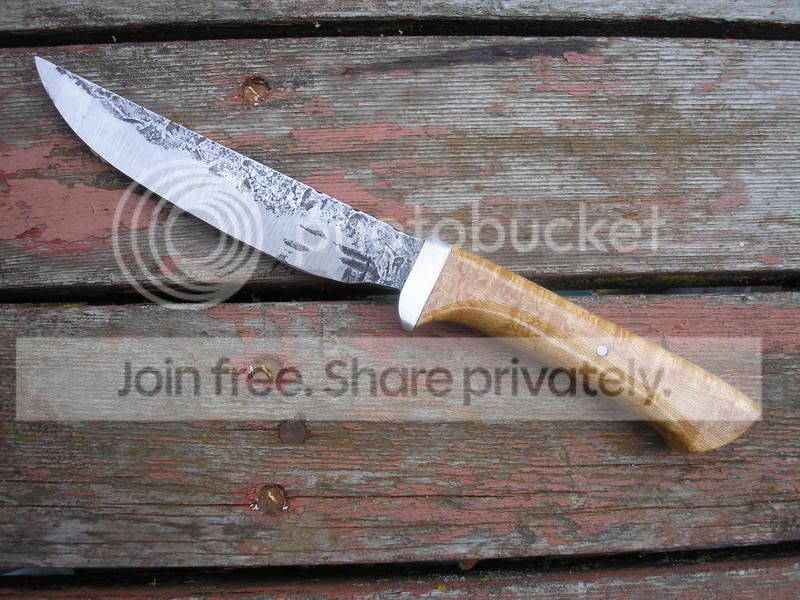
And like grinding practice a lot. And I gotta say Tia is a master at this art. As you can see I still have a ways to go but the fun is getting their.
Cheers Ron.
It is also good to let the blade cool have a break and examine the blade fully and if needed mark it with chalk to show you where the blank needs a tweak.
And like grinding practice a lot. And I gotta say Tia is a master at this art. As you can see I still have a ways to go but the fun is getting their.
Cheers Ron.