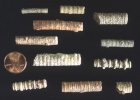
Fossil or rock quarry tool mark?

Status
Not open for further replies.

LMT66

Gold Member
Joined
Jun 18, 2008
Messages
11,317
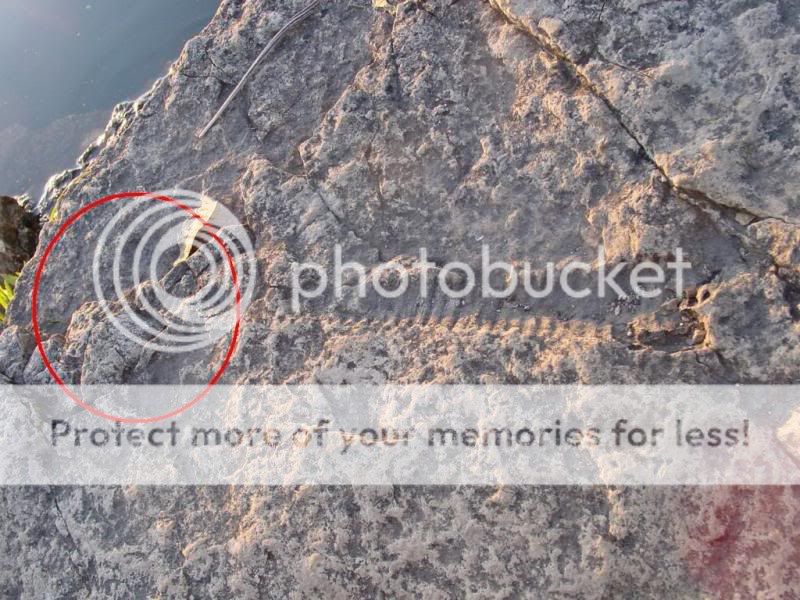
I found this today at a lake that was formerly a limestone quarry in the late 1800's.
Is it a fossil or some type of tool mark inserted after drilling into the rock to break it? Note that the imprint lines have no spiral to them. I think it's a fossil.
My shoe is a mens US size 11 1/2 and the knife is a Busse Satin Jack LE that is 11.50" overall with a 6.0" blade.
I've seen fossils shaped like this before but they were never this big!
 
Last edited:
That was my first thoughts but the part by my heel and the handle end of the knife has me scatching my head.
 
That does look like its got a larger diameter than the rest. It might be that the amount of limestone that split off or eroded there was less than that further towards the face. Did you see any other examples of these markings on other exposures?
 
Never seen things like this before.
Very interesting.

Sorry, No idea. Nothing.
I know no tool for this mark, neither for ancient creature.
 
That does look like its got a larger diameter than the rest. It might be that the amount of limestone that split off or eroded there was less than that further towards the face. Did you see any other examples of these markings on other exposures?

I did not but I'm going to go out again next weekend and do some searching.

Here's an interesting page ( http://www.fossilmuseum.net/Tree_of_Life/PhylumMollusca/SubclassAmmonoidea.htm ) that states this:
While the majority of ammonites have a shell that is a flattened coil, others have a shell that is partially uncoiled, partially coiled and partially straight (as in Australiceras), nearly straight (as in baculites and belemnites), or coiled helically - superficially like that of a large gastropod (as in Turrilites and Bostrychoceras). These partially-to-totally uncoiled forms appeared in the Lower Cretaceous and are known as heteromorphs.
 
One thing that strikes my curiosity is the very end opposite of my heel where that rock is uneven, does not fit inline with the rest of the impression and it actually conforms to the uneven surface as seen in the first picture. Look at the very end where the rock surface drops down to a new facing. The mark is out of line slighlty and somewhat drapes over the edge off center.
 
Text on sign near where this was found:
"From this overlook, you can see a story in the landscape. It begins 400 million years ago when shallow seas covered this area. The remains of sea creatures form the dolomitic limestone bedrock, which can be seen in nearby outcroppings and quarry sites.
The ground you are standing on and the hills across the valley were formed 13,000 years ago when rocks and clay were deposited by the Wisconsin Glacier. Meltwater from the glacier carved out this valley and exposed the limestone bedrock.
During the 1800s, limestone from quarries in the area was used to build the Chicago Water Tower and many buildings in Lemont. Visitors to the abandoned quarry site can find fossils that are three times older than dinosaurs
."
Link to some pictures > http://township.com/lemont/historical/PixPages/Quarries/Quarry1.htm
 
I'm really interested in finding a tool that would make this. Most of the old quarry tools i've seen have a spiral drill which is followed by a cone shaped tool or two wedge shapes are slipped in the hole then impacted to split it.

Either way, Fossil or tool mark........ it made my afternoon!
 
Doesn't look like the marks of any tooling I recognize. Got any "backed off" shots or shots from a lower angle? It's the area I have circled in this picture that caught my eye.

Circledarea.jpg
 
Doesn't look like the marks of any tooling I recognize. Got any "backed off" shots or shots from a lower angle? It's the area I have circled in this picture that caught my eye.

Circledarea.jpg

YES! That's the spot. You see it too right?

I'm going to get some up close angle shots next weekend and bring along a chalk line tool.
 
YES! That's the spot. You see it too right?

I'm going to get some up close angle shots next weekend and bring along a chalk line tool.

Well..yeah...I see it. At first I was concentrating on the inside of the grooves being more round like those of some worm's rings...not a V shape like the teeth of a tool or even like "flattened" V's of a dulled tool., the fact that the larger end impression appears to be deeper yet the rings stay a consistant depth, and the fact that the "end" of the impression is so much wider than the rest. However that spot is what really caught my eye because it looks in this picture as if the rock shows signs of having formed abound something, and a "jog" in the general line of...whatever it was. I am curious to see other pictures.
 
I have seen similar fossil imprints of crinoids or
'sea lilies". If I can find a good link or two I will post them.

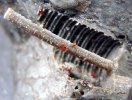
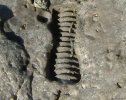
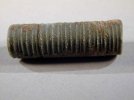
Here ya go. If that is indeed a crinoid, it is an unusually (though not impossibly) large one.
 

Attachments

  • crinoid.jpg
    crinoid.jpg
    35.1 KB · Views: 87
  • crinoid imprint.jpg
    crinoid imprint.jpg
    45.4 KB · Views: 101
  • crinoid stem.jpg
    crinoid stem.jpg
    29 KB · Views: 73
  • crinoid stems.jpg
    crinoid stems.jpg
    16 KB · Views: 78
Last edited:
Porky-

I figured you were a yooper with that name, but based on the quote, were you down by the high line road in Lemont? Bluff Road by the old smoke stack in the flag stone quarries?

Text on sign near where this was found:
"From this overlook, you can see a story in the landscape. It begins 400 million years ago when shallow seas covered this area. The remains of sea creatures form the dolomitic limestone bedrock, which can be seen in nearby outcroppings and quarry sites.
The ground you are standing on and the hills across the valley were formed 13,000 years ago when rocks and clay were deposited by the Wisconsin Glacier. Meltwater from the glacier carved out this valley and exposed the limestone bedrock.
During the 1800s, limestone from quarries in the area was used to build the Chicago Water Tower and many buildings in Lemont. Visitors to the abandoned quarry site can find fossils that are three times older than dinosaurs
."
Link to some pictures > http://township.com/lemont/historical/PixPages/Quarries/Quarry1.htm
 
It is a very large Crinoid stem impression. 400 million years ago would put it into the Devonian period which would be right for this type of fossil. We have them in the quarries here and they are about the size of a pencil in thickness. It is weathered, so it gives it a worn rounded look.
 
i would think, a drill would have cut the end (far right in photo) in at least a concave depression?
 
Status
Not open for further replies.
Back
Top