fourth knife need input

Joined
Dec 26, 2008
Messages
247
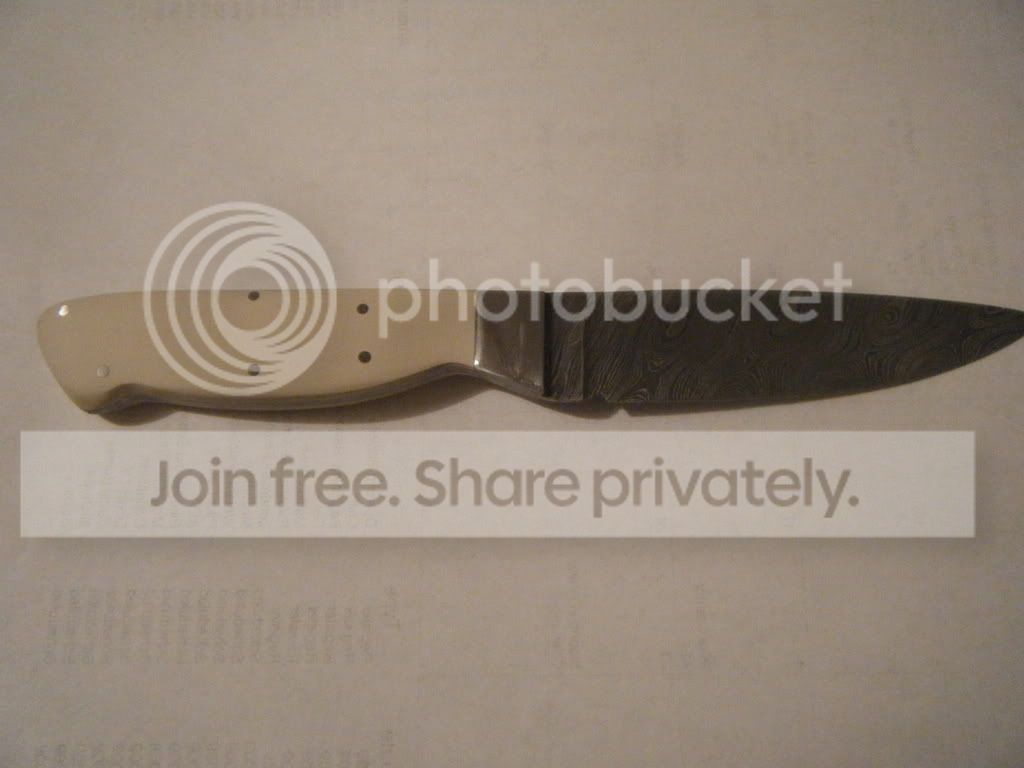
Here are some pics of my fourth knife, made some mistakes but learned what does not work:)
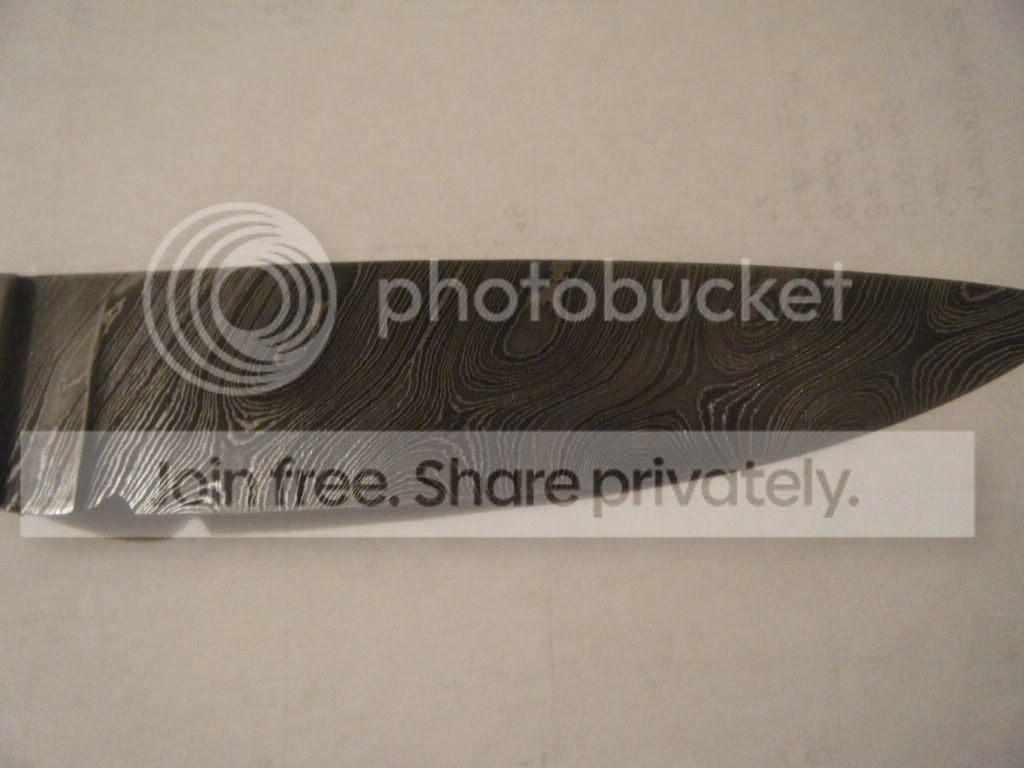
The blade is damascus that was given to me by a friend, sorry i cant remember what forge it is from.
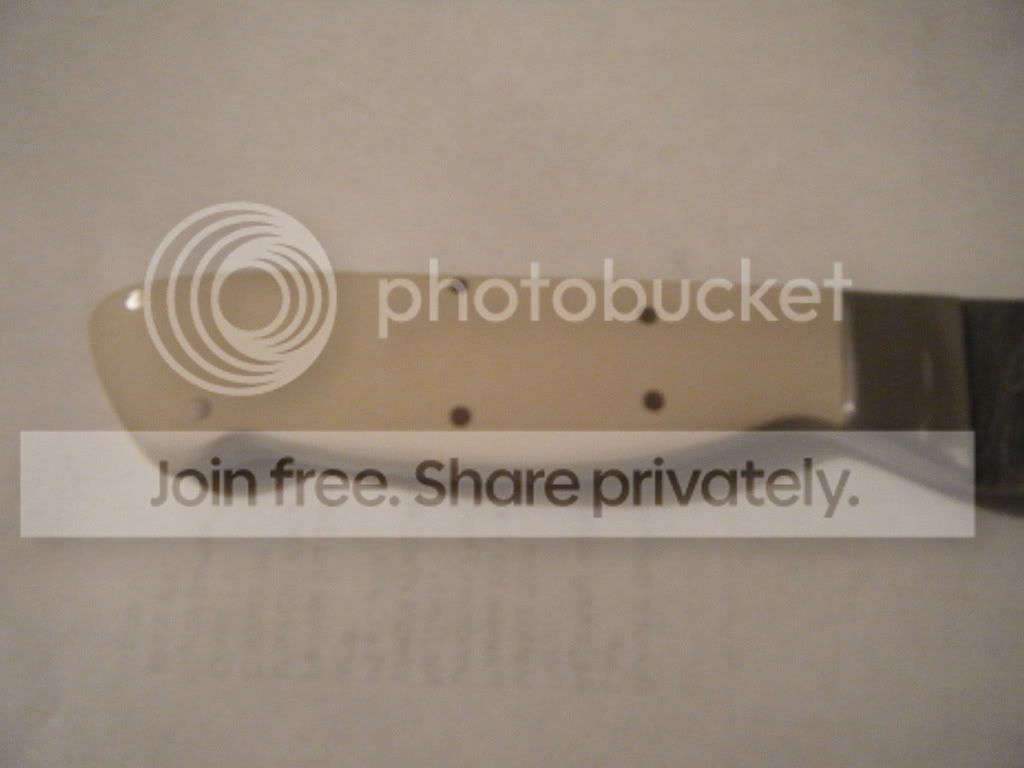
The gaurd and pins are stainless, handles are Ivory micarta
Still needs alot of hand finishing but just wanted to get some input, what could i change to make it better?:confused:
Sorry about the poor pic quality. I saw a poor mans pic booth on here that im going to build.
DSCF0308.jpg

DSCF0309.jpg

DSCF0311.jpg
 
Good looking knife. Since you asked for comments, I'll give you my two cents (and my opinions aren't worth much more than that...just ask my wife ;) ).

I would enlarge and move slightly forward the radius on the bottom front of the handle. Maybe use a one inch 1/2 round file to create a smoother radius, and move it forward so that it intersects with the bolster slightly. That way you have a radius to the bottom of your bolster instead of the straight diagonal line you have now. I don't even know that you have to move it forward any, but enlarging it would make it more pleasing to my eye and maybe more comfortable to hand as well. Also maybe slightly increase the radius of the cutout at the rear of the handle as well.

I also would have maybe brought that middle top pin down a bit. Seems close to the edge of the handle.

One other thing, I would either enlarge the choil slightly so that it intersects with the bottom of the ricasso, or in future knives, move it back some so it intersects. The slope into the choil from the bottom of the ricasso looks a little off to me. You could probably take a dremel and grinding stone and accomplish that with this knife as well, if you wanted to.

Again, just my opinion for what it's worth, and more suggestions than criticism. It really is a lovely looking little knife for a 4th one! I love damascus with ivory micarta.

Great job!

--nathan
 
I think it looks good. Other than the finishing that you have left to do, I think maybe the placement of the pins on the handle would look better in a more of a symetrical pattern. Other than that looks great for a fourth knife.

-frank
 
Nice knife, especially for the fourth one. Since you asked, I'll point out what I would pay attention to next time. Your grinds looks good.

- Try to keep your pins symmetrical about the center line, or center curve, of the handle. Pins that are out of place stick out like a sore thumb. It doesn't really do anything for strength, but it makes it much more pleasing to look at.

- Your choil is a little far forward, atleast by my standards. It is also an odd shape, but perhaps that's the photo. Small choils, in my mind, look the best when they have a small radius, like a small chainsaw file, and line up with the plunge cut.

Hope that helps.

Take care,
Brook
 
Last edited:
Thanks for the prompt and honest input guys, thats the only way i can improve.
The pins seem to be giving me trouble, Ive thought about drawing intersecting lines before i drill to get them lined up. On this one I thought i had a little better pattern until i already had it pinned.
As for the choil, it was a boo boo, will move it back.:)
Also I think I will increase the radius behind the bolster.
Keep 'em coming!
 
I use a set of calipers to measure in from edges to make sure I have everything as even as possible before drilling. Mark it with a sharpie, then step back and look at it from different angles. I sort of blur my vision a bit and that allows you to really just see the pattern and spacing on the handle without being overwhelmed by the details. I do the same thing when looking at my knife profiles. For profiles, also hanging it up so that it is backlit (in a window, for instance) will give you a chance to really see the shape.

Also, set the pins far enough in so that as you shape the handle, you don't end up with the pin on the edge of the handle as it curves as in your top middle pin. Also try and space them as evenly as possible down the length of the handle. Again, I use calipers to make sure I have the spacing nailed down.

--nathan
 
Wait to drill your holes until you are positive that you won't change the profile of the tang anymore. I usually make hidden tang knives, but when I do a full tang knife, I don't drill the holes until just before HT.
 
Same here. I drill just before heat treat, or actually just before I hand finish in prep for heat treat.

--nathan
 
looks real nice just need to measure better for pin place ment they are off .very pretty damascus
kellyw
 
don'tcha just love the way we share info - I've been making knives for 10 years and I'm still learning things from a new maker's thread.

"I use a set of calipers - - -'

Thanks Nathan - I've always eyeballed mine. When it works, it looks great. but, when I miss, it's UGLY!! From now one, I'll measure with calipers.

Kelly - I can't add anything to what the others have said. I agree with them. and - Great 4th - wish my 4th had looked that good.
 
Last edited:
Hi - I don't think you need to change much of the shape, the knife flow looks decent to me. Here are my suggestions:

Do all of your hand finishing of the blade before you put the handle on. Don't be tempted, I know you want to see the knife, but it's always easier to work on when it's just a blank.

I also agree that your sharpening notch is a bit off, most folks shoot for half in the grind, half in the unground portion of the ricasso. If you make mistakes, it's not so bad to push it forwards some, but it looks better if it doesn't start beyond the plunge.

For pin placement, you want to try and form some shape or symmetry with the pins. You can measure them, but I think you really just need to lay them out on the tang with a sharpie. If they don't look right, erase and draw them again. Spend some time looking at the knife, you really need to look at it and tell yourself if the holes need to move. If you've got someone else around your place, ask them what they think of placement before you drill. Sometimes our eyes are kinder than a third party.
 
One more thing I forgot to mention. It makes sharpening a little easier if the edge extends below the ricasso just a bit. The way this blade is designed the user doesn't have much room for error when sharpening the blade and could easily scratch the ricasso on the stone.
 
For determining pin placement, you've had a lot of suggestions already, all of which I use. To quantify and add some of my own, here are the other suggestions, plus mine summarized.
  • Eyeballing pin placement works most of the time, but not all of the time.
  • Use a sharpie to lay them out on the tang before hand.
  • Drill pin holes just prior to heat treat.
  • Use calipers to lay out pins.
  • These last ones are additional ones from me.
  • If only doing one line of pins down the center (actually doesn't pertain to the knife you asked about, but...), try to keep pins lined up in the center of the handle or ever so slightly above center (never below center line). It just looks better centered or just above center.
  • Trace the entire knife and tang on paper with a pencil 4 or 5 times. Then layout the pins with a pencil in 4 or 5 different configurations, until you hit on the one you like best. You'll find that about 50% of the time, you're changing the shape of the tang, just from your drawings, deciding that the layout would look better with a slightly modified tang. I can't stress how much paper and pencil I use in my shop!!! It's kind of like the measure twice, cut once rule. I draw it many times, then create it in steel.
 
I don't agree that the edge should necessarily extend beyond the ricasso, the only real purpose his notch there has is to aide sharpening.
 
Acrid Saint,

Yeah, there are many ways to cut the choil in. I was only referring to my preference and not stating that all knives should be that way. My point was that it aids in sharpening even more when the edge extends below the ricasso, even if only 1/16". I am meticulous when I sharpen a blade and pay close attention to the ricasso in relation to the stone, so I don't scratch it, but some people - for example, customers or friends that are given a knife - aren't always so patient and could easily scratch their prized knife. I try to consider those types of issues when designing a knife. Having said all that, you are correct, it's not necessary.
 
I guess I can see your side of it - I kind of assume that if they'll need to sharpen their knives regularly then they'll be doing work that could affect the finish or they'll just send the knife back to me. If it's a hard use knife, a small protrusion of edge will be sharpened away rather quickly anyhow.
 
For those who stumble into this thread. He reopened another thread after doing some work on the knife.
 
Back
Top