
-
The BladeForums.com 2024 Traditional Knife is available! Price is $250 ea (shipped within CONUS).
Order here: https://www.bladeforums.com/help/2024-traditional/
You are using an out of date browser. It may not display this or other websites correctly.
You should upgrade or use an alternative browser.
You should upgrade or use an alternative browser.
Frame lock stronger then hidden liner lock?
- Thread starter nozh2002
- Start date

- Joined
- Jan 18, 2007
- Messages
- 34,032
Right! You are very right!

- Joined
- Aug 27, 2004
- Messages
- 12,957
Its not just Striders though. If you start looking you'll see its the majority.
I think people expect more out of liner locks than what they were originally intended for. Mostly these were made and appealed to folks that carried and used or grew up with slip joints before the days of many convenient locking folders available from production companies. When Walker invented it in conjunction with Mr. Lake I think they, like many of us that grew up with slip joints had noticed some of the electricians knives with the locking screw driver and a brass lock that functions much the same way as a modern liner lock does.
This simple brass lock was not meant for anything other than a safety side lock system for a slip joint to work in conjuction with the back spring to keep a tool from closing. Blade or tool play developed on these quite often but since the back spring was there it was never any issue for most good ole boys carrying these knives. For some the lock was a hinderance that got in the way when they were done and wanted to close the tool as I know some that removed that nuisance lock. Many others just accepted that it worked fine even if the screwdriver could move a little but at least it would not close. Notice they never put the lock on the blade but instead, the screw driver because they knew people had sense enough to not do the same things with a blade that they would want to do with the screwdriver. Or so they thought.
So. Walker and Lake knew immediately the lock for a blade, especially one with no backspring would have to be more reliable and secure and lots stronger but also that it would not suffice to be work hardened brass to meet all these requirements. Even still some of the first ones were infact brass though and some did get made and used on slip joints. I believe Kershaw is still making one of these in a two blade model in two different sizes.
It seems to me the original intent of the Walker liner lock was because of seeing a need to keep that sharp a$$ blade from accidentally closing on your hand or fingers during use in rare situations only. I mean, normal use, like the same uses you would have used a slip joint for where sometimes you would maybe thrust it forward a bit in a cut and notice that the force of some movements and uses of it tested both the back spring and the skill of the user.
I don't think anyone had thoughts then of putting them to tactical uses and chopping or heavy duty hard wear forces and uses of this lock like we see it being used for today. The liner locks were simply no more than a lock like that on an electricians folder screwdriver, but beefed up a mite to make up for no backspring to help out. It appealed to those that had maybe had an accidental closing during normal use with a slip joint and to be honest that was what appealed to folks about them not war time heavy duty tactical use. Due to the folks buying these locks, which typically were slip joint owners that used their knives like slip joints were used they worked fine and many just accepted the blade play as no big deal because at least the blade didn't close on them. Anyone that has used one of the screwdriver blades and really used it I mean can attest to how long those lasted and how unreliable they are if you really pushed it too far. Granted stainless and titanium are much better but the stresses are still greater than the lock can actually take based on the number I repair in any given year.
People wonder all the time how these so called heavy duty liner locking folders can develop play so soon after buying them or why the lock travels all the way across the blade within the first year (or sooner) of use and I think its simply because they are being used for things they were never actually capable of doing or intended for but can do everynow and then. You use a liner lock heavy and I mean really use it pretending it can begin to keep up with a good lockback or axis lock folder and give it a work out daily in the field it won't take long to see what happens to it. I can guarantee you that it will get old and see retirement or a repairman sooner rather than later. You may not hear about it from the manufacturers but believe me they fix and replace their fair share of locks of this type every year.
When Chris Reeve saw this wear issue with liner locks he came up with his answer to this problem in his frame lock and its a much better solution to the problem he saw but not full proof. Its certainly better than the liner lock for hard wear and heavy uses though and a step in the right direction. The thicker liner locks are probably a step in the right direction but honestly they could be made with a similar access on the lock side like the one cut out or ramped for releasing the lock and this alone would make them a lot more secure than the ones that don't have that feature.
An integral lock maker once told me that making liner locks is like raising a child and building him/her up as best you can with all they need to go out into the world only to find that just because it left home doesn't mean it left for good. In other words they come back to see you everytime they have a problem. Even the guys that only make small light duty gents folders of this type get them back so you can just know from this that guys making them as hard use tacticals see their fair share also. It goes with the territory.
STR
I think people expect more out of liner locks than what they were originally intended for. Mostly these were made and appealed to folks that carried and used or grew up with slip joints before the days of many convenient locking folders available from production companies. When Walker invented it in conjunction with Mr. Lake I think they, like many of us that grew up with slip joints had noticed some of the electricians knives with the locking screw driver and a brass lock that functions much the same way as a modern liner lock does.
This simple brass lock was not meant for anything other than a safety side lock system for a slip joint to work in conjuction with the back spring to keep a tool from closing. Blade or tool play developed on these quite often but since the back spring was there it was never any issue for most good ole boys carrying these knives. For some the lock was a hinderance that got in the way when they were done and wanted to close the tool as I know some that removed that nuisance lock. Many others just accepted that it worked fine even if the screwdriver could move a little but at least it would not close. Notice they never put the lock on the blade but instead, the screw driver because they knew people had sense enough to not do the same things with a blade that they would want to do with the screwdriver. Or so they thought.
So. Walker and Lake knew immediately the lock for a blade, especially one with no backspring would have to be more reliable and secure and lots stronger but also that it would not suffice to be work hardened brass to meet all these requirements. Even still some of the first ones were infact brass though and some did get made and used on slip joints. I believe Kershaw is still making one of these in a two blade model in two different sizes.
It seems to me the original intent of the Walker liner lock was because of seeing a need to keep that sharp a$$ blade from accidentally closing on your hand or fingers during use in rare situations only. I mean, normal use, like the same uses you would have used a slip joint for where sometimes you would maybe thrust it forward a bit in a cut and notice that the force of some movements and uses of it tested both the back spring and the skill of the user.
I don't think anyone had thoughts then of putting them to tactical uses and chopping or heavy duty hard wear forces and uses of this lock like we see it being used for today. The liner locks were simply no more than a lock like that on an electricians folder screwdriver, but beefed up a mite to make up for no backspring to help out. It appealed to those that had maybe had an accidental closing during normal use with a slip joint and to be honest that was what appealed to folks about them not war time heavy duty tactical use. Due to the folks buying these locks, which typically were slip joint owners that used their knives like slip joints were used they worked fine and many just accepted the blade play as no big deal because at least the blade didn't close on them. Anyone that has used one of the screwdriver blades and really used it I mean can attest to how long those lasted and how unreliable they are if you really pushed it too far. Granted stainless and titanium are much better but the stresses are still greater than the lock can actually take based on the number I repair in any given year.
People wonder all the time how these so called heavy duty liner locking folders can develop play so soon after buying them or why the lock travels all the way across the blade within the first year (or sooner) of use and I think its simply because they are being used for things they were never actually capable of doing or intended for but can do everynow and then. You use a liner lock heavy and I mean really use it pretending it can begin to keep up with a good lockback or axis lock folder and give it a work out daily in the field it won't take long to see what happens to it. I can guarantee you that it will get old and see retirement or a repairman sooner rather than later. You may not hear about it from the manufacturers but believe me they fix and replace their fair share of locks of this type every year.
When Chris Reeve saw this wear issue with liner locks he came up with his answer to this problem in his frame lock and its a much better solution to the problem he saw but not full proof. Its certainly better than the liner lock for hard wear and heavy uses though and a step in the right direction. The thicker liner locks are probably a step in the right direction but honestly they could be made with a similar access on the lock side like the one cut out or ramped for releasing the lock and this alone would make them a lot more secure than the ones that don't have that feature.
An integral lock maker once told me that making liner locks is like raising a child and building him/her up as best you can with all they need to go out into the world only to find that just because it left home doesn't mean it left for good. In other words they come back to see you everytime they have a problem. Even the guys that only make small light duty gents folders of this type get them back so you can just know from this that guys making them as hard use tacticals see their fair share also. It goes with the territory.
STR

nozh2002
BANNED
- Joined
- Jun 9, 2003
- Messages
- 5,736
That is why I won't buy a strider.
Please, open your own thread and start all this there, I particualry asked at the begining not to have it here, I want to clearify this questions - if you want fight, please do it in other place!
So far discussion was pretty reasonable. Why do you start calling names - you want to trash this thread?
Thanks, Vassili.

- Joined
- Jul 16, 2005
- Messages
- 2,150
That would have definetely been a fixed blade situation for me.This post pertains to the twisting of a liner lock. This past year i was bowfishing in louisiana for alligators. the first 9 footer we pulled in the boat my buddy went to finish it off with a nice prouduction Emerson liner lock. He stuck the croc in the back of the neck trying to cut his spine and luckily the knife was in deep enough that when he put some torque on the blade the knife shut and only cut one of his fingers. I promptly handed him a fixed bladed knife and he finished the job. Now you can't expect a folder to work as a fixed blade like the gentlemen posted and i am not saying anything bad about folders i was just replying to the gentlemens question about folders shutting when twisted or torqued. I like folders and have a large collection of them they have there place. But anytime i think i may really need a knife i carry a fixed blade you never know what your gonna get into. I think the meat of his hand must have pushed on the liner and caused it to shut

- Joined
- Oct 3, 1998
- Messages
- 4,842
Heh, sounds like a good fixed blade situation to me too. But, the thing is, there's any number of folders that'd work just fine. There's always tons of stories like this, and the vast majority seem to be about liner locks, which gives anecdotal backup to testing evidence. People who like liner locks complain that "folders can fail", but they seem to ignore the fact that when we hear stories of folders failing, 9 times out of 10 it's a liner lock that's done the failing. You practically have to stick your head in the ground not to see something fundamentally difficut about manufacturing the format. Apologies nozh if this is wandering off topic, but I think it's at least vaguely on-topic.
Vassili, one of the best liner locks I've tested was a gentleman's folder with an incredibly thin titanium linerlock. The maker and I put so much stress on the blade that the liner flexed at an outrageous angle. But, we were never able to get that liner to pop off. That's one of many cases that has convinced me that if you get the lock/tang geometry right, thickness or thinness of the liner does not matter. A thicker liner does nothing but give the maker a margin of error on the lock/tang geometry -- it allows him to make small mistakes on the geometry and still be okay. But if liner thickness were the prime determining factor, there wouldn't be so many rock solid thin liner locks, or so many thicker liners that fail. Thick liner = more margin of error, but lock/tang geometry = reliability or not.
msiley, no doubt framelocks can be susceptible to counterclockwise torque for the reason you mention (assuming a righty framelock). My theory as to why we don't see more of this in real life: by the time you're torquing hard, you've probably already held the knife very firmly so the lockup is already reinforced significantly.
gunmike1: gotcha, agreed!
Joe, So what you are saying is I can feel comfortable paying $450+ for the Lambert or Lightfoot LinerLock Folders they produce and sleep well at night.I emailed both makers and it seems liners are their forte. I haven't spent more than $150 on a linerlock, all Emersons. I have been happy with them buy all my high end folders are framelock. I just find it interesting my Obanauf and XM18 Hinderer framelocks were less than $400.
MPE
nozh2002
BANNED
- Joined
- Jun 9, 2003
- Messages
- 5,736
Apologies nozh if this is wandering off topic, but I think it's at least vaguely on-topic.
Oh, you should not, I just saw so many times discussion turned urgly, when names were called. Some people just lurkng around looking for excuse to fight and I do not want it. But intellegent discussin on related issues is just excellent.
I learn something out of this discussion and it is pretty interesting. But what do you think fundamentally is weak in liner locks? I mean there is some pretty solid and some has additions like safety button or like Microtech spring bar - did it make it better? ANd what about that gentelman liner lok you did test?
In general I guess what do you think to look for to understand is this lock better or not.
I guess most important advantage is easy-to-manufacture.
Thanks, Vassili.
In my own experience, I have some liner locks that lock up solid even after years of on/off use (i.e., two BM Strykers, a Spyderco 440V Military, etc.). Then there are others that start to wear very quickly, without much use at all.
For example, I have a couple of liner locks that I soon discovered would start to 'pop off' the blade with moderate hand pressure to the blade spine, though not yet just fully close. On closer inspection, I realized both had a very steep angle at the blade tang/liner lock mating surface. I compared the angle to my long-lived and reliable ones, and those were not very steep in comparison, and the mating surface on those were more of a gentle "concave" angle.
Besides being easier to slip off of, I believe the very steep angle on the tang mating surface simply grinds away at the liner lock much more rapidly.
Jim
For example, I have a couple of liner locks that I soon discovered would start to 'pop off' the blade with moderate hand pressure to the blade spine, though not yet just fully close. On closer inspection, I realized both had a very steep angle at the blade tang/liner lock mating surface. I compared the angle to my long-lived and reliable ones, and those were not very steep in comparison, and the mating surface on those were more of a gentle "concave" angle.
Besides being easier to slip off of, I believe the very steep angle on the tang mating surface simply grinds away at the liner lock much more rapidly.
Jim

- Joined
- Mar 18, 2006
- Messages
- 520
Lock failure resulting from poor design by reputable mfgs. is so rare it's not much of an issue beyond the campfire (or forum). It is, however, worthwhile to view the lock under magnification to see: the ramp is not too steep, the leaf stays in the middle third EVERY time it's opened and then with pressure applied to the blade, that the leaf angle matches the ramp angle front to back, that every thing is aligned. Lock backs should have the notch and back spring angles at nearly 90 degrees. These should be checked after hard use and always on a any new knife that may see hard use.
Failure resulting from misuse is more common. Locks are intended to prevent accidental closing, not to guarantee against closing under any possible circumstance. Gunk in the works is often the prime suspect.
I print this not to state the obvious or to preach, but to celebrate why slips and fixed blades (especially for alligators) are not yet obsolete and may never be. Slips are just as safe as they were 100 years ago and still have a place in our pockets.
Feel free to jump on me with both feet (no studded wading soles please).
Failure resulting from misuse is more common. Locks are intended to prevent accidental closing, not to guarantee against closing under any possible circumstance. Gunk in the works is often the prime suspect.
I print this not to state the obvious or to preach, but to celebrate why slips and fixed blades (especially for alligators) are not yet obsolete and may never be. Slips are just as safe as they were 100 years ago and still have a place in our pockets.
Feel free to jump on me with both feet (no studded wading soles please).
- Joined
- Sep 4, 2004
- Messages
- 1,670
That's one of the best posts I've ever read, STR.Its not just Striders though. If you start looking you'll see its the majority....
Thick titanium framelocks with long leafs and "flat" ramps will, in my experience, always work better than thin, short leaf stainless liner locks with steep ramps.
I have a Buck Tarani and SnG to visually compare side by side. The first Buck would walk out of engagement with hand pressure, although I admit to lightly spinewhacking it on a leather covered steering wheel when I found out. The replacement flexes under hand pressure and pops out with a spinewhack.
Framelocks resist hand twisting better because they are stiffer, have more frictional area in contact, and a longer leaf to minimize sideways deflection with the accompanying flatter ramp. Kershaw does it right with the Vapor II, so its not a matter of price, just proper execution.
Of course, I have a Boa in liner lock that won't. I discovered this with hand pressure - like STR said, doing a cut I wouldn't have with a slip joint. So, it's not a matter of price, just proper execution.
I think part of the better lockups with titanium are because of the inherently higher galling factor of the metal - it simply is stickier, therefore less likely slide under pressure. Some stainless used in liners is probably much lower, or ineffective in the thin stock used.
Thanks for the pictures, STR. It shows that regardless, a framelock still must be shaped with close tolerances regardless of maker, waved or not.
I have a Buck Tarani and SnG to visually compare side by side. The first Buck would walk out of engagement with hand pressure, although I admit to lightly spinewhacking it on a leather covered steering wheel when I found out. The replacement flexes under hand pressure and pops out with a spinewhack.
Framelocks resist hand twisting better because they are stiffer, have more frictional area in contact, and a longer leaf to minimize sideways deflection with the accompanying flatter ramp. Kershaw does it right with the Vapor II, so its not a matter of price, just proper execution.
Of course, I have a Boa in liner lock that won't. I discovered this with hand pressure - like STR said, doing a cut I wouldn't have with a slip joint. So, it's not a matter of price, just proper execution.
I think part of the better lockups with titanium are because of the inherently higher galling factor of the metal - it simply is stickier, therefore less likely slide under pressure. Some stainless used in liners is probably much lower, or ineffective in the thin stock used.
Thanks for the pictures, STR. It shows that regardless, a framelock still must be shaped with close tolerances regardless of maker, waved or not.

- Joined
- Dec 2, 1999
- Messages
- 12,249
No flames hopefully, I think this is on topic. IMO the angle of the blade tang is critical for either liner lock or integral lock. This has already been mentioned.
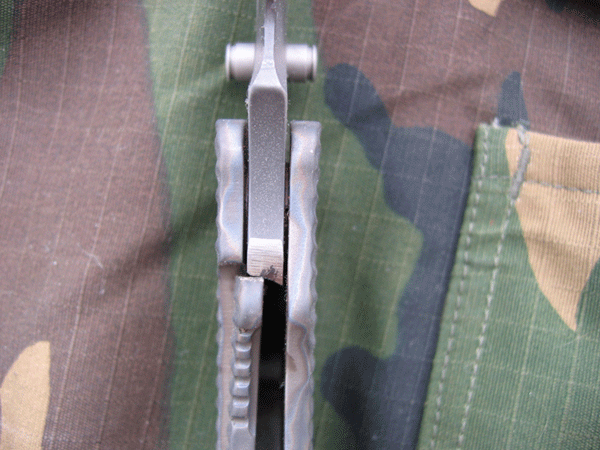
Also to add to what STR has said, I've seen this on other knives as well. The above is just an example.
My issue is this, observe how the tang of the blade is ground above. The first part is very flat, then the angle increases VERY sharply. IMO, what's happening is makers are throwing the precision needed to get good lock fit out the window. The first part of the tang lets the lock bar slide over, but the remaining angle is too steep to take up blade play. The result is the lock has play and slips even though it covers the first part of the tang, but it can never wear enough to match the angle on the other part of the tang.
Also to add to what STR has said, I've seen this on other knives as well. The above is just an example.
Engine designers long ago sealed valves to seats with a 44 and 45 combo valve to valve seat interference.
As a press brake operator, I can see that it's hard to get something in production to stay within one degree. Grinding is probably no easier, as the wheels degrade and lose precision in the very process of creating it in the steel. This controlled by the operator on the production floor.
It's long been said that if the boss doesn't check, it's not important, and bosses have to learn to prioritize their work day to keep the important things important. We need to politely remind them of that as necessary, and letting them know about their product helps.
As a press brake operator, I can see that it's hard to get something in production to stay within one degree. Grinding is probably no easier, as the wheels degrade and lose precision in the very process of creating it in the steel. This controlled by the operator on the production floor.
It's long been said that if the boss doesn't check, it's not important, and bosses have to learn to prioritize their work day to keep the important things important. We need to politely remind them of that as necessary, and letting them know about their product helps.
- Joined
- Oct 3, 1998
- Messages
- 4,842
Framelocks resist hand twisting better because they are stiffer, have more frictional area in contact, and a longer leaf to minimize sideways deflection with the accompanying flatter ramp. Kershaw does it right with the Vapor II, so its not a matter of price, just proper execution.
The issue of stiffness is a good one to bring up. It makes sense that most framelocks, with big thick metal handle slabs, will be stiffer. There is no doubt that part of the torquing problem is due to the lock/tang geometry change as the whole piece flexes. In fact, earlier in this thread I mentioned a little gents' folder with a very thin liner lock that held rock solid -- one of the interesting design points was that aside from the major 3 screws, the maker put a bunch of pins between the handles, which I assume helped keep the frame stiffer and more resistant to torque.
Thick titanium framelocks with long leafs and "flat" ramps will, in my experience, always work better than thin, short leaf stainless liner locks with steep ramps.
Framelocks resist hand twisting better because they are stiffer, have more frictional area in contact, and a longer leaf to minimize sideways deflection with the accompanying flatter ramp. Kershaw does it right with the Vapor II, so its not a matter of price, just proper execution.
I think I would have to disagree on the most part: Ti is softer than steel (in particular hardened steel, and the liner of the liner lock is hardened, though differently than the blade steel) and therefore much more prone to deformation, the contact area could be larger in principle but usually isn't and stiffness is very much a matter of construction. One of the stiffest folders I have ever had in my and is the CF Mili. The CF just makes this knife very, very stiff. So depending on scale materials and thickness is should be possible to make a liner lock that is stiffer than a frame lock. And I don't see how a long leaf would help reducing deflection. I would rather think the oposite is true. And finally, under significant loads the liner slips due to deformation of th leaf, which can be equally large on both designs depending on how thick the cutout on the framelock leaf is. I mean the framelock leaf is not the same thickness throughout, but has some cutouts to make the leaf operable (otherwise the leaf would be to stiff to disengage).
I am not trying to say that linerlocks are better than framelocks. I just think that it is necessary to take a very close look at what kind of liner lock you comparing with what kind of famelock, and often the comparison ends up being one between a $100 linerlock and a $400 framelock which I think is not quite fair (even though, as seen, price is no guarantee of quality).
Yes, price is no indicator. And the CF Military is a great example of how to do it right.
Ti being softer is why it may work better in the lock - it grabs the inherent roughness of the steel ramp, which creates more friction. I don't worry about the Ti wearing out because two different hardness metals in contact always causes the harder one to wear first - in this case, the blade ramp.
I think the length of the liner leaf is critical to performance because it allows a flatter ramp angle. Short leaf liners inherently have steeper angles which allow more side thrust to push the leaf out of engagement. Cutouts on the framelock leaf are only handling compression loads; side deflection forces will overcome the lock ramp engagement long before the cutout gets to yield pressures.
I see better performance with longer leafs, frame or liner. Short leafs don't do the job as well, or have to have other compensations.
Ti being softer is why it may work better in the lock - it grabs the inherent roughness of the steel ramp, which creates more friction. I don't worry about the Ti wearing out because two different hardness metals in contact always causes the harder one to wear first - in this case, the blade ramp.
I think the length of the liner leaf is critical to performance because it allows a flatter ramp angle. Short leaf liners inherently have steeper angles which allow more side thrust to push the leaf out of engagement. Cutouts on the framelock leaf are only handling compression loads; side deflection forces will overcome the lock ramp engagement long before the cutout gets to yield pressures.
I see better performance with longer leafs, frame or liner. Short leafs don't do the job as well, or have to have other compensations.

- Joined
- Apr 12, 2000
- Messages
- 2,116
I would be nice to know the breaking strength of the popular frame locks on the market. Large Sebenza, Camillus Dominator, Benchmade Skirmish and mini-skirmish, etc. If it's at least 200-300 pounds, which is probably is, that's probably way more force than I would ever put on a knife, even if I was hanging from it. 