Here is a question, why is the cut out on frame locks so deep on the lock? It seems to me that it would be the major weak point of the lock itself. I have a 12 and the cut out is very deep and the ti is very thin at the cut out. So why is this? thanks and keepem sharp

-
The BladeForums.com 2024 Traditional Knife is available! Price is $250 ea (shipped within CONUS).
Order here: https://www.bladeforums.com/help/2024-traditional/
You are using an out of date browser. It may not display this or other websites correctly.
You should upgrade or use an alternative browser.
You should upgrade or use an alternative browser.
Frame Locks
- Thread starter longbow
- Start date

- Joined
- Nov 1, 2000
- Messages
- 28,365
I wondered the same thing. Take a look at the HD7 as well. Same problem.
- Joined
- Jan 6, 2009
- Messages
- 639
I also dont kniw the answer but if i had to guess....material has been removed and then during a heat treat process due to less material it causes a bend somehow?

- Joined
- Nov 17, 2008
- Messages
- 3,654
If I had to guess, I'd say that the cut out is there to make the lock bar easier to disengage. If, say, a ZT 551 didn't have any material removed from the frame lock bar, it would be nigh-impossible to push the lockbar out of the way and disengage the lock.

I don't buy that line of reasoning at all. I have had many liner locks that were extremely thick and they might have had a little of the locking side removed and I mean little yet they didn't give me any problem when disengaging the lock. Some that come to mind are the BUCK 800, 5.11 First Responder, Ontario's folder that is huge the Hossom Retribution I think it is called. Others too I am sure. I don't know if you can make a locking bar at .125" or even slightly thicker without a huge cutout why not a frame lock? Just does not seem reasonable to me.
My 12 is paper thin on the cut out. Does not inspire confidence by any stretch of the imagination although I assume it is. Haven't heard other wise. Anyways thanks for the opinions but definitely wondering. keepem sharp
My 12 is paper thin on the cut out. Does not inspire confidence by any stretch of the imagination although I assume it is. Haven't heard other wise. Anyways thanks for the opinions but definitely wondering. keepem sharp

Kaizen1
Gold Member
- Joined
- Jan 4, 2006
- Messages
- 6,314
The weakest points on a framelock during vertical stress will generally come down to the:
-Stop pin
-Pivot
-lock bar cutout
-Point where the lock bar face meets the tang
I've seen a CQC-12 with a ridiculously thin cutout and that was just unnecessary. If the cutout is only there to allow disengagement of the lock (or some degree of convenience to do so), then there's no reason for it to be thinner than a comparable folder with a liner lock. My understanding was that was just an anomaly. I have seen other 12s with thicker cutouts than the one I was just talking about so I didn't think it was a problem.
-Stop pin
-Pivot
-lock bar cutout
-Point where the lock bar face meets the tang
I've seen a CQC-12 with a ridiculously thin cutout and that was just unnecessary. If the cutout is only there to allow disengagement of the lock (or some degree of convenience to do so), then there's no reason for it to be thinner than a comparable folder with a liner lock. My understanding was that was just an anomaly. I have seen other 12s with thicker cutouts than the one I was just talking about so I didn't think it was a problem.
My last two buys BM 760 and 755 both have framelocks. And both have surprisingly weakened framelocks. That is the only fault I see in both knives. And a serious fault from my point of view.
What is wrong with them - why they do it? Do not understand why they weaken the lock even further, I do not think there is any call for that.
What is wrong with them - why they do it? Do not understand why they weaken the lock even further, I do not think there is any call for that.
Last edited:

- Joined
- Nov 9, 2009
- Messages
- 44,314
My last two buys BM 760 and 755 both have framelocks. And both have surprisingly weakened framelocks. That is the only fault I see in both knives. And a serious fault from my point of view.
What is wrong with them - why they do it? Do not understand why they weaken the lock even further, I do not think there is any call for that.
2 things:
1- What does the bold part of your post mean exactly? In as much detail as you can, what is a "weakened framelock" mean?
2- Can you build a better frame lock? What models have you made that are better or equivalent to the Emerson HD-7, Benchmade 755, or Spyderco Military Ti?
I'm sure Ernie, Sal, and Shane would love to know what they have been doing wrong all this time.

- Joined
- Sep 10, 2010
- Messages
- 3,950
I haven't owned that many Ti framelock knives but I have the same concern. The Ti on my sage 2 and leafstorm was so thin it just did not look sturdy at all. Im not a big fan of Ti framelocks in general because I feel like you have to baby them. You can't flick them open and you have to be careful when disengaging them that you don't bend the Ti too far back. I would definitely buy a Ti framelock again but it is not my favorite.

- Joined
- Nov 24, 2005
- Messages
- 10,038
I haven't owned that many Ti framelock knives but I have the same concern. The Ti on my sage 2 and leafstorm was so thin it just did not look sturdy at all. Im not a big fan of Ti framelocks in general because I feel like you have to baby them. You can't flick them open and you have to be careful when disengaging them that you don't bend the Ti too far back. I would definitely buy a Ti framelock again but it is not my favorite.
Hinderer & Strider are 2 of the hardest use folders and both are ti framelocks. Rick Hinderer posted openly in a forum about wrist flipping his XM-18 & said to "flip the hell out of his folder."
Look at the custom IKBS and roller thrust bearing flippers - ti framelocks and those babies really come blasting out. How about speed assist ZT 030X series ti framelocks? Baby any of these? I don't think so.

- Joined
- Nov 1, 2000
- Messages
- 28,365
I don't buy that line of reasoning at all. I have had many liner locks that were extremely thick and they might have had a little of the locking side removed and I mean little yet they didn't give me any problem when disengaging the lock. Some that come to mind are the BUCK 800, 5.11 First Responder, Ontario's folder that is huge the Hossom Retribution I think it is called. Others too I am sure. I don't know if you can make a locking bar at .125" or even slightly thicker without a huge cutout why not a frame lock? Just does not seem reasonable to me.
I agree. I own a Buck 880 and have 2 Ontario/Hossom folders at Reese's shop. Very well executed liner/frame locks.
i think what we have here is a perception of weakness that doesnt exist. were talking a part of the lockbar thats usually wider at the notch than it is at the blade. id not second guess the engineering if you didnt have some evidence to back up your concerns. there are too many high quality knives that use this type of lock and its a proven system. This thin section might be weaker than if it had not been cut or notched but i havnt seen where one has failed at this point. and i think its pretty obvious that it might take super human strength to operate one that was uncut.
- Joined
- Nov 1, 2000
- Messages
- 28,365
Well, then, uh... I'd like the perception of strength too!

- Joined
- Aug 27, 2004
- Messages
- 12,957
My last two buys BM 760 and 755 both have framelocks. And both have surprisingly weakened framelocks. That is the only fault I see in both knives. And a serious fault from my point of view.
What is wrong with them - why they do it? Do not understand why they weaken the lock even further, I do not think there is any call for that.
There are many reasons why lock cuts are done as they are in the industry. Simply put its for reasons involving making for a more 'liner lock like' easy, smooth action for the blade as it rolls opened and closed but its more than this really. It is true that most makers and manufacturers like covering the bases to please the majority. The minority that would rather have the thicker lock cut really don't seem to understand at times that many would complain about the stiff action and resistance to the lock feeling that it fights them when they want to close the blade. You can certainly make locks from slabs of steel or titanium and leave the lock cut thicker than most are and thats a proven fact as many have done this from time to time including myself but there is a price for that when you do it. To some this is an advantage and to others its not so its a matter of what you want and what you expect from your knife. I've done some .095 thick solid slab frame locks for folks only to get them mailed back to me after they got it asking me to please put a lock cut in it. It seems after they received it they realized it was nice for a short while but overall they found they didn't like it as much as they thought they would once they owned it a while.
The first thing noticed when you leave the dished out area in the lock thicker is the amount of lateral pressure exerted by the lock on the blade which equates to more resistance when you push the lock with your thumb to release the blade also. Sure it can mean its less likely to close by accident but with most uses thats not really an issue a lot of the time anyways. Noticed difference is going to be felt in a slab left pretty thick and it will be very hard to make a flipper model with a lock that has that much spring tension on it. It would be hard to flick them open at all really when you make your knives this way. Frankly it should be standard practice that any frame lock sold in New York be made so the lock has that much extra pressure on it because it may actually help to make them legal so cops will stop confiscating them as 'gravity knives but thats another story.

Second and perhaps something some of you have experienced with some of your knives is this. The detent ball is that ball bearing in the lock that is responsible for giving both a smoother opening and closing action by allowing the blade to ride on a similar hardness steel bearing but also to keep the tip down when closed. This ball in the lock can be pushed so hard into the blade on thicker slab locks that the ball flattens down at a much faster pace than it would with a thinned down lock cut. Fact is this can happen even on the thinner lock cut models so we can't kid ourselves here but it may take longer than one done thicker like we are speaking of in this thread. Its for this reason that it may not be worth mention because it can happen even with thin liner locks. The point is it could be almost overnight with one made such that the lock cut is very shallow leaving it fairly thick.
However, with this type of lock there are things probably worth mention that most don't think about. One is that the lock cuts when made thinner like we see in a lot of knives can make it easier to hyper extend the locks out the wrong way causing the lock to lose spring tension. This can obviously make the lock iffy for doing its job and can lead to vertical blade play and need for adjustment when it happens but its not something that happens frequently enough to really say its a big issue. When it does happen its usually a smaller frame lock model carried without the clip on it.
Many don't realize that many frame locks are set up with the pocket clip positioned such that it can double duty as a lock stop to some extent thus preventing or at least reducing the chances of a hyper extension of the lock out the wrong way. So, a thicker lock cut would make for a safer knife to carry clip less if you opted to carry that way. It would be harder to hyper extend the lock on a solid slab model as opposed to one .033 thick but the real question is not so much can it be done but which is the better way to do them. There is a price either way and when you really weigh the pros and cons I think most makers agree that most prefer an easy opening action and an easy to manipulate lock as opposed to one that only men can close. Some of my solid slab models were so stout my wife could not even begin to close the blade once it locked up.
STR
Attachments
- Joined
- Nov 1, 2000
- Messages
- 28,365
Makes me glad I never bought a Comrade MF. I'd rather have a 13 or custom 12.
- Joined
- Aug 27, 2004
- Messages
- 12,957
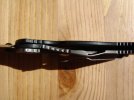
I knew it was only a matter of time before that HD-7 pic popped up.
Its worth showing I think and for good reasons. One, the lock did it's job on that HD7. If I ever experience a lock defeat of a frame lock during use I can only hope my knife would defeat the same way still securing the blade in the process. There are far worse ways to have a lock failure than what that pic shows thats for sure. In that type of situation where something has to give one has to wonder if it would really be smart to make the lock so strong that it forced something like the stop or a pivot screw head to pop instead of what we see there. In that case the defeat could be quite a bit more catastrophic than the controlled burn (so to speak) in the way that lock defeated.
STR
- Joined
- Apr 9, 2008
- Messages
- 1,319
I just had the stupidest idea ever.
How about we put the frame lock on a pivot, with a spring pushing it closed!
How about we put the frame lock on a pivot, with a spring pushing it closed!