Framelock overextension = Ruined?

Status
Not open for further replies.
The CRK Umnumzaans ceramic ball lockface solves the wear problem.
Even better, there is no friction sticking at the interface at all. None.
This knife has the smoothest release I’ve ever felt on a framelock.

Time will tell, but I’m betting this design will be the new standard for years to come.
The 21 year wait was worth it.

Good job Chris.
 
STR, the OP is not talking about over extension he is talking about the lock bar traveling all the way over the nonlocking handle side, i.e. wearing out. I would suggest he send the knives to you to do what you did to my MPF 3, when you peened the end of the lock bar.

OP, talk to STR he can probably fix your problems, I do know this I have seen many pictures and read several post on this topic and the sebenza here on this forum and there are plenty of sebenza's that get carried and used day in and day out and the lock up on them is pretty darn close to when it was new. Some of the knives I have seen were over 10 years old.

My mistake. I mis-read his description.

There are a couple ways to fix it. Peening is often done to the locks by more than one maker and manufacturer. This requires a skilled hand and the right tools though and I have never liked it for frame locks that much although it can work. Reeve covers his knives. I'd suggest sending it back to them. The natural wear to self correct is normal. I've seen a CQC12 frame lock for sharpening for the last four years going on five and the lock travels all the way across the blade contact even with a light opening and so far over it is apparently touching the G10 side but each year when I see it the owner of the knife is insistant that I only sharpen it and nothing more. There is no vertical play at all, and the lock up is probably more reliable as it is according to him than when he first got it. Seeing how long this folder has remained unchanged I'd suggest it is something that could also be very likely the case with the Sebenza but if you just want to have it adjusted or the lock replaced with a new unworn one that is your choice and should be discussed with Reeve knives. If there is no vertical movement and the lock isn't sticking real bad I'd use it and be happy for the very solid bank vault lock up until the day it does show some vertical movement. Then I'd send it in and let them do it so it does not void your warranty.

Increasing the size of the stop pin can refresh the lock but you can't always do this on all knives. Its dependent on how close to the edge of the body the head of the screw will be if its a screwed down type and dependent on what the choices for the next size up are and then there is also the other thing people that do this never think of and thats the fact that these type locks have a detent ball that is installed in the lock. These balls are what makes your folder legal in a lot of cases where they actually work and they do this by falling into a starter hole in the blade just as the blade comes to rest when closed and sits on the stop pin nice and neat.

Follow me here if you can. If you go from a 1/8" stop pin diameter that was in there to begin with and decide to bump that up to a 3/16" diameter stop pin to refresh the lock guess what? Its likely you'll find out that the blade tip now sticks up out of the folder slab sides when you try to close the blade. More, the detent is deactivated and since you drilled holes into both slab sides/liners or whatever to increase the size of the stop diameter you now have to adjust the blade to make it sit as it did on the smaller diameter stop. You will likely also have to adjust the blade just to rotate it past the new bigger stop if the tolerances are tight because the contact area of the blade will probably bump your new bigger pin as you swing the blade around trying to close it. If this is a black coated blade you'll have a nice shiny roughed up spot to deal with. If satin, some finish work to do, if bead blasted you'll have to reblast it and then resharpen after you dull the crap out of your blade in the blast cabinet. If you take too much metal off the blade when adjusting it to make your tip go down so its safe to carry and so your detent works you now have a situation where your blade falls deeper than it should when closed which can lead to the edge dinging on a stand off in the rear of the folder that spaces the sides or if the spacer is hard or metal in the rear it can hit that with your edge each time you close the blade.

This of course is still a problem even if the edge doesn't hit anything and you take off too much metal to make your adjustment because then the blade falling into the ball and then continuing on to close deeper causes you to get the same situation where your detent is not correctly working and the blade moves freely just for a bit with no real retention. If it moves enough to end up giving it momentum by flicking it makes it an illegal gravity knive by being easier to flick open by centrifugal force or from holding it upside down to see if a minor action of the hand and movement can make the point drop down out of the sides exposing it to cut things like your pocket or worse your hand and fingers.

Its not something I recommend you try doing or you'll end up getting in over your head. Its even tricky sometimes for guys that do it and have done it before but key to making this work is knowing when to leave well enough alone. In some instances you'd be far better off to just install a new detent at a new spot on the lock and mark the blade somewhere else for a new hole and a new ball trail than to leave it in an unsafe condition and in other situations this is not possible. Anyway, that may lose some of you if you can't follow what I'm picturing as I type. I apologize if so. Its clear to me but I was told recently I lost someone in the translation. :D
 
Last edited:
I thank you all for the helpfull responses.

I was hoping STR (the framelock expert) would chime in & I'm glad he did.Unfourtunately I only understood about 50% of what you said STR:o.
For instance,I don't know what peening means.

The 635 has been taken apart & cleaned/oiled,so I'm pretty sure that voids their warranty.However,I wouldn't mind paying a small fee for them to correct this.It's one of my favorite knives & I can't stand bladeplay.

I apologise for using the wrong term (overextension).What I really meant was wear.Where the lock travels all the way to the other side.

I'm mostly worried about this happening to a high end knife.I mean if I'm going to spend $400-$500 on a knife,I'd expect it to last a long time.

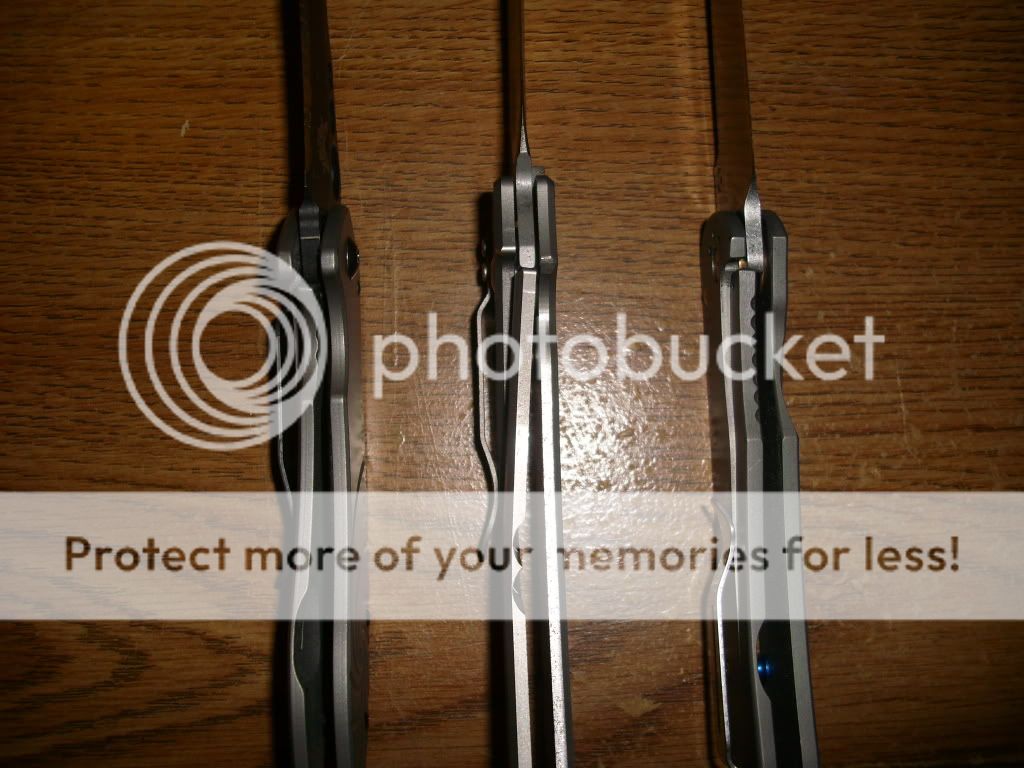
Here's a pic of three of my Ti framelocks to give you a better idea of what I'm talking about.The Bradley's still like new.The others have been used carried quite a bit.
From left to right-BM 635-CRKT S-2-Bradley Alias 1

DSCI0469.jpg
 
I was kind of purposefully vague on the peening because its something that when done wrong can really mess things up for folks so I didn't want to describe it too much. Using a flat end punch and a ball peen hammer cutlers have peened a specific point of the lock contact to quite literally and quite physically squish more of the lock material, read- lock contact, forward to tighten a contact and refresh a lock. It leads to stcking more often than not. As an example, I sent a 1998 Emerson SpecWar liner lock in to Emerson years ago for a lock that looked like your S2 and got it back peened a few weeks later and it will wear even the strongest thumb out when it sticks to this day. It has never quite gotten past that sticking and before peening the lock contact it never stuck at all. I retired the knife after this of course and still have it but its never going to be the same and although I could adjust it I opted to retire it instead since I rarely get it out much anymore at all.

The other problem is that when peening is done with too much force it can fracture a lock face even of titanium so again it takes a specific method to do it consistently and correctly not to mention you have to know where to peen and where not to peen to do it correctly so there is no blade roll or blade rock when locked open for use.

I hope this clears it up. I could go on but its just going to lose you again and by the way. I do not consider myself an expert in anything just to be clear for the record. I just am one that is around and confident enough at times to type an answer to the questions asked when I know. There are many that are more informed and more experienced than I am but they either don't type well enough or don't like forums that much and chose to let those things go without answering them for whatever reasons.

STR
 
JTR357, Does the Skirmish have vertical blade play or side to side? From the pics it does not appear that it's lock bar is worn all the way over.

Also a TI frame lock that you will probably like is the Hinderer XM18. It has a very early lock up which gives it tons of room to wear.
 
Thanks for the honest reply STR.I didn't mean to offend you by calling you an expert.You just seem to know more about framelocks than anyone on these forums(from what I've read anyway).

tjsulli790,The bladeplay is side to side.It's really not that big a deal I suppose.I just hate any kind of bladeplay.Also the blade isn't centered anymore,another pet peeve of mine :o.
 
tjsulli790,The bladeplay is side to side.It's really not that big a deal I suppose.I just hate any kind of bladeplay.Also the blade isn't centered anymore,another pet peeve of mine :o.

Have you had any success adjusting the pivot screw? That should cure the side to side play you have developed, I think if the knife's lock was at fault you would experience the vertical play. And don't worry many share the same sentiments as you, I can normally live with an off center blade but it still bothers me.
 
Have you had any success adjusting the pivot screw? That should cure the side to side play you have developed.

Yes,I've adjusted it.However,if I tighten it too much,there's no play,but it doesn't open easily.I like to grab the blade & snap it open,rather than use the opening hole.
 
Thanks for the honest reply STR.I didn't mean to offend you by calling you an expert.You just seem to know more about framelocks than anyone on these forums(from what I've read anyway).

tjsulli790,The bladeplay is side to side.It's really not that big a deal I suppose.I just hate any kind of bladeplay.Also the blade isn't centered anymore,another pet peeve of mine :o.

Thanks and no offense was taken I'm just saying> I know a lot about them but I learn and make mistakes also and I just never considered myself an expert in them.

There are various schools of thought no matter what aspect it is you are discussing in folders and the more you look, the deeper you look the more you see that. For example, I think there are many that would argue that a lock contact should only be done on a wheel at a 7 degree angle and just as many that would argue no, it should be a flat platten at that angle, or a wheel but at a 10 degree angle, while others would say no it is supposed to be 6 degrees and then they'd discuss philosophy about the lock length for the long cut, then how wide is best for the lock, detent ball position, size of the detent ball, what the detent is made of, steel, ceramic or nylon, what type of washers are best, how many lock cuts to spring the lock, then which side to put the lock cuts on, and it goes on and on with one difference of opinion after another and yet they all can work once you get it down but no one could really be called an expert when no one agrees on how to do it right. :eek:

If anything I guess I just get to see all the various examples of how many different methods to the madness there are due to the nature of the kind of work I do. Its all in how you were taught or maybe what you feel has worked best for you in the end and for others its probably more about what seems to be easiest to reproduce and do so consistently. If you look around you can see that many learn as they grow and the way they did a contact or some other aspect of the many involved in knife making in an older knife has evolved to a new type or a new angle, new material and so on. I'm no exception to this. As with anything we all learn as we practice the art we try to master. Eventually we come to realize there is more than one way to get where we want to be. I made a four poster bed out of aspen logs once and while working on it a bed maker came in and informed me that you can't make a bed that way. Yet, I did it and then slept on it for 25 years before taking it apart and retiring it.

Blade play can result from several things from a washer being seated incorrectly to someone having changed them out and putting in the wrong thickness washers which causes undue stresses in other places in the system.

Also, here is a link to a lock that I had sent to me to replace and when I opened it up I found that someone had peened it in the past at least twice.
This is peening the contact. Normally you don't see this done double tap like this though although I've seen three tappers too go figure.

http://www.bladeforums.com/forums/attachment.php?attachmentid=96654&d=1210135264

 
Benchmades customer service is top notch, send it in and they will fix or replace it. They told me I could try to take apart and switch up parts/scales on a couple of axis locks and if I couldn't get it back together to send the parts in a bag and they would fix it. They will not deny you for cleaning your knife. Good luck!
 
VERY interesting thread BTW. My thanks to STR for the great posts I feel myself getting smarter just by reading them.:thumbup:
 
How does it compare to steels when it comes to memory?

Thanks . :)

Titanium can take wicked bends and what appears to be even deformations and snap right back to its original shape many times, as was proven quite visually in that Extreme Ratio vs Strider SnG side by side comparsion review some years back.

http://www.badlandsforums.com/faq/ExtremaStrider.shtml


When its a heat treatable steel like say 410 stainless or something better and taken up to 45 Rockwell or there abouts for a good spring hardness, steel has a fine memory but it won't take the deformation or abuse that ti will and snap back to shape the same way. Steel is also not as tolerant of the extreme cold like titanium is. Both have their strengths and weaknesses. Personally I wouldn't 'dilute' my folders with a 300 series steel but for a liner it should be fine in most applications. However, like with Emerson switching to the 300 series non lock side liner on their folders I question that choice for a detent set in a small piece of metal with spring tension to it that is supposed to keep the blade closed so it doesn't open in the pocket by gravity.

I have not been all that impressed with the 300 series stainless for pocket clips back when I experimented with it before moving to titanium. The reason I opted away from that stainless was for how easy they bend almost like commercially pure titanium that has no added alloy in it to make it strong like what we use called knifemaker grade AKA, 6AL-4V titanium. I think its possible that when some users clean their knives that are equipped with these liners they will run into the issue of deactivating the ball detent and far easier than anything used in the past by Emerson. Of course they'll do this much like I did when all I did was lay it down and push it flat down on a hard surface when just pulling out a non lock side to trace the pattern on a new slab for a new lock side by pushing in that little protrusion that the ball is set in on the liner. This happened to me not realizing it until I put it back together and there is noticed no real retention anymore to keep the blade closed. Effectively I made it a gravity knife in short order accidentally. 410 stainless at 40-45 Rockwell would hold a much better set than this choice of steel. If this gets to be a recurring problematic area for EKI with enough reports its feesible that it may cause Emerson to activate the ball in the lock as well on future models so both balls help to hold the blade tip down safely between the liners when closed.

Also, I have a picture of an old cut down large Sebenza lock cuts looking at it from the inside. I cut it this way to take measurements and while I do not recall what those were I can assure you that this is perhaps the best way I've seen to do lock relief cuts at the point on a slab lock side where we makers spring our locks. You can see basically the thinner area cut out for the Sebenza lock in the middle portion of the width of the lock. That is a bit deeper than the outer relief that are progressively thicker and tapered so to speak. The pattern is more oval as a cut out almost like a drum sander type attachment is used and that also makes only smaller areas of the lock thinned down more and other areas immediately around it progress thicker and thicker back up to full thickness. Its always been the standard for me as the best way to engineer a lock relief cut. I wish I could duplicate it very closely but have no clue how he does it.

STR
 
Last edited:
Status
Not open for further replies.
Back
Top