The blade stock is thicker near the heel, as can be seen in the radiused corner of the plunge grind as it meets the ricasso. The thicker steel will show a wider bevel at the same consistent angle used for the rest of the edge; this is typical and even 'normal' under the circumstances. The flip-side to that is, if one wants to keep the bevel width uniform along the full length of the edge, then the sharpening angle must be increased (made wider, or more obtuse) as the contact approaches the ricasso. This is further complicated by the fact that the radiused corner of the plunge grind will cause the blade edge to lift away and off the flat face of the hone, as the bevel curves outward to the ricasso. Much like sharpening a recurve, the only contact with the flat sharpening stone will be on the edge/corner of the stone. This is why sharpening the area near the radiused plunge will take much, much longer to complete, and therefore why it never seems to reach the apex.
When sharpening such blades, I've usually come to making a decision, one way or the other, as to how far back toward the heel I want/need the fully-apexed edge to go. That thick portion of steel, as the very thin edge transitions into and through the thicker steel near the ricasso, is always going to make for some very slow-going sharpening. It's a by-product of the designed blade grind: a very thin & hollow-ground, fine-slicing edge, supported and strengthened by a much thicker 'backbone' of the blade. The radiused corner of the plunge grind preserves strength in the blade, in preventing the 'stress riser' that'd be there with an abrupt 90° turn from the cutting edge to the ricasso, making the edge and the blade more vulnerable to cracking/breaking (with ZDP-189, that's a big consideration).
At times, with a couple of knives, I've tried to persist and fully thin the edge all the way back to the ricasso. On such a blade grind, even if it's made razor-sharp in doing so, the bevel will be VERY wide near the ricasso, and it's not pretty. Also makes for a very harsh, sharp and ugly-looking corner in the plunge, as the cutting edge abruptly meets the ricasso. To me, it's not worth it, in order to make that last 1/8"-1/4" of the edge sharp.
Don't worry too much about the variation in the bevel width near the ricasso, and just focus on fine-tuning the edge forward of that portion. Patience rules. :thumbup:
David



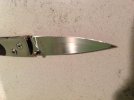
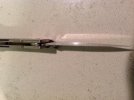

 Take your time, take breaks, just relax.... If the sharpie is removed towards the shoulder too low, if the sharpie is removed towards the apex to high. Adjust accordingly


