
-
The BladeForums.com 2024 Traditional Knife is available! Price is $250 ea (shipped within CONUS).
Order here: https://www.bladeforums.com/help/2024-traditional/
You are using an out of date browser. It may not display this or other websites correctly.
You should upgrade or use an alternative browser.
You should upgrade or use an alternative browser.
full bevel grind or hollow grind?
- Thread starter Midget
- Start date


Midget
Gold Member
- Joined
- Jun 1, 2002
- Messages
- 2,807
i dunno...
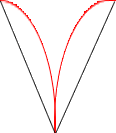
it just seems to me, that the full bevel grind (the one on the right) would always be superior in cutting ability, because the grind comes down and a smaller angle from the spine to the edge. that is, i'd always expect lesser resistence/friction as the blade passes through the material. i mean, that's why kitchen knives always have full bevel grinds, right?
on the other hand, the grind on the left (half bevel grind or something?) probably is stronger, right? in terms of chopping/prying.
it just seems to me, that the full bevel grind (the one on the right) would always be superior in cutting ability, because the grind comes down and a smaller angle from the spine to the edge. that is, i'd always expect lesser resistence/friction as the blade passes through the material. i mean, that's why kitchen knives always have full bevel grinds, right?
on the other hand, the grind on the left (half bevel grind or something?) probably is stronger, right? in terms of chopping/prying.
Cliff Stamp
BANNED
- Joined
- Oct 5, 1998
- Messages
- 17,562
Andy_L said:normal hollow or flat, depending on how it's done the hollow will be thinner closer to the edge so will have better shallow cutting while the flat grind will be better for slicing things to the full depth of the blade
This is unfortunately too common a problems however it isn't intrinsic to the grind but rather an implementation. You can take a flat or convex ground blade and hollow it out so it cuts better. Alvin Johnston has been describing how to do that on rec.knives for over ten years.
The problem in most cases is that people are comparing a full flat grind with a low sabre grind, or the hollow grinds are such that they are shaped like a "T" and the material binds at the top. This doesn't have to be the way they are done, see the hollow grinds on typical Japanese knives and chisels for example which doesn't have issues with binding.
-Cliff
For whittling/carving the flat grind is better (the one on the right). It is easier to make shallow cuts with a flat blade and they turn a nice shaving off the piece. Hollow grind blades tend to bite in deep - OK for stop cuts but not for removing material.
Cliff Stamp
BANNED
- Joined
- Oct 5, 1998
- Messages
- 17,562
db said:If you take a flat or convex grind and hollow it out wouldn't it be a hollow grind then? And if you do that wouldn't it be thinner? Therfor a hollow grind is thinner than a flat grind.
And then you can flat grind it again you have made it thinner, so a flat grind is thinner than a hollow grind. If you extend your logic it contradicts itself because your presuppositions are not well defined.
If you define a wedge by three points of a triangle and you connect these points by convex, flat, and concave arcs, then the cross section will be greater for the convex than flat and greater for the flat than concave.
However when people regrind knives they change the apex points so this rule doesn't hold so trivially. You also also grind off material and leave the blade with a thinner cross section and make it cut worse.
You can in fact make it cut worse and be more fragile at the same time. You can also make it cut better and be more durable at the same time. You can in fact do all of these at the same time on the same blade because it can change from one task to another.
-Cliff
Cliff Stamp
BANNED
- Joined
- Oct 5, 1998
- Messages
- 17,562
Felling axes have primary hollow grinds, unless the wood is really soft in which case they are convex like splitting mauls because you don't need an efficient cutting profile on soft woods you need the blade not to stick so you need a thick profile. The edges have a primary convex grinds which are very close to flat and usually run a flat micro-bevel.
-Cliff
-Cliff
Thankyou glad to see that wasn't a myth like you've said in the past.Cliff Stamp said:If you define a wedge by three points of a triangle and you connect these points by convex, flat, and concave arcs, then the cross section will be greater for the convex than flat and greater for the flat than concave.
-Cliff

You should probably add what cutting tasks you will be asking of the knife.
While I generally agree that the hollow grind will "cut" better as the blade profile is thinner than the flat grind, the cutting edge itself on both types will probably be in the 20-22deg range that many knifemakers use. Unless the rest of the blade has to pass through whatever you are cutting (like if you were cutting very thick materials), it should make little practical difference. Once you factor in different knife steels and heat treatments, the difference between the performance of the physical grinds themselves should not matter.
I like both designs. High hollow grinds look great on polished blades while the full flat looks best on coated or matte finished blades.
While I generally agree that the hollow grind will "cut" better as the blade profile is thinner than the flat grind, the cutting edge itself on both types will probably be in the 20-22deg range that many knifemakers use. Unless the rest of the blade has to pass through whatever you are cutting (like if you were cutting very thick materials), it should make little practical difference. Once you factor in different knife steels and heat treatments, the difference between the performance of the physical grinds themselves should not matter.
I like both designs. High hollow grinds look great on polished blades while the full flat looks best on coated or matte finished blades.
Cliff Stamp
BANNED
- Joined
- Oct 5, 1998
- Messages
- 17,562
db said:Thankyou glad to see that wasn't a myth like you've said in the past.
Which I never did. What I have said was there are many myths about convex bevels which center on the promotion of the curvature irrespective of the cross section. Specifically, and most recently which you are likely refering to :
http://www.bladeforums.com/forums/showpost.php?p=3884778&postcount=15
-Cliff
Right thread wrong post. http://www.bladeforums.com/forums/showpost.php?p=3887605&postcount=32
Cliff Stamp
BANNED
- Joined
- Oct 5, 1998
- Messages
- 17,562
What I said in the above and that linked post are not in contradition. You have to define your presuppositions. When people grind knives they alter the apex points and thus just as I noted in the above the general assertion about curvature and cross section doesn't hold because the triangle frame is constantly changing. This is what leads to the myths about curvature dominating over cross section.
-Cliff
-Cliff
All of the technical info is great and all, but from the knives I've used and actually cut with, for me, the high hollow-grind works best.
Some of my very best slicers are:
Buck 110
Spyderco Centofante III
Spyderco Vesuvius
Kabar-Dozier Hunter
Schrade Old Timer 6OT
That is not to say that my Spyderco Military, Spyderco Calypso Jr, and Benchmade 550 do not perform well....just not as well as the others listed above.
My Buck 110 is my very best slicer and I think it is because it has such awesome blade geometry.
So, all of the technical data aside, which knives are your best slicers (overall) and what type grind do they have.
Some of my very best slicers are:
Buck 110
Spyderco Centofante III
Spyderco Vesuvius
Kabar-Dozier Hunter
Schrade Old Timer 6OT
That is not to say that my Spyderco Military, Spyderco Calypso Jr, and Benchmade 550 do not perform well....just not as well as the others listed above.
My Buck 110 is my very best slicer and I think it is because it has such awesome blade geometry.
So, all of the technical data aside, which knives are your best slicers (overall) and what type grind do they have.
Just one more thing that makers have argued over for years. I have both, like the look of a flat grind but recognize the value of good hollow grinding. You will find that many commercial pocket knives are flat and there is little crying over the edge, at least for that reason. I think either will work for you and to find a reason to have one grind over the other is a very narrow field to be looking at.