
-
The BladeForums.com 2024 Traditional Knife is available! Price is $250 ea (shipped within CONUS).
Order here: https://www.bladeforums.com/help/2024-traditional/
You are using an out of date browser. It may not display this or other websites correctly.
You should upgrade or use an alternative browser.
You should upgrade or use an alternative browser.
gas forge, how much and where can you get one from?
- Thread starter eccvets
- Start date

- Joined
- Apr 2, 2011
- Messages
- 425
http://www.woodsmonkey.com/index.ph...mini-forge&catid=41:how-to-articles&Itemid=63
http://zoellerforge.com/simplegasforge.html
You can easily build one for under$100, I've done it check out these links zoeller has a bunch of designs and parts. Search forge and mini forge here , there are many options.
http://zoellerforge.com/simplegasforge.html
You can easily build one for under$100, I've done it check out these links zoeller has a bunch of designs and parts. Search forge and mini forge here , there are many options.
- Joined
- May 4, 2010
- Messages
- 382
I bought a nice used dual burner on Craigslist for $400. Maybe I over Payed but I like it. Doesn't use nearly as much propane as I thought it would.

I'm sorta scared about making my own because im scared im gonna blow myself up... what are the risks involved with making your own?
P.S. thanks for the advice for the Uncle Al's upright, never heard of them before. any idea on where i could get one from? I cant seem to find it on google (my googlefu is bad today.).
P.S. thanks for the advice for the Uncle Al's upright, never heard of them before. any idea on where i could get one from? I cant seem to find it on google (my googlefu is bad today.).

- Joined
- Feb 4, 2011
- Messages
- 1,429
I'm sorta scared about making my own because im scared im gonna blow myself up... what are the risks involved with making your own?
P.S. thanks for the advice for the Uncle Al's upright, never heard of them before. any idea on where i could get one from? I cant seem to find it on google (my googlefu is bad today.).
You could buy one of these forges... Nice build. Clean and will work well..
http://www.threesistersforge.com/
It's kind of build yourself as you'll have to line it, build a burner. But it gets you started...
I built one like it this weekend...I still have to weld the hinges for the top, fill in some gaps and grind it clean...I'm no expert welder, it took me 4 hours so far...... almost worth buying one if I had more money instead of the time I had...

http://www.woodsmonkey.com/index.ph...mini-forge&catid=41:how-to-articles&Itemid=63
http://zoellerforge.com/simplegasforge.html
You can easily build one for under$100, I've done it check out these links zoeller has a bunch of designs and parts. Search forge and mini forge here , there are many options.
wait a min, there are no speical nozzles or connections you need to make a forge which can get up to welding temps? I though there was some kinda speicalized connections and/or fittings so that the forge wont fall apart or explode but it seems you just need to aim the tip of a propane/mapp torch into the hole. I though you needed some kinda blower which wont melt hooked up to the forge. is this not so? could you use a compressor to blow air in to the forge?
P.S. thanks for the info/links! I'm learning a lot.
- Joined
- Apr 2, 2011
- Messages
- 425
wait a min, there are no speical nozzles or connections you need to make a forge which can get up to welding temps? I though there was some kinda speicalized connections and/or fittings so that the forge wont fall apart or explode but it seems you just need to aim the tip of a propane/mapp torch into the hole. I though you needed some kinda blower which wont melt hooked up to the forge. is this not so? could you use a compressor to blow air in to the forge?
P.S. thanks for the info/links! I'm learning a lot.
I can only speak of the 2 brick mini-forge , keep the nozzle an inch away from your hole just in case . I've upgraded to a bbq size propane tank and slathered the 2 brick with lots of refractory cement. I have ceramic wool and I could build a bigger one but for where I live this is low key enough to heat treat some 1084/1095 . Maybe I'll buy an anvil and hammers down the road.
eccvets
No info on your profile as to your location. If you are anywhere near North GA, come to the Trackrock Hammer-in Sept 23.24.25 (see posting on Ga Guild Forum at KNF). You can inspect and discuss several style homemade forges, see them operate, learn pros/cons, etc. It will help you make your choices easier.
As mentioned above, they are very simple to build less expensive than you think and you learn a lot about what makes them tick and how to make repairs when you need to, if you build your own. The science has been done just follow the rules.
If you are worried about explosions.....that can happen with any of them. It won't be the forge but the operator!
No info on your profile as to your location. If you are anywhere near North GA, come to the Trackrock Hammer-in Sept 23.24.25 (see posting on Ga Guild Forum at KNF). You can inspect and discuss several style homemade forges, see them operate, learn pros/cons, etc. It will help you make your choices easier.
As mentioned above, they are very simple to build less expensive than you think and you learn a lot about what makes them tick and how to make repairs when you need to, if you build your own. The science has been done just follow the rules.
If you are worried about explosions.....that can happen with any of them. It won't be the forge but the operator!

- Joined
- Feb 28, 2002
- Messages
- 392
The connectors on the outside of the forge aren't exposed to high heat. Use brass or steel. People have used hair driers as blowers, not the best but can be made to work. The North Carolina (NC) forges aren't great for knife making since they tend to generate hot spots. As a side note Fluidsteel, is your burner port centered at a 90 degree angle? or is it set at an angle? I can't quite tell from the photo.
Wayne Suhrbier
Wayne Suhrbier
- Joined
- Feb 4, 2011
- Messages
- 1,429
The connectors on the outside of the forge aren't exposed to high heat. Use brass or steel. People have used hair driers as blowers, not the best but can be made to work. The North Carolina (NC) forges aren't great for knife making since they tend to generate hot spots. As a side note Fluidsteel, is your burner port centered at a 90 degree angle? or is it set at an angle? I can't quite tell from the photo.
Wayne Suhrbier
It comes in on an angle about 2/3rds of the way up the side. It's 15" from door to door but only 8" diameter... maybe a little small in diameter with around 200" interior volume but , but I'll mostly be working with barstock and blades....it should be easy on the propane.
I'll use it as a prototype for maybe a bigger one.
eccvets
No info on your profile as to your location. If you are anywhere near North GA, come to the Trackrock Hammer-in Sept 23.24.25 (see posting on Ga Guild Forum at KNF). You can inspect and discuss several style homemade forges, see them operate, learn pros/cons, etc. It will help you make your choices easier.
As mentioned above, they are very simple to build less expensive than you think and you learn a lot about what makes them tick and how to make repairs when you need to, if you build your own. The science has been done just follow the rules.
If you are worried about explosions.....that can happen with any of them. It won't be the forge but the operator!
I'm ususally on the west coast/ususally in cali but thanks for the offer.

- Joined
- Apr 10, 2002
- Messages
- 138
For what it's worth, i built the simple gas forge on the zoeller site. I use mine for heat treating 01 and while I don't forge, i would think there would be no problem achieving welding temps with this setup. I can easily idle at 1500 degrees on very little gas pressure, usually around 4 psi .
Attachments
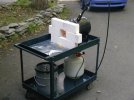
For what it's worth, i built the simple gas forge on the zoeller site. I use mine for heat treating 01 and while I don't forge, i would think there would be no problem achieving welding temps with this setup. I can easily idle at 1500 degrees on very little gas pressure, usually around 4 psi .
How much did it cost you to make your forge. It's very nice and looks quite portable!
how do you guys measure how much heat output your forges can make and will simply pumping in more propane mean higher temps?
>How much did it cost you to make your forge. It's very nice and looks quite portable!<
If your are a half decent scrounger or have a friend that is, you should be able to build a simple forge like RJ's for well under $100. Everything except the valves, hose and lining material can be gotten for free or near free if you look in the right places. Sometimes even the valves and hoses. Only expenses I have in my forges are K-wool, ITC 100, and fuel.
>how do you guys measure how much heat output your forges can make and will simply pumping in more propane mean higher temps? <
Measuring heat can be done many ways - do some research. Lot depends on what you plan to do in/with your forge.
You can easily reach welding heats in a venturi torched forge if you build it right - means no need for blower or electricity.
Increased fuel feed alone does not mean higher temps. It's all based around ratios of dimensions, volumes, pressures, etc.
Again, do the research and study up before you build.
Agree with comment on the NC forges - will work, but major problem with hot spots which increases problems beginners have with overheating steel.
If your are a half decent scrounger or have a friend that is, you should be able to build a simple forge like RJ's for well under $100. Everything except the valves, hose and lining material can be gotten for free or near free if you look in the right places. Sometimes even the valves and hoses. Only expenses I have in my forges are K-wool, ITC 100, and fuel.
>how do you guys measure how much heat output your forges can make and will simply pumping in more propane mean higher temps? <
Measuring heat can be done many ways - do some research. Lot depends on what you plan to do in/with your forge.
You can easily reach welding heats in a venturi torched forge if you build it right - means no need for blower or electricity.
Increased fuel feed alone does not mean higher temps. It's all based around ratios of dimensions, volumes, pressures, etc.
Again, do the research and study up before you build.
Agree with comment on the NC forges - will work, but major problem with hot spots which increases problems beginners have with overheating steel.

- Joined
- Oct 20, 2008
- Messages
- 5,547
Caution: incoming possibly pedantic wall of text. Take it for whatever it's worth...
You have two main choices- venturi (no blower, also called naturally aspirated) or blown (also called forced air forge).
Many of the gas forges on the market right now are venturi forges, such as the NC tool forges, the Diamondback forges, and the Chile forges. These are the ones that have no blower, and will have one to three burner tubes sticking up, at an angle or even straight. They often will have a flare at the top, such as a bell reducer or a reducing tee (Zoeller's sidearm burners.)
Basically, the fuel line comes off the tank into a regulator, (usually 0-30 psi) flows through a line, goes through a shut-off valve, and terminates in a jet (sized gas orifice) that points down the burner tube from the top. The pressure of the fuel stream entering the burner tube draws air in with it, they mix in the burner tube, and ignite at the other end once they have entered the forge chamber. A choke plate can be added to the top end of the burner to provide some fuel/air adjustment.
A blown burner uses a similar arrangement of forge body and burner tube, but instead of a flared open burner top to draw in air, there will be a chamber larger than the burner tube diameter, in which fuel is introduced (usually through a larger and less critical orifice then with venturi) and forced air is introduced. This air supply likely will consist of a blower of sufficient CFM, squirrel cage or radial, blowing air through large pipe or hose, with a valve or duct gate to control the blast, into the mixing chamber of the burner assembly. Flame adjustments are made with the fuel pressure regulator and the air blast valve.
Both are simple to make. Each is more simple to make than the other in a way. If you want to make your own venturi burners, I recommend going to Larry Zoeller's site and checking out his info and supplies. There are a few parts when making a good venturi burner that may be difficult to track down, and a couple things that you might prefer to buy rather than drill/tap/bore yourself. It all depends on your shop, experience, and tenacity.
If you want to make a blown forge, check out Indian George's tutorial. It explains well. Or, go to anvilfire.com for a good bit of info on making several types of gas forge. Or, check out the material by Stacy Apelt in the stickies here. He's a blown burner whiz.
In either case, the forge body is essentially a piece of 8,10, or 12" steel pipe lined with 2" of ceramic blanket, (you could use castable refractory, but I don't recommend that for a first or general use forge) which is then coated with satanite, ITC-100, Plistix 900F,or some combo of the above. The coating is so ceramic fibers do not become airborne and enter your lungs. Products such as the ITC may increase your forge temps or efficiency as well.
The lined forge body will have a hole coming in the side large enough for your burner flame to enter. Research will indicate if you want to use burner flares or other burner tip arrangements, and how big the hole in the wool needs to be to accommodate this. Generally the burner tube mounts concentrically into a sleeve welded to the outside of the forge shell, and is held with set screws. The fit should be good enough that outside air does not leak into the forge past the burner tube.
Doors can be as simple as cheap yellow firebricks stacked at both ends (easily re-configured into different door shapes, sizes) or as complex as blanket or board lined, hinging or sliding metal ends with small doors cut in, or even movable internal refractory baffles to increase or decrease heat chamber length as needed. I've done all of these, and prefer simple brick and a small forge for most stuff.
You will also see a debate about vertical vs. horizontal forges and much info about the vertical design- it's a good idea, works OK for general purpose but shines for forge welding. For a first forge, horizontal makes more sense IMO. It's a little easier to build, there's more resources out there about it, and it's nice to have a brick floor by the door.
Forges often have floors- and often, this is as simple as a thin firebrick or some kiln shelf laid on top of the wool on the bottom of the forge. They take abuse better than the wool alone, can be easily replaced, and it can be nice to just set stock into the door, resting on the floor as opposed to having to mess with balancing or retaining it somehow at the door so it projects into the forge (this is a common difficulty with vertical forges). Stock can be laid on the wool of a horizontal forge floor, but better to have a hard, replaceable surface there.
Wayne Suhrbier at hightemptools.com will be a good source for materials and info. The company, formerly known as Ellis supply, still has what looks like the lowest prices out there right now for durablanket by the running foot. They have the other coatings and refractories as well as plenty other stuff.
But, shop around. It can really be worth it to compare prices with this stuff. To my mind, buying a forge for $300-$800 plus shipping, vs. building one to my own specs for +/- $100, is no hard decision. Plus, you will have all the fun of doing it yourself.
You have two main choices- venturi (no blower, also called naturally aspirated) or blown (also called forced air forge).
Many of the gas forges on the market right now are venturi forges, such as the NC tool forges, the Diamondback forges, and the Chile forges. These are the ones that have no blower, and will have one to three burner tubes sticking up, at an angle or even straight. They often will have a flare at the top, such as a bell reducer or a reducing tee (Zoeller's sidearm burners.)
Basically, the fuel line comes off the tank into a regulator, (usually 0-30 psi) flows through a line, goes through a shut-off valve, and terminates in a jet (sized gas orifice) that points down the burner tube from the top. The pressure of the fuel stream entering the burner tube draws air in with it, they mix in the burner tube, and ignite at the other end once they have entered the forge chamber. A choke plate can be added to the top end of the burner to provide some fuel/air adjustment.
A blown burner uses a similar arrangement of forge body and burner tube, but instead of a flared open burner top to draw in air, there will be a chamber larger than the burner tube diameter, in which fuel is introduced (usually through a larger and less critical orifice then with venturi) and forced air is introduced. This air supply likely will consist of a blower of sufficient CFM, squirrel cage or radial, blowing air through large pipe or hose, with a valve or duct gate to control the blast, into the mixing chamber of the burner assembly. Flame adjustments are made with the fuel pressure regulator and the air blast valve.
Both are simple to make. Each is more simple to make than the other in a way. If you want to make your own venturi burners, I recommend going to Larry Zoeller's site and checking out his info and supplies. There are a few parts when making a good venturi burner that may be difficult to track down, and a couple things that you might prefer to buy rather than drill/tap/bore yourself. It all depends on your shop, experience, and tenacity.
If you want to make a blown forge, check out Indian George's tutorial. It explains well. Or, go to anvilfire.com for a good bit of info on making several types of gas forge. Or, check out the material by Stacy Apelt in the stickies here. He's a blown burner whiz.
In either case, the forge body is essentially a piece of 8,10, or 12" steel pipe lined with 2" of ceramic blanket, (you could use castable refractory, but I don't recommend that for a first or general use forge) which is then coated with satanite, ITC-100, Plistix 900F,or some combo of the above. The coating is so ceramic fibers do not become airborne and enter your lungs. Products such as the ITC may increase your forge temps or efficiency as well.
The lined forge body will have a hole coming in the side large enough for your burner flame to enter. Research will indicate if you want to use burner flares or other burner tip arrangements, and how big the hole in the wool needs to be to accommodate this. Generally the burner tube mounts concentrically into a sleeve welded to the outside of the forge shell, and is held with set screws. The fit should be good enough that outside air does not leak into the forge past the burner tube.
Doors can be as simple as cheap yellow firebricks stacked at both ends (easily re-configured into different door shapes, sizes) or as complex as blanket or board lined, hinging or sliding metal ends with small doors cut in, or even movable internal refractory baffles to increase or decrease heat chamber length as needed. I've done all of these, and prefer simple brick and a small forge for most stuff.
You will also see a debate about vertical vs. horizontal forges and much info about the vertical design- it's a good idea, works OK for general purpose but shines for forge welding. For a first forge, horizontal makes more sense IMO. It's a little easier to build, there's more resources out there about it, and it's nice to have a brick floor by the door.
Forges often have floors- and often, this is as simple as a thin firebrick or some kiln shelf laid on top of the wool on the bottom of the forge. They take abuse better than the wool alone, can be easily replaced, and it can be nice to just set stock into the door, resting on the floor as opposed to having to mess with balancing or retaining it somehow at the door so it projects into the forge (this is a common difficulty with vertical forges). Stock can be laid on the wool of a horizontal forge floor, but better to have a hard, replaceable surface there.
Wayne Suhrbier at hightemptools.com will be a good source for materials and info. The company, formerly known as Ellis supply, still has what looks like the lowest prices out there right now for durablanket by the running foot. They have the other coatings and refractories as well as plenty other stuff.
But, shop around. It can really be worth it to compare prices with this stuff. To my mind, buying a forge for $300-$800 plus shipping, vs. building one to my own specs for +/- $100, is no hard decision. Plus, you will have all the fun of doing it yourself.
Last edited: