Caution: incoming possibly pedantic wall of text. Take it for whatever it's worth...
You have two main choices- venturi (no blower, also called naturally aspirated) or blown (also called forced air forge).
Many of the gas forges on the market right now are venturi forges, such as the NC tool forges, the Diamondback forges, and the Chile forges. These are the ones that have no blower, and will have one to three burner tubes sticking up, at an angle or even straight. They often will have a flare at the top, such as a bell reducer or a reducing tee (Zoeller's sidearm burners.)
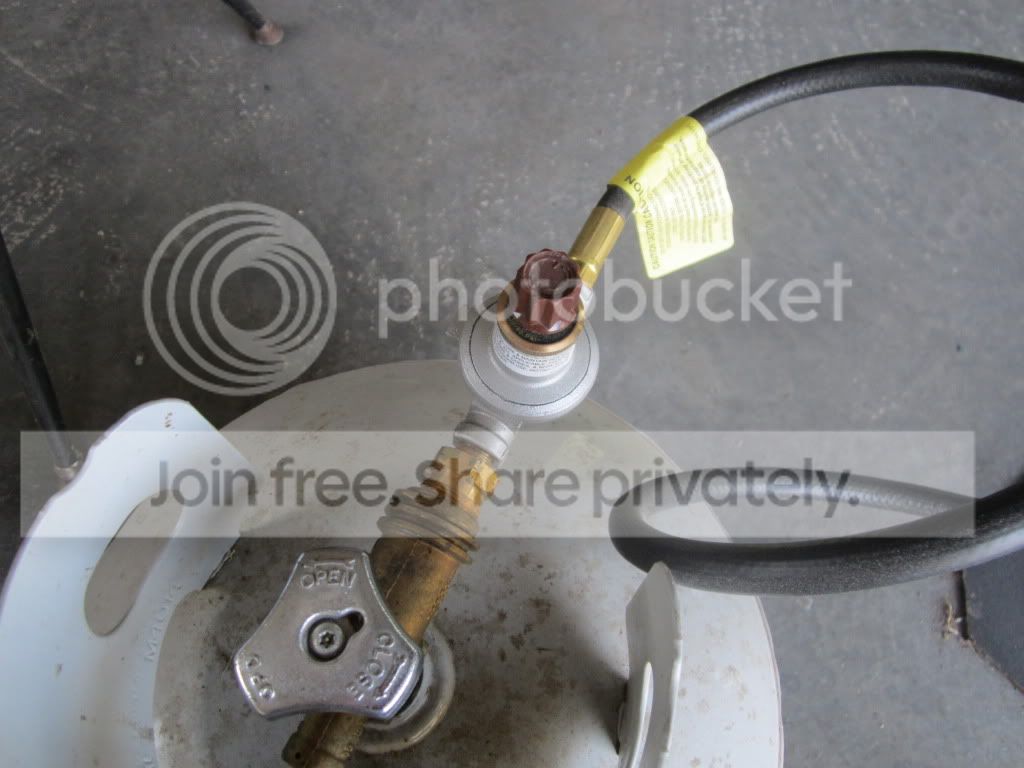
Basically, the fuel line comes off the tank into a regulator, (usually 0-30 psi) flows through a line, goes through a shut-off valve, and terminates in a jet (sized gas orifice) that points down the burner tube from the top. The pressure of the fuel stream entering the burner tube draws air in with it, they mix in the burner tube, and ignite at the other end once they have entered the forge chamber. A choke plate can be added to the top end of the burner to provide some fuel/air adjustment.
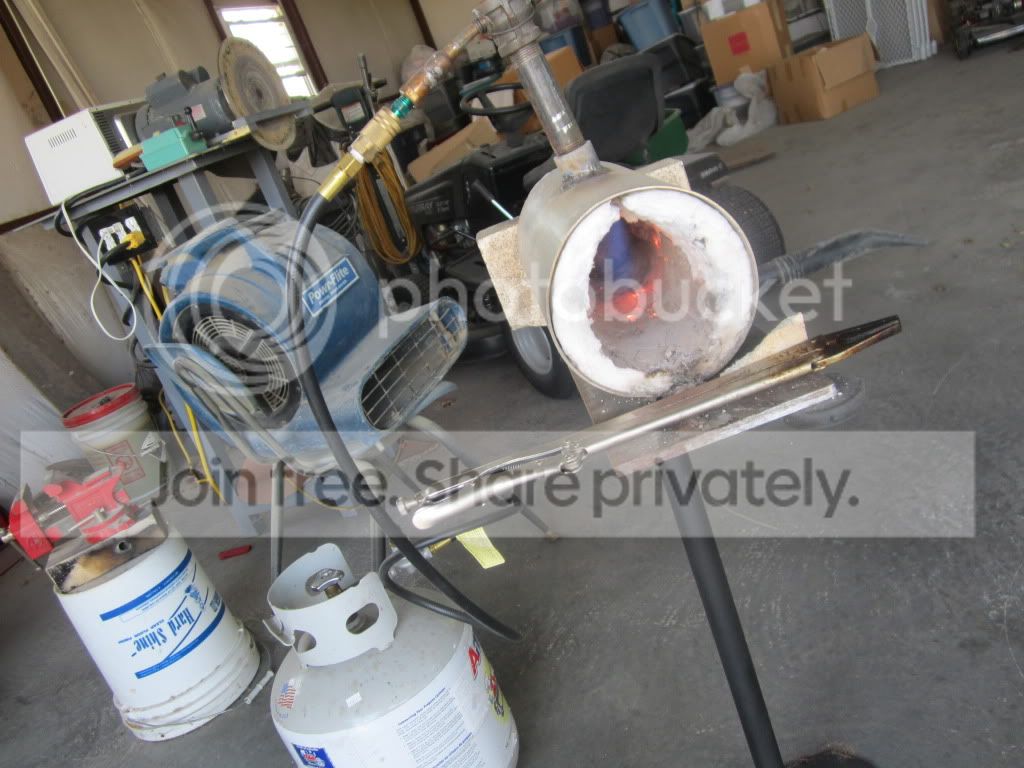
A blown burner uses a similar arrangement of forge body and burner tube, but instead of a flared open burner top to draw in air, there will be a chamber larger than the burner tube diameter, in which fuel is introduced (usually through a larger and less critical orifice then with venturi) and forced air is introduced. This air supply likely will consist of a blower of sufficient CFM, squirrel cage or radial, blowing air through large pipe or hose, with a valve or duct gate to control the blast, into the mixing chamber of the burner assembly. Flame adjustments are made with the fuel pressure regulator and the air blast valve.
Both are simple to make. Each is more simple to make than the other in a way. If you want to make your own venturi burners, I recommend going to Larry Zoeller's site and checking out his info and supplies. There are a few parts when making a good venturi burner that may be difficult to track down, and a couple things that you might prefer to buy rather than drill/tap/bore yourself. It all depends on your shop, experience, and tenacity.
If you want to make a blown forge, check out Indian George's tutorial. It explains well. Or, go to anvilfire.com for a good bit of info on making several types of gas forge. Or, check out the material by Stacy Apelt in the stickies here. He's a blown burner whiz.
In either case, the forge body is essentially a piece of 8,10, or 12" steel pipe lined with 2" of ceramic blanket, (you could use castable refractory, but I don't recommend that for a first or general use forge) which is then coated with satanite, ITC-100, Plistix 900F,or some combo of the above. The coating is so ceramic fibers do not become airborne and enter your lungs. Products such as the ITC may increase your forge temps or efficiency as well.
The lined forge body will have a hole coming in the side large enough for your burner flame to enter. Research will indicate if you want to use burner flares or other burner tip arrangements, and how big the hole in the wool needs to be to accommodate this. Generally the burner tube mounts concentrically into a sleeve welded to the outside of the forge shell, and is held with set screws. The fit should be good enough that outside air does not leak into the forge past the burner tube.
Doors can be as simple as cheap yellow firebricks stacked at both ends (easily re-configured into different door shapes, sizes) or as complex as blanket or board lined, hinging or sliding metal ends with small doors cut in, or even movable internal refractory baffles to increase or decrease heat chamber length as needed. I've done all of these, and prefer simple brick and a small forge for most stuff.
You will also see a debate about vertical vs. horizontal forges and much info about the vertical design- it's a good idea, works OK for general purpose but shines for forge welding. For a first forge, horizontal makes more sense IMO. It's a little easier to build, there's more resources out there about it, and it's nice to have a brick floor by the door.
Forges often have floors- and often, this is as simple as a thin firebrick or some kiln shelf laid on top of the wool on the bottom of the forge. They take abuse better than the wool alone, can be easily replaced, and it can be nice to just set stock into the door, resting on the floor as opposed to having to mess with balancing or retaining it somehow at the door so it projects into the forge (this is a common difficulty with vertical forges). Stock can be laid on the wool of a horizontal forge floor, but better to have a hard, replaceable surface there.
Wayne Suhrbier at hightemptools.com will be a good source for materials and info. The company, formerly known as Ellis supply, still has what looks like the lowest prices out there right now for durablanket by the running foot. They have the other coatings and refractories as well as plenty other stuff.
But, shop around. It can really be worth it to compare prices with this stuff. To my mind, buying a forge for $300-$800 plus shipping, vs. building one to my own specs for +/- $100, is no hard decision. Plus, you will have all the fun of doing it yourself.
wow thanks for the great info. this wraps up a lot of questions I had!