Gas spring conversion on KMG, or what to lessen vibration?

Joined
Nov 27, 2013
Messages
1,626
I'm thinking about doing a gas spring conversion to my KMG. The problem I'm having is vibration. It's especially bad when I use my Wuertz machine tool surface grinder. It makes the finish all wavy, which is no good at all. I'm pretty sure it's the grinder and not Travis Wuertz's equipment. Anyway, do you guys think this would help with vibration? If not, does anyone have any ideas?

I've searched on here for specific info regarding the gas spring setup and found varied information. Some say get a 30lb gas spring, others say get a heavier spring. Even up to 100lbs. I've found some adjustable gas springs but you only adjust them once and then they're set at that weight. I'd kind of like to be able to select a certain weight and be done with it.

I was looking at these two items specifically:

https://www.mcmaster.com/#4138t53/=15dgcqs

https://www.mcmaster.com/#9512k95/=15dgd3v


Would those two items work? Would it be the mount I would need? If so, what weight of spring would you guys suggest?

I was going to do a direct drive conversion but unfortunately I don't have the right motor to do it with. I have a Lesson 56 and I need a 56c frame motor I think. I could stomach the $240 or so for the conversion, but another $300 for another motor would be a real kick in the nuts at the moment.

I've been trying to take a video of the grinder running to illustrate the problem but my phone is junk. I'm gonna use my lady's phone tomorrow and take a video if I can't figure mine out tonight. Any other ideas would be helpful.
 
I converted mine to direct drive using a lovejoy coupling and works amazing. When I'm out in the shop again I will snap a pic for you.
 
I'm thinking about doing a gas spring conversion to my KMG. The problem I'm having is vibration. It's especially bad when I use my Wuertz machine tool surface grinder. It makes the finish all wavy, which is no good at all. I'm pretty sure it's the grinder and not Travis Wuertz's equipment. Anyway, do you guys think this would help with vibration? If not, does anyone have any ideas?

I've searched on here for specific info regarding the gas spring setup and found varied information. Some say get a 30lb gas spring, others say get a heavier spring. Even up to 100lbs. I've found some adjustable gas springs but you only adjust them once and then they're set at that weight. I'd kind of like to be able to select a certain weight and be done with it.

I was looking at these two items specifically:

https://www.mcmaster.com/#4138t53/=15dgcqs

https://www.mcmaster.com/#9512k95/=15dgd3v


Would those two items work? Would it be the mount I would need? If so, what weight of spring would you guys suggest?

I was going to do a direct drive conversion but unfortunately I don't have the right motor to do it with. I have a Lesson 56 and I need a 56c frame motor I think. I could stomach the $240 or so for the conversion, but another $300 for another motor would be a real kick in the nuts at the moment.

I've been trying to take a video of the grinder running to illustrate the problem but my phone is junk. I'm gonna use my lady's phone tomorrow and take a video if I can't figure mine out tonight. Any other ideas would be helpful.

Belt tension can be the solution to blade wobble and dive

However it's not the solution to vibration.

vibration,
If you have vibration, it's because something that rotates is out of balance.

A step pulley setup has more things possible to go wrong.

Let's see your step pulleys and wheels, what type are they ?
Are they any rough cast spots on them or all they all turned, are they balanced?

Were the keyways on the shaft put in, or is is fully keyed shaft ?
I would put that on slow turning farm stuff, but not a grinder

Are all the shafts straight?
How do you know?

Take off all v and grinding belts
Run the motor, check for vibration
Add the v belt closest to the motor
Check for vibration
and so on
 
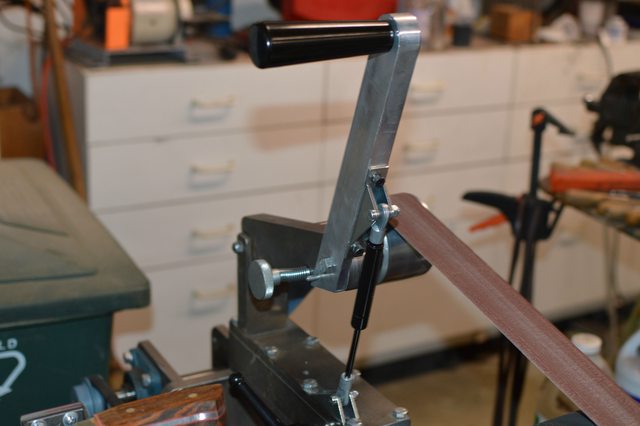
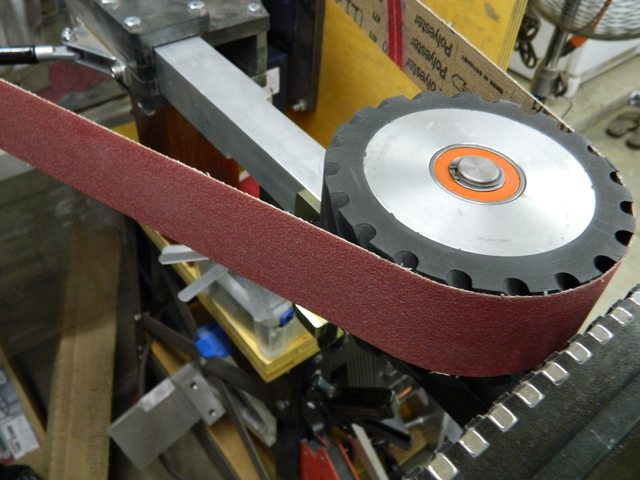
JG, I don't know if your tension spring is the cause of your vibration but the gas piston is superior to the spring on the KMG. Here is a picture of the gas piston I ordered from McMaster-Carr. It is about 9 inches long and is 40 Lbs of tension. I would suggest you take the belt off your grinder and grab the tracking wheel and try to move it from side to side to see if it's tight or the bearings are loose. Also run the grinder at a slow speed without the belt and see if the drive wheel is running smooth with no runout or vertical wobble. If the bearings on the jackshaft are bad the shaft will not true at higher speeds. If your belts run at high speed with out the surface grinder attached with no tracking wobble then the attachment should run smooth also. Are you using a 5 1/2 Bader contact wheel on your surface grinder attachment? It should spin perfectly true when you spin it by hand. I have the same attachment. Good luck. Larry


ghDPcl6l.jpg


y4vrPBil.jpg
 
I converted mine to direct drive using a lovejoy coupling and works amazing. When I'm out in the shop again I will snap a pic for you.

Does that enable you to use a 56 motor/mount to a 56c mount? If so, do you have a part number or link to the part? I'd really like to do the direct drive if possible, but I can't afford the direct drive conversion AND a new 56c motor. If it was another $50-$75 part to make it work, I could probably stomach that.

I'll still probably do the gas spring too, just because I've heard so many good things about it. Also, it might be belt wobble causing the wavy finish when using the surface grinder. I suppose it couldn't hurt to try it out. I balanced a nickel on the tool arm and ran it full speed and it stayed still so it might just be the belt wobble and I wasn't articulating the problem correctly.

As far as the step pulley setup goes, it's the stock KMG setup with a red linked power twist v belt(I think that's what they're called). That's what it came with when I bought it. I can take a picture tomorrow. As far as I can tell it's all good quality parts and stock from Beaumont. It has a Lesson 56 2hp motor, wired down to 1.5hp 110v and a kbac VFD. I will check all the pulleys and wheels tomorrow like you suggested. I'm typing this on my tablet, in bed at the moment.
 
JG, I don't know if your tension spring is the cause of your vibration but the gas piston is superior to the spring on the KMG. Here is a picture of the gas piston I ordered from McMaster-Carr. It is about 9 inches long and is 40 Lbs of tension. I would suggest you take the belt off your grinder and grab the tracking wheel and try to move it from side to side to see if it's tight or the bearings are loose. Also run the grinder at a slow speed without the belt and see if the drive wheel is running smooth with no runout or vertical wobble. If the bearings on the jackshaft are bad the shaft will not true at higher speeds. If your belts run at high speed with out the surface grinder attached with no tracking wobble then the attachment should run smooth also. Are you using a 5 1/2 Bader contact wheel on your surface grinder attachment? It should spin perfectly true when you spin it by hand. I have the same attachment. Good luck. Larry


ghDPcl6l.jpg


y4vrPBil.jpg

I will check that stuff out tomorrow for sure. Thanks for the advice Larry! Did you by chance know the part number!best for the gas spring and mounts you're using? They look different than the ones I listed above.

So what does everyone think in regards to the weight of the gas spring? Also, which spring/mounting method is preferable?

Thanks a bunch JT, Count, and everyone else who shared info. I greatly appreciate the help.
 
Jg, The three parts numbers you need to check on the McMaster-Carr website are: 9416K29 , 9416K11 , and 9416K84 . I tried the 30 lb piston and after a while I decided that the 40 lb piston was a better choice. It was. You need four of the cap crews, two of the brackets, and one 5.9 inch gas piston and specify what lb tension you want. Larry P.S. You also need to make an aluminum arm extension to mount the piston to.. I used 1/2 inch aluminum bar from my local metal supply. It was cheap...about $4.00 per pound and they don't weigh much. LL

zYmxqSGl.jpg
 
Last edited:
The Count called it. There's no fast way around this, man. A gas strut isn't going to fix vibration in a machine, at least not to the extent that I'm assuming you're talking about. As you haven't outlined what steps you've taken to troubleshoot, I'll list the things that I found on my own machine (some of which led to the direct drive conversion kit).

Make certain the wheels on your attachments are square to their respective tool arms. For example, the idler pulleys on my factory KMG platen attachment were both off. The bottom one was a couple of degrees, but the top was just over seven degrees skewed - that means that the belt is now fighting the crowned drive wheel, the tracking wheel AND the idler wheels to track properly. Won't work right until you fix this.

When I threw an indicator on the outer ends of my drive pulley shaft, it was off by a couple thousandths on both ends. That was a problem, but not THE problem. The CENTER of the shaft was off by over thirty thousandths. The vibration this created was terrifying, and worse, there was NO indication that the shaft had taken a hit at any point. It was just bent! I can only assume it was installed this way, as there's no way it could have happened by impact and not left any marks.

Make sure everything is square. EVERYTHING. I used the drive wheel as my indexing point, and through a shitload of time and patience worked backwards and forwards making certain that each component was squared with the next. Not an easy thing to do on these machines, as there's no good baseline to mark off of. See Brian Fellhoelter's thread on modifications on this, as that was enormously helpful to me.

JT's lovejoy coupling is a cheaper solution, but remember that, without a larger drive wheel, you're going to lose quite a bit of speed, assuming you were using pulley sheaves.

There are three phase C-face mount motors to be had all over the place for cheap. You don't NEED to buy a brand new motor, if you don't want to. Find a cheap one and you're almost there. Remember, though, the direct drive kit is only a fix if you've, in fact, determined that the pulleys are your problem!
 
You don't really need a "conversion kit" to mount a direct drive motor to the K&G. Many folks just bolt most down to base and slide motor on screws so the drive wheel aligns with tension wheel and platen. Easy to do and no extra parts to speak of require purchasing. Just use the same motor, just remove all those jack shaft and pulleys that tend to cause more vibration. BUT, as said, you now have a single speed grinder.... Unless you already have a 3 ph motor with VFD drive. If so, you're in business.

Ken H>
 
Agreed. The only counter to doing it that way, of course is alignment. Need to make sure everything is square. See the recurring theme here? :)

I think a big reason that guys are buying these direct drive kits, though, is only partially to eliminate the pulleys. It also makes 'flipping' the grinder on a hinge so it'll do vertical/horizontal duty much easier. Still, the key to a smooth running machine is eliminating the variables and making sure things are where they ought to be. With the KMG, unfortunately that isn't a guaranteed proposition.
 
I just dug up Brian's post, and it's quoted here. Great illustration:

It's hard to explain it all, since it was actually a pretty big procedure.

Since there are no dowels or anything in the build, and the screw holes are oversized to allow the screws to fit, the whole machine wasn't square.

I started by making sure the receiver for the arm was actually square to the drive wheel.
It wasn't, so that took some creative adjusting and measuring.
This is an important step, because otherwise the drive and driven wheels end up with axis that are not parallel with each other. something like this \ |
They need to be parallel, more like this ||
Hope that's clear, because it's the key.

Once that was done, and I was sure the axles weren't cocked in relation to each other, I put the tracking wheel in a neutral position, and took a measurement off of it.
Again, no easy task, I had to get creative.

I then made sure the centerline of the drive wheel was on the same plane as the tracking, and did the same for the wheels on all the tooling arms.

All was better after that.

Maybe a drawing will help a little.

Screwy_Tracking.jpg


This is looking straight down on the grinder, it's just the wheels.

You can see on the right, what I started with.

The wheels were crooked in relation to each other, and the centerlines didn't all line up.

The left, is what you want.


By the way, I discovered all of this, when I built my own grinder.

I made a 3 wheel grinder that tracked like a dream, and when I moved the belt to the KMG, it wobbled all over the place.
Same belt, 2 machines, 2 different results.

I investigated, and fixed it.

It seems like when the wheels are crooked to each other, the drive wheel is trying to drive the belt off of the contact wheel/platen/slack belt.
It only gets so far before the tracking wheel overcomes it, and brings it back.

Diving off and coming back = Wobble

At least that's today's theory.
 
The gas spring will be a nice edition, but I'll also agree with the Count and Matthew. Something is out of balance. Start by taking the motor drive belt off and just running the motor. If everything is smooth, re-install the belt and just run the shaft and drive wheel (no grinding belt). If still smooth, put on a belt, push your spring down as far as possible, pull your tool arm as tight as possible, and tighten the knob snug. If you start getting the vibration now, switch to another tool arm and try again. If you still get vibration, try running a belt just between the drive wheel and a contact wheel or platen, without running it over the tracking wheel. See if the vibrations is worse, better, or removed. Just start eliminating variables...
 
Back
Top