- Joined
- Sep 26, 2005
- Messages
- 3,516
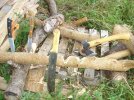
Hey folks, took a few blades out today, I really wanted to see how well these two stacked up against each other since I modded up the tram a bit.
there was 2 inches of blade with no edge at all, so I put a convex one on there to match the rest of the blade, which is still more or less a scandi edge I worked on a bit. I also put the handle to the belt sander and now it fits much better.
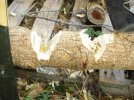
I chopped an old seasoned limb of some type of hard wood (anyone know?) I used 60 hits with fairly light chops to make it easier to keep it consistent. The one on the left is the tram, on the right is the mini.
It was close, I had to give it to the tram. It had a much bigger sweet spot, almost 3/4 of the blade, and it's thinner profile made it easier to bite in where I wanted it to, the mini kept sort of glancing off and landing dead center in the cut. (you can see the wedge is more V shaped for the mini)
This could easily be my lack of chopping experience, but I just felt the tram was easier to control the whole time.
Both tools were similar weight, but the mini had much of that foreward of the handle. For it's size the mini does extremely well, a bigger hatchet would have done better. In green wood I believe it would have surpassed the tram,
(which suffered no edge damage at all. In the above pic the wedge on the far left is when I took a few big swings with the tram to check for edge damage.)
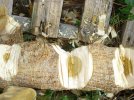
I did one other test, which was to see if the canadian special could chop.
It could! I noticed that if I choked back on the handle there was a lot of weight foreward and still a decent grip with the finger grooves. In the above pic with the three wedges, I cut into the middle one from another angle with both barkies, and was pleased with how well the canadian special did.
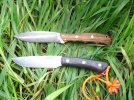
The fox river was no slouch, doing better then many similar sized blades, but the CS was at least 30% better.
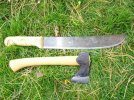
When whittling, both proved excellent, the fox rivers foreward angled blade gave it leverage, and on the Canadian special there is a slight recurve toward the handle that kind of catches what you are whittling. The fox rivers handle was comfier, and the canadian specials was good but a small hotspot on the palm below the baby finger, it's wide there and the scales are a bit square.
Thanks for looking, give me some advice on how to do a better review and ask any questions I forgot to answer in advance.


there was 2 inches of blade with no edge at all, so I put a convex one on there to match the rest of the blade, which is still more or less a scandi edge I worked on a bit. I also put the handle to the belt sander and now it fits much better.
I chopped an old seasoned limb of some type of hard wood (anyone know?) I used 60 hits with fairly light chops to make it easier to keep it consistent. The one on the left is the tram, on the right is the mini.
It was close, I had to give it to the tram. It had a much bigger sweet spot, almost 3/4 of the blade, and it's thinner profile made it easier to bite in where I wanted it to, the mini kept sort of glancing off and landing dead center in the cut. (you can see the wedge is more V shaped for the mini)
This could easily be my lack of chopping experience, but I just felt the tram was easier to control the whole time.
Both tools were similar weight, but the mini had much of that foreward of the handle. For it's size the mini does extremely well, a bigger hatchet would have done better. In green wood I believe it would have surpassed the tram,
(which suffered no edge damage at all. In the above pic the wedge on the far left is when I took a few big swings with the tram to check for edge damage.)
I did one other test, which was to see if the canadian special could chop.
It could! I noticed that if I choked back on the handle there was a lot of weight foreward and still a decent grip with the finger grooves. In the above pic with the three wedges, I cut into the middle one from another angle with both barkies, and was pleased with how well the canadian special did.
The fox river was no slouch, doing better then many similar sized blades, but the CS was at least 30% better.
When whittling, both proved excellent, the fox rivers foreward angled blade gave it leverage, and on the Canadian special there is a slight recurve toward the handle that kind of catches what you are whittling. The fox rivers handle was comfier, and the canadian specials was good but a small hotspot on the palm below the baby finger, it's wide there and the scales are a bit square.
Thanks for looking, give me some advice on how to do a better review and ask any questions I forgot to answer in advance.