
-
The BladeForums.com 2024 Traditional Knife is available! Price is $250 ea (shipped within CONUS).
Order here: https://www.bladeforums.com/help/2024-traditional/
You are using an out of date browser. It may not display this or other websites correctly.
You should upgrade or use an alternative browser.
You should upgrade or use an alternative browser.
GEC Lockback Blade Play, is this common?
- Thread starter david childers
- Start date


- Joined
- Jul 30, 2006
- Messages
- 45,486
I dunno. I don't have any Schrade lockbacks. But I have had Buck, Gerber (pre-Fiskars) and early Spyderco lockback knives that all had a bit of vertical play. And I've had others that did not.
I tend to agree with Mike and several others that the current focus on absolutely zero blade play in production lockback knives is just that, a current focus. As long as the blade stays still when I'm trying to make a cut, it's never been a problem for me. I tend to agree with Ed, if a bit of vertical play were a deal breaker for me, I'd either stay away from that design or go custom.
I tend to agree with Mike and several others that the current focus on absolutely zero blade play in production lockback knives is just that, a current focus. As long as the blade stays still when I'm trying to make a cut, it's never been a problem for me. I tend to agree with Ed, if a bit of vertical play were a deal breaker for me, I'd either stay away from that design or go custom.
Blade play or lack there of has been a criteria for evaluation in the sale and purchase of knives in the past and present.
Descriptions of used knives almost always include mention of any or no blade play to determine their condition.
I'd presume it's not mentioned in new knife advertisments as it's a given there is none.
I for one will continue to value blade play in purchase decisions
Descriptions of used knives almost always include mention of any or no blade play to determine their condition.
I'd presume it's not mentioned in new knife advertisments as it's a given there is none.
I for one will continue to value blade play in purchase decisions
The fact that I own a few lock backs that have no vertical play or very, very minimal play is my personal source of frustration on this issue. They demonstrate that it is possible to build a lock back without play, or at the very least with minimal play.
The original design goal of the Buck 110 (mine from the 70s doesn't have play, fwiw) was to build a folding knife that could perform like a fixed blade. In the extreme, this is non-sense since any folding knife can fail under enough closing force. But, rightly or wrongly, in practical terms people have come to expect reliable lock up under normal fixed blade type uses. IMO, this is what separates the fixed blade and good locking folder from a slip joint.
Here are three scenarios where I regularly rely on reliable lock up. First when I cut deep into the grain on wood such as bend cutting limbs and brush. It is possible for the blade to get jammed in the wood requiring the knife to be rocked and twisted to get loose. Normal with fixed blades. Not something I want to do with a slip joint. I want to be able to do this with a locking folder.
Second, the knife is open and I'm working repeatedly in a situation where it is possible for me to bump something with the spine of blade. Clearing brush and stuff out of gardens is a place where the can happen. While the forces aren't high like the infamous (and misguided) internet spine whack test, it's not dissimilar. Again, this is routine with a fixed blade, something I don't use a slip joint for and something I want to be able to do reliably with a locking folder.
Third, I'm working with the knife in a dirty or sandy environment. Camping, yard work and boat work on beaches are all places where I encounter this. The knife may be dropped in the dirt and sand and a full flushing wash may not be possible. This is routine for a fixed blade and something I want or expect out of a locking folder.
Here are a couple of shots of the internals of lock backs.
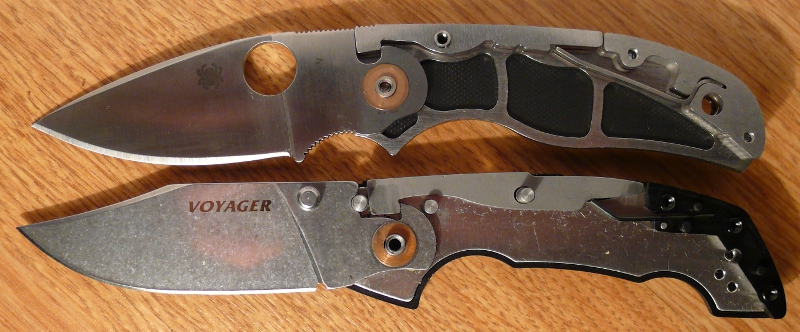
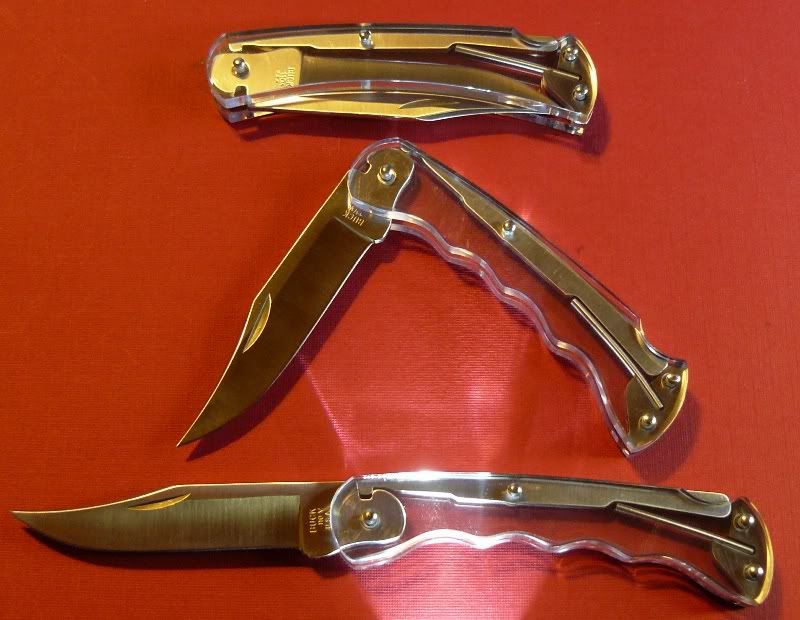
On a lock back, the ability for the knife to withstand closing force on the blade depends entirely on the lock bar and tang indent to stay connected like a fingernail on a cliff face crack. There are several ways for this to fail. Strong opening pressure can force things apart in a variety ways including: misalignment of the leading face of the blade/lock bar interface, causing the bar to lift; deformation of the pivot pins or bushing, causing the blade to drop away from the lock bar; striking the back of spine hard on something can cause the lock bar to lift away and lastly the mechanism can get fouled by junk.
Several things make this all worse. Soft pivot pins, smooth operating brass bushings, fine blanked parts and inadequate finishing can all introduce more slop.
My frustration is with my old (pre brass bushing) Bucks and my Schrades. They lock up tight, which leaves me with high expectations, I guess. Worse, on lock back I've had that had slop, the slop led to more slop under heavy use. Common among sloppy mechanical bits.
I've actually given up on lock backs for hard work and stick with Opinel's and their lock rings. They can fail under huge amounts of closing force, which I avoid. But they aren't prone to the Gomer Pyle failure of sloppy lock backs. "Surprise! Surprise! Surprise!"
The original design goal of the Buck 110 (mine from the 70s doesn't have play, fwiw) was to build a folding knife that could perform like a fixed blade. In the extreme, this is non-sense since any folding knife can fail under enough closing force. But, rightly or wrongly, in practical terms people have come to expect reliable lock up under normal fixed blade type uses. IMO, this is what separates the fixed blade and good locking folder from a slip joint.
Here are three scenarios where I regularly rely on reliable lock up. First when I cut deep into the grain on wood such as bend cutting limbs and brush. It is possible for the blade to get jammed in the wood requiring the knife to be rocked and twisted to get loose. Normal with fixed blades. Not something I want to do with a slip joint. I want to be able to do this with a locking folder.
Second, the knife is open and I'm working repeatedly in a situation where it is possible for me to bump something with the spine of blade. Clearing brush and stuff out of gardens is a place where the can happen. While the forces aren't high like the infamous (and misguided) internet spine whack test, it's not dissimilar. Again, this is routine with a fixed blade, something I don't use a slip joint for and something I want to be able to do reliably with a locking folder.
Third, I'm working with the knife in a dirty or sandy environment. Camping, yard work and boat work on beaches are all places where I encounter this. The knife may be dropped in the dirt and sand and a full flushing wash may not be possible. This is routine for a fixed blade and something I want or expect out of a locking folder.
Here are a couple of shots of the internals of lock backs.
On a lock back, the ability for the knife to withstand closing force on the blade depends entirely on the lock bar and tang indent to stay connected like a fingernail on a cliff face crack. There are several ways for this to fail. Strong opening pressure can force things apart in a variety ways including: misalignment of the leading face of the blade/lock bar interface, causing the bar to lift; deformation of the pivot pins or bushing, causing the blade to drop away from the lock bar; striking the back of spine hard on something can cause the lock bar to lift away and lastly the mechanism can get fouled by junk.
Several things make this all worse. Soft pivot pins, smooth operating brass bushings, fine blanked parts and inadequate finishing can all introduce more slop.
My frustration is with my old (pre brass bushing) Bucks and my Schrades. They lock up tight, which leaves me with high expectations, I guess. Worse, on lock back I've had that had slop, the slop led to more slop under heavy use. Common among sloppy mechanical bits.
I've actually given up on lock backs for hard work and stick with Opinel's and their lock rings. They can fail under huge amounts of closing force, which I avoid. But they aren't prone to the Gomer Pyle failure of sloppy lock backs. "Surprise! Surprise! Surprise!"

knifeswapper
Knife Peddler
- Joined
- Sep 3, 2004
- Messages
- 3,301
If a knife is sent back to a factory, it gets 20-30 minutes of personal attention on one particular issue. If the factories started giving every knife 20-30 minutes of personal attention on each particular aspect that could be an issue to some; we couldn't afford them. So it doesn't surprise me that any factory can resolve any particular non-desirable aspect for a customer on a given knife; but that has little to do with what they could do before they shipped them as opposed to what they can afford to do to each knife before they ship them in the first place.
The heavy framed lockbacks of Buck, Schrade, and even Case are engineered differently. They have a tension bar that sits in the non pivot end and applies pressure to the locking bar making it more like a backspring. With the added pressure on the bar you can afford to tighten the joints more than with a shim. Also, most used a much harder material than NS as a pin on the pivot which allows less flex. Maybe GEC should have used that design in the first place and created 6oz lockbacks instead of 3oz lockbacks. But paying a couple grand to tool for another chance at a design is probably not in the cards.
Would it be great if none had any play, were free flowing, and disengaged easily - yes. At this point is it a reality for 100% of GEC lockbacks - no. Nobody would be happier than GEC distributors if GEC put out perfect knives, every time. But we have (and continue to) file the concerns on this issue with the factory, and they have tried to get closer tolerances. But the silent majority are happy with their lockback. My guess is three out of four are tight; and of the other 25% only one out of four gets into someones hands that simply cannot tolerate any discernible movement. So they are trying to fix an issue that is a real problem for 7% of buyers. But those 7% have just as much a right to be happy with the knife as the other 93%.
But it sounds like to me that GEC has give it their best shot and are likely to avoid lockback patterns in the future. I explained to them that this is one of the dwindling number of complaints on their products, and it would be better to cut it from the line-up than continue to take the black eye.
The heavy framed lockbacks of Buck, Schrade, and even Case are engineered differently. They have a tension bar that sits in the non pivot end and applies pressure to the locking bar making it more like a backspring. With the added pressure on the bar you can afford to tighten the joints more than with a shim. Also, most used a much harder material than NS as a pin on the pivot which allows less flex. Maybe GEC should have used that design in the first place and created 6oz lockbacks instead of 3oz lockbacks. But paying a couple grand to tool for another chance at a design is probably not in the cards.
Would it be great if none had any play, were free flowing, and disengaged easily - yes. At this point is it a reality for 100% of GEC lockbacks - no. Nobody would be happier than GEC distributors if GEC put out perfect knives, every time. But we have (and continue to) file the concerns on this issue with the factory, and they have tried to get closer tolerances. But the silent majority are happy with their lockback. My guess is three out of four are tight; and of the other 25% only one out of four gets into someones hands that simply cannot tolerate any discernible movement. So they are trying to fix an issue that is a real problem for 7% of buyers. But those 7% have just as much a right to be happy with the knife as the other 93%.
But it sounds like to me that GEC has give it their best shot and are likely to avoid lockback patterns in the future. I explained to them that this is one of the dwindling number of complaints on their products, and it would be better to cut it from the line-up than continue to take the black eye.
Given Pinnah's post, which I have no dispute with, my takeaway message is: Don't use a lockback folder in a situation that calls for severe torque on the blade. Period. Instead, use a stout fixed blade — or even better, go get the saw, the axe, or the loppers.
Let's keep in mind that the 110 and subsequent lockbacks in that design were primarily intended for field dressing of deer and other animals. Not wood processing or brush clearing.
If the original 110 lockback was capable of handling tough jobs (high torque) without excessive wear or mechanical failure, that was a result of the design and materials used to make the knife. People here have noted that the knife is "still a $30 knife," even after all these years. Well, yes, although it's now a $40 knife. My guess is that the company has had to make various internal changes (and perhaps lowered QC) to keep the knife price down at what it is. These have had the effect of allowing play to develop under heavy use, especially when combined with people now using it in a manner that's outside the original design perfomance envelope.
Super-steel knives and high-end folders have given people the idea that these things should come out of the box perfect, and they should remain perfect even under heavy usage. All for $40.
I gotta ask how realistic those expectations are in the current day.
Let's keep in mind that the 110 and subsequent lockbacks in that design were primarily intended for field dressing of deer and other animals. Not wood processing or brush clearing.
If the original 110 lockback was capable of handling tough jobs (high torque) without excessive wear or mechanical failure, that was a result of the design and materials used to make the knife. People here have noted that the knife is "still a $30 knife," even after all these years. Well, yes, although it's now a $40 knife. My guess is that the company has had to make various internal changes (and perhaps lowered QC) to keep the knife price down at what it is. These have had the effect of allowing play to develop under heavy use, especially when combined with people now using it in a manner that's outside the original design perfomance envelope.
Super-steel knives and high-end folders have given people the idea that these things should come out of the box perfect, and they should remain perfect even under heavy usage. All for $40.
I gotta ask how realistic those expectations are in the current day.

- Joined
- Sep 30, 2004
- Messages
- 6,997
Just one thing of note, in reply... Actually, over the years, Buck has beefed up the 110, not the other way around. When you compare an older one to a contemporary one, you'll notice the new one is heavier, and the lockbar pin is now made of steel instead of brass, etc.Given Pinnah's post, which I have no dispute with, my takeaway message is: Don't use a lockback folder in a situation that calls for severe torque on the blade. Period. Instead, use a stout fixed blade — or even better, go get the saw, the axe, or the loppers.
Let's keep in mind that the 110 and subsequent lockbacks in that design were primarily intended for field dressing of deer and other animals. Not wood processing or brush clearing.
If the original 110 lockback was capable of handling tough jobs (high torque) without excessive wear or mechanical failure, that was a result of the design and materials used to make the knife. People here have noted that the knife is "still a $30 knife," even after all these years. Well, yes, although it's now a $40 knife. My guess is that the company has had to make various internal changes (and perhaps lowered QC) to keep the knife price down at what it is. These have had the effect of allowing play to develop under heavy use, especially when combined with people now using it in a manner that's outside the original design perfomance envelope.
Super-steel knives and high-end folders have given people the idea that these things should come out of the box perfect, and they should remain perfect even under heavy usage. All for $40.
I gotta ask how realistic those expectations are in the current day.
Just one thing of note, in reply... Actually, over the years, Buck has beefed up the 110, not the other way around. When you compare an older one to a contemporary one, you'll notice the new one is heavier, and the lockbar pin is now made of steel instead of brass, etc.
Thanks for the correction. Then this suggests that they are paying less attention to QC, and relying on fixing returns to take care of problems. Not a good strategy in the long run because reputations are much, much easier to lose than to earn back. But if they are committed to the price point, then they don't have much room, short of a total upgrade retooling.
I also agree with the comments by Knifeswapper in regard to GEC, namely that the current "black eye" over blade play will likely encourage the company to drop lockbacks from their line in future.
Given Pinnah's post, which I have no dispute with, my takeaway message is: Don't use a lockback folder in a situation that calls for severe torque on the blade. Period. Instead, use a stout fixed blade — or even better, go get the saw, the axe, or the loppers.
Good advice.
We have to understand horses for courses. folding knives are not fixed blades and traditional knives are even a step down in terms of the ability to take a beating. I wouldn't torque any of my folding knives--even less my traditionals. It is just asking for trouble.
Given Pinnah's post, which I have no dispute with, my takeaway message is: Don't use a lockback folder in a situation that calls for severe torque on the blade. Period. Instead, use a stout fixed blade — or even better, go get the saw, the axe, or the loppers.
Or use an Opinel! :wink:
Let's keep in mind that the 110 and subsequent lockbacks in that design were primarily intended for field dressing of deer and other animals. Not wood processing or brush clearing.
If the original 110 lockback was capable of handling tough jobs (high torque) without excessive wear or mechanical failure, that was a result of the design and materials used to make the knife.
While true, I think this under-sells the durability and impact of the early ones. The Buck 110 achieved it's iconic status as much or more by the degree to which it was embraced by tradesmen, including the military, who used the knife abusively hard without gaining a reputation for failure. There's a story told by the old timers (internet myth?) about how the Buck 112 came into being. The story goes that there was a brawl on the USS Ranger in which several sailors were stabbed with Buck 110s. This led the CO to issue a ban on knives with blades over 3", which led Buck to produce the smaller 112, aka the Ranger. Point of the story is that the 110 was widely carried by sailors of that era.
Super-steel knives and high-end folders have given people the idea that these things should come out of the box perfect, and they should remain perfect even under heavy usage. All for $40.
I gotta ask how realistic those expectations are in the current day.
There's also the matter of basic design. I've found that the lock ring design of the Opinel is simply more durable on these kinds of stresses. The design has some problems too, but not in this regard. And the the Opinel is a $15 knife.
Just one thing of note, in reply... Actually, over the years, Buck has beefed up the 110, not the other way around. When you compare an older one to a contemporary one, you'll notice the new one is heavier, and the lockbar pin is now made of steel instead of brass, etc.
This is true, but they've made other changes too. The went from steel bushings to brass bushings (when is not clear but roughly around the change from the 2 dot to the 3 dot version, I think). And when they moved to 420HC, they also moved to fine blanking which, in theory, eliminates the need of hand filing of parts to fit well. In theory. In practice, it keeps prices down.
We have to understand horses for courses. folding knives are not fixed blades and traditional knives are even a step down in terms of the ability to take a beating. I wouldn't torque any of my folding knives--even less my traditionals. It is just asking for trouble.
This is certainly true for traditional slip joints and lock backs that rely on thin slab style bolster held together with flush peened pivots. But the old Buck enthusiasts (and old Schrade LB-7 enthusiasts) will point to the thick bolsters of the 110 as being a part of the legendary durability (that, and tougher, better finished internals) of the older 110s.
And, to beat the horse of the Opinel thread drift... I don't think this is true of the Opinels. The pivot pins on Opinels are not peened flush so they are less likely to open up. And the Opinel is peened to a single circular inner collar and not separate slabs. Opinels will suffer some damage to wear the the top of the blade tang hits the collar, as shown in the picture below, but this doesn't create either vertical or lateral blade play in them.

Anyway, getting this back to lock backs, a few are very tough and those should be admired.
Or use an Opinel! :wink:
While true, I think this under-sells the durability and impact of the early ones. The Buck 110 achieved it's iconic status as much or more by the degree to which it was embraced by tradesmen, including the military, who used the knife abusively hard without gaining a reputation for failure.....
There's also the matter of basic design. I've found that the lock ring design of the Opinel is simply more durable on these kinds of stresses. The design has some problems too, but not in this regard. And the the Opinel is a $15 knife.
And, to beat the horse of the Opinel thread drift... I don't think this is true of the Opinels. The pivot pins on Opinels are not peened flush so they are less likely to open up. And the Opinel is peened to a single circular inner collar and not separate slabs. Opinels will suffer some damage to wear the the top of the blade tang hits the collar, as shown in the picture below, but this doesn't create either vertical or lateral blade play in them.
Anyway, getting this back to lock backs, a few are very tough and those should be admired.
Well, I certainly like Opis — I have three of them — but even if they are strong enough to deal with brush, I simply wouldn't use one in those circumstances. To me, it seems like a tool/job misfit. And a hundred success stories won't get me to stress, let alone trust, an Opi under those conditions. It's asking for trouble — get the loppers/saw/axe.
As for the early 110s and related models being very strong — again, no quibbles from me. They were (and surviving models are still) strong and robust unless they've been badly abused. However, I'm forced to recognize that now some 50+ years into the model run, it's too much to expect that the general production item is going to match the early ones, unless the price is raised to cover the extra attention and QC necessary to keep the quality up.
And that applies not just to Buck; GEC and every manufacturer has to balance these things. I think one of your points is that the lockback design itself is inherently weak. I'd agree, but modify that to say that it cannot be made sufficiently robust [EDIT: for that kind of rough, high-torque treatment] — and sell at $40 or thereabouts.
Confronting a job that requires cutting, I don't simply reach for what's in my pocket unless I have no choice. I carry and use lockbacks, including Opinels, but I never use a knife without first thinking, what if it fails on me? Sometimes I go ahead, sometimes I go get a different knife or other tool.
Last edited:

- Joined
- Jan 3, 2011
- Messages
- 1,479
I have two #42s. A Northfield and a Tidioute. Both of them have up & down play...No side to side play. I can feel and hear the soft click as I move the blades up & down. One was from the secondary market (but NIT) and the other from a dealer. I'm not concerned about them failing in normal use. But it makes one wonder when I also have several others that lock up tight. 3 Buck lock backs, 5 USA Schrade lockbacks, one S&M Mountain Man that lock up solid as can be. These are all half or less of the cost of the 42s.
Most surprising of all is a Rough Rider RR 067 lockback, smooth white bone handles, 5" closed, w/ nylon case that is tight and came as sharp as any of them for $15.
While the GECs are very nice...If I anticipate some hard use, I'll put a Buck or a Schrade on my belt. I'm not confident about the GEC, S&M or the RR for hard use.
Maybe it is time for GEC to admit defeat and leave this market. It is a black eye for them...that they really don't need to compete in the folder market.
Tom
Most surprising of all is a Rough Rider RR 067 lockback, smooth white bone handles, 5" closed, w/ nylon case that is tight and came as sharp as any of them for $15.
While the GECs are very nice...If I anticipate some hard use, I'll put a Buck or a Schrade on my belt. I'm not confident about the GEC, S&M or the RR for hard use.
Maybe it is time for GEC to admit defeat and leave this market. It is a black eye for them...that they really don't need to compete in the folder market.
Tom
Last edited:
blademan 13
Gold Member
- Joined
- Jan 25, 2000
- Messages
- 4,493
Pinnah,
Great pics on the internals of various lock backs. Would anyone happen to have one of the #42 or #72 GEC. Never seen one of those from the inside?
Great pics on the internals of various lock backs. Would anyone happen to have one of the #42 or #72 GEC. Never seen one of those from the inside?
- Joined
- Sep 20, 2013
- Messages
- 75
Well said Mike. like i said originally, the up and down play is very slight and I wouldn't have paid it much attention if this had been a buck 110. GEC though has always had such a stellar reputation in their slipjoints, that any imperfection I find is suprising. Maybe this isn't fair to them as a company, but when you advertise yourself as a better than normal product and price your wares as such, you expect better and in most cases they certainly deliver. This has definately not soiled my opinion of GEC as a top notch knife maker and will continue to purchase their products and will talk them up to other knife buyers. Maybe I will look elsewhere for lockback knives though. Yes I have had Case and Buck lockbacks with the same issues. The lockbacks I have had with no issues at all are the higher end Spyderco's and any Moki knife I have had the pleasure to own. It may be a tough call for them as a company as to whether or not continue to make lockbacks. If they cannot resolve the quality issues even if they are slight, people will complain, but if they stop making them, fans of their lockbacks will certainly not be happy either.
- Joined
- Jul 30, 2006
- Messages
- 45,486
GEC though has always had such a stellar reputation in their slipjoints, that any imperfection I find is suprising.
You aren't understanding the situation. It isn't a matter of "Quality". It is not a matter of "imperfection". To be truthful, getting a classic lockback with zero play is a matter of luck.
It comes down to machining tolerances. A classic lockback mechanism is not self correcting for fit like a modern liner lock is. In order for there to be no movement, it has to fit dead nuts. Dead nuts to the extent that the fit has to be tighter than that provided by the standard machining techniques of a production knife factory.
Here is a picture of a lockback lock that I swiped off a web site:

Notice that the fit has to be exact, else there is going to be movement. The bar has to be exactly the same size as the notch in the blade. The tolerance for a high precision milling machine on a 1/4" notch is about ± one mil (0.001 inch). Notice I said "high precision". "Standard precision" milling would be ±0.010. The tolerance on on milling the bar that has to fit inside is the same. That means that for the combination, the tolerance is ±0.002". Since you can't have a bar that just does not fit in at all, you have to size the notch a couple of thou oversize to allow for when the the bar tolerance is + and the notch tolerance -. If you followed me, you can see that it becomes quite possible to hold the tightest manufacturing tolerances possible, and still have some movement in the finished lock.
It is possible to hold tighter tolerances if you hand lap every lock piece. It is also possible to get nano precision mills which will mill at much tighter tolerances. Neither one is going to happen in a production shop. Both options would drive the cost of a production knife into the stratosphere. (Nano mills take frickin forever to machine anything. They also have stratospheric prices.)
Now you can pull a cheatsie and angle the sides of the notch. The the bar slides down until it can't go any further in. But, if you do, you will not have a classic lockback lock. You also won't have as secure a lock as a lock with straight sides and a bit of movement in it.
According to Spyderco's Sal Glessar, you can also make other changes to the lock shape. I further understand that Spyderco has done this and has all but eliminated movement in their lock backs. But it is no longer the classic lockback that your grandfather would have carried.
It's all well and good to want what we want, but it has to be a reasonable want.
- Joined
- Jan 12, 2009
- Messages
- 3,198
I personally think a lot of the problem starts here on this site. When folks get their new GECs, it is normal for them to go on at some length about the perfect fit, finish, and operation of the knife. Others chime in with the same opinion. I have no doubt in many cases this is true as it happens over and over again. Almost always the message is the same, and that is that GEC quality is through the roof. Seems to me that this could easily generate some false expectations.
That could lead one to believe that GEC is near perfection in its efforts and allows little room when it isn't achieved. Disappointment follows when you are in the group that didn't get the "perfect" knife that everyone else seems to have.
This model seems to be an exception, and with all the discussion on its shortcomings here as said before I don't know why anyone looking for perfection would buy one.
On the other hand, it IS difficult to understand how so many older knives came out of the factory with near perfect lockup. I have several Seki city knives that lock up tight, some 30 years old. My 110 and my LB7 lock up tight as a drum. I even have an old Puma Game Warden folder that has had the living snot beat out of it that still locks up with only the tiniest bit of play. It is probably 40 years old and I am now its third owner.
So how did they do it? I don't know. I understand it is a different construction, different processes, etc. But then, these were inexpensive knives with only the Puma being an exception. The remaining Seki knives I have are near traditional examples and while I don't think they are built the same as the Schrades and Bucks, the still lock up with no play. Not one of these knives is less than 30 years old. Would it have helped if GEC had used a better engineered locking system (with an eye on realistic manufacturing tolerances) when designing this model? I don't know that, either.
Worse, there are so many of the screwed together knives being made that lock up super tight (look at pinnah's Cold Steel with the Triad Lock) that one expects all knives to be of the same tolerance of fitting. I know these are not traditional patterns but new designs, use innovative production techniques, newer materials, etc. But they also cost 1/3 of a GEC.
If you are a dedicated knife enthusiast the you will love your traditional knife warts and all. If you are more value conscious, then you might feel that if you pay the money you did for a GEC and it doesn't lock up as well as your $50 Cold Steel, you could have some hard feelings.
I am with the general sentiment here. If GEC can't get it the pattern to more consistently solid lockup, they should just quit making the pattern. No one is perfect and they seem to do quite well with their other designs. While the tiny amount of play Mike describes is to me ridiculous to criticize, I didn't just pay $150 for that knife, either. If I thought it was unacceptable, I would send the knife back, get another model, then if dying for a lockback get a Cold Steel with the Triad lock.
Robert
That could lead one to believe that GEC is near perfection in its efforts and allows little room when it isn't achieved. Disappointment follows when you are in the group that didn't get the "perfect" knife that everyone else seems to have.
This model seems to be an exception, and with all the discussion on its shortcomings here as said before I don't know why anyone looking for perfection would buy one.
On the other hand, it IS difficult to understand how so many older knives came out of the factory with near perfect lockup. I have several Seki city knives that lock up tight, some 30 years old. My 110 and my LB7 lock up tight as a drum. I even have an old Puma Game Warden folder that has had the living snot beat out of it that still locks up with only the tiniest bit of play. It is probably 40 years old and I am now its third owner.
So how did they do it? I don't know. I understand it is a different construction, different processes, etc. But then, these were inexpensive knives with only the Puma being an exception. The remaining Seki knives I have are near traditional examples and while I don't think they are built the same as the Schrades and Bucks, the still lock up with no play. Not one of these knives is less than 30 years old. Would it have helped if GEC had used a better engineered locking system (with an eye on realistic manufacturing tolerances) when designing this model? I don't know that, either.
Worse, there are so many of the screwed together knives being made that lock up super tight (look at pinnah's Cold Steel with the Triad Lock) that one expects all knives to be of the same tolerance of fitting. I know these are not traditional patterns but new designs, use innovative production techniques, newer materials, etc. But they also cost 1/3 of a GEC.
If you are a dedicated knife enthusiast the you will love your traditional knife warts and all. If you are more value conscious, then you might feel that if you pay the money you did for a GEC and it doesn't lock up as well as your $50 Cold Steel, you could have some hard feelings.
I am with the general sentiment here. If GEC can't get it the pattern to more consistently solid lockup, they should just quit making the pattern. No one is perfect and they seem to do quite well with their other designs. While the tiny amount of play Mike describes is to me ridiculous to criticize, I didn't just pay $150 for that knife, either. If I thought it was unacceptable, I would send the knife back, get another model, then if dying for a lockback get a Cold Steel with the Triad lock.
Robert
Last edited:

- Joined
- Dec 2, 2005
- Messages
- 73,787
I haven't bought a lock-back in a long time, so all mine are old. I just had to go and check and they all have absolutely zero play.
What amount of play are we talking about here though? I'm not sure a degree or two would bother me too much, I'd be more concerned with side to side play.
Interesting discussion anyway, and some good points made.
What amount of play are we talking about here though? I'm not sure a degree or two would bother me too much, I'd be more concerned with side to side play.
Interesting discussion anyway, and some good points made.