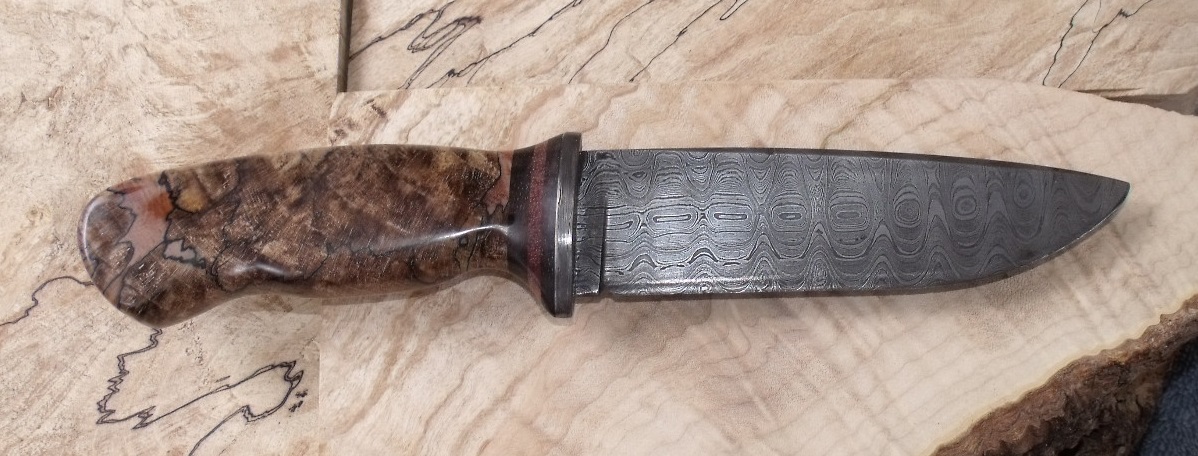
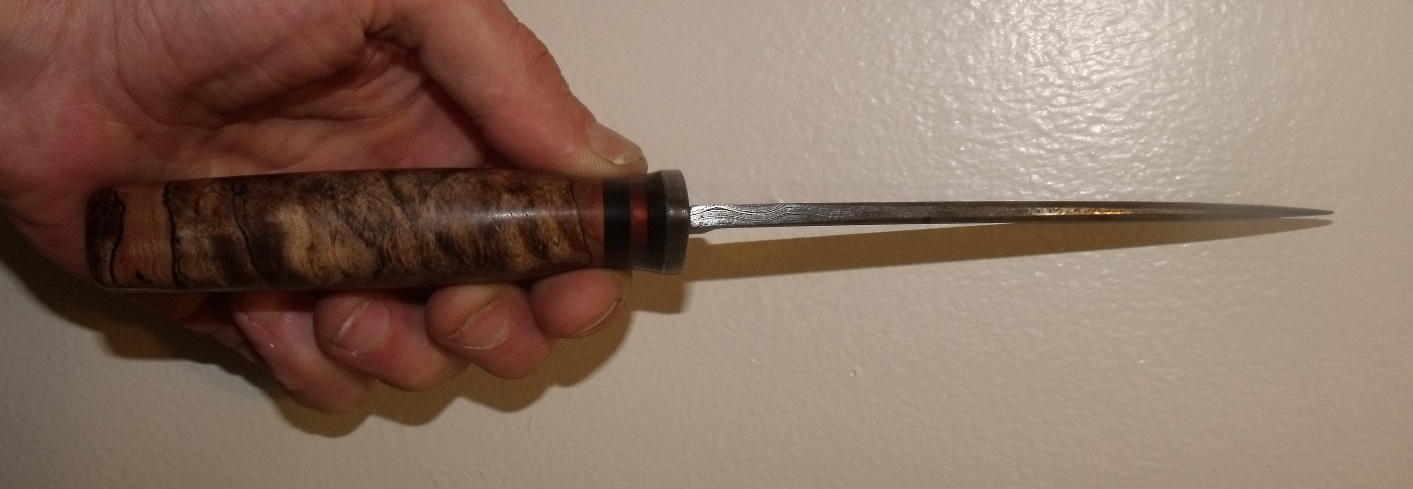
Gerber replacement - WIP

weo

Joined
Sep 21, 2014
Messages
3,111
Hello all. Hopefully it's cooler where you are (I have no understanding of how you S.O.Bs (Sole Occupation Blacksmiths) work in the summer months, especially you guys and gals in the more equatorial climates....)
Well, I thought I'd do what I do best and jump in with both feet and bite off more than I can chew....My new life gives me the ability to get into my forge only on weekends now, and so I thought that's a good way to do a WIP. As this is only my 3rd blade/knife I may make some mistakes, but I can't learn if someone doesn't teach me, so please feel free to add suggestions/corrections as needed.

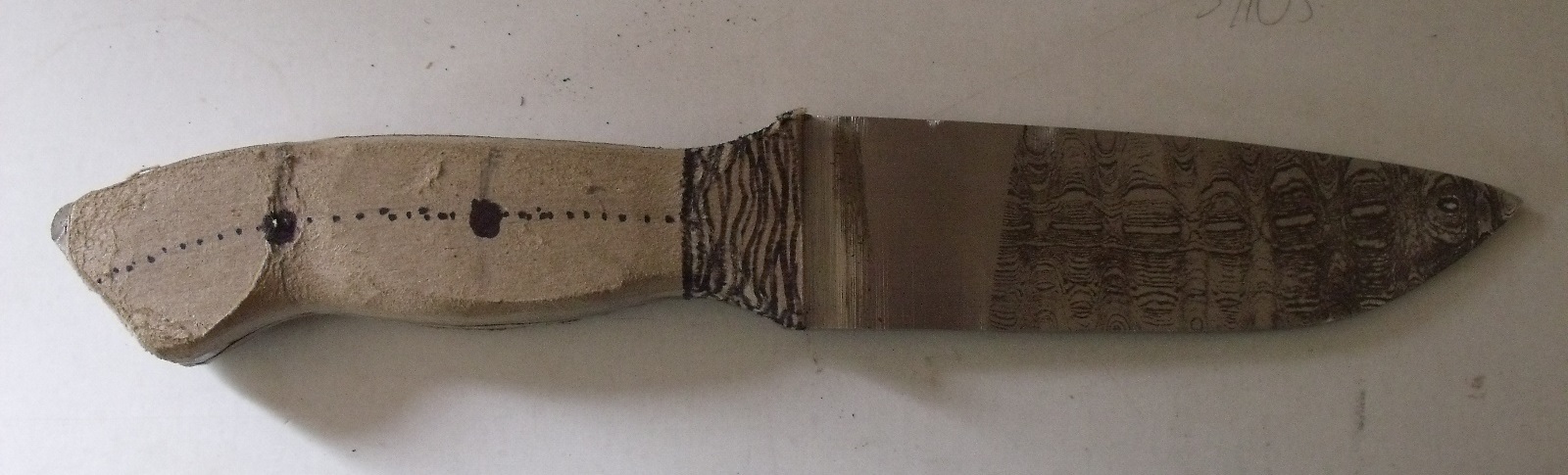
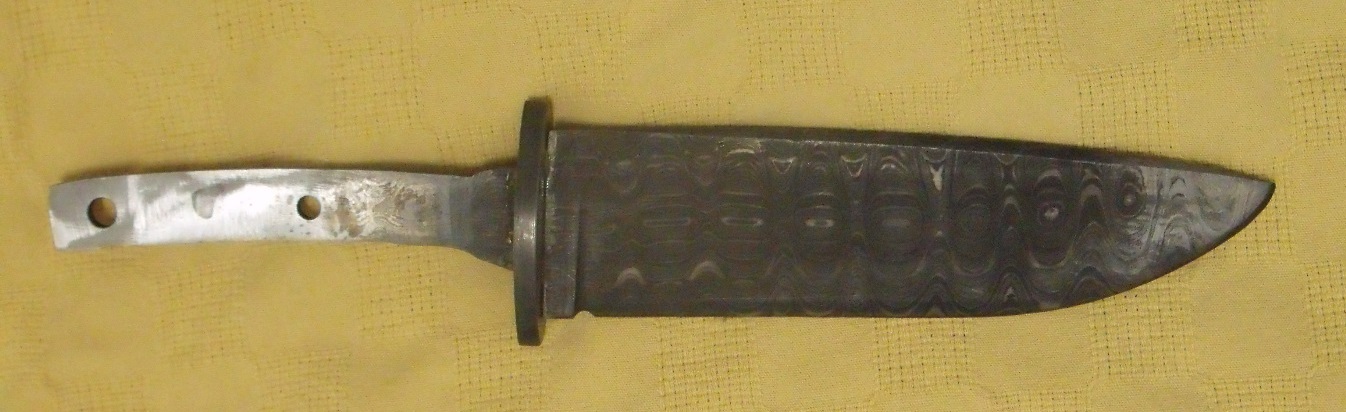
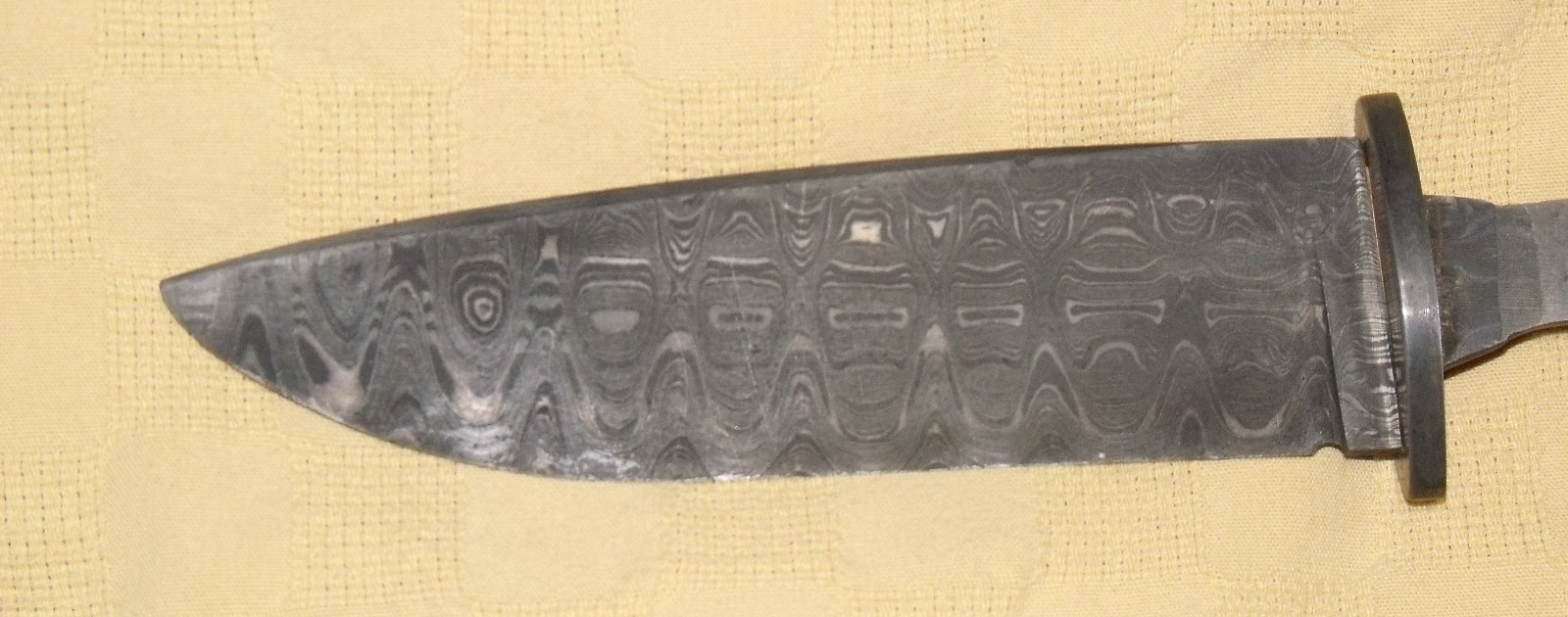
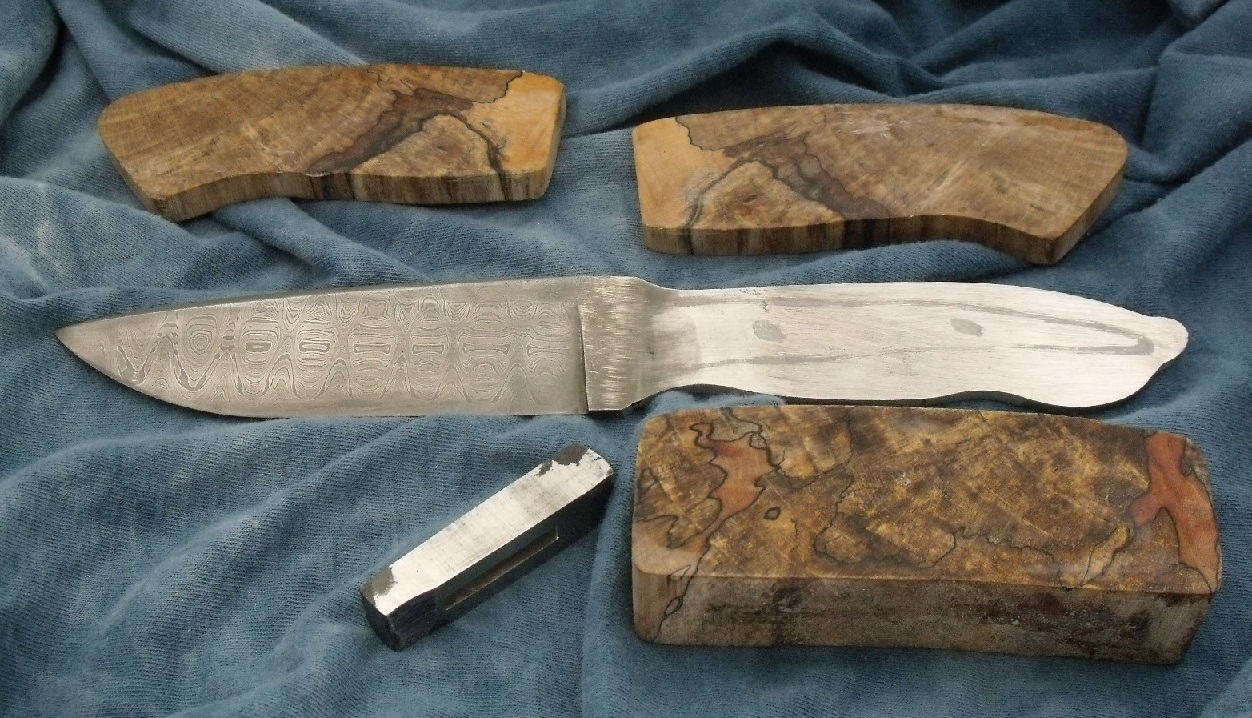
Here's pic of where I am at this point. The billet is 352 layers of 1095/15N20 with a ladder pattern with grooves cut in with an angle grinder. The chunk for the finger guard is the tip of the billet after the initial weld when I didn't pay close enough attention and tapered the billet. It's 22 layers, and I need to do a little forging to thicken the piece for the guard line scribed. The handle material is some spalted maple from one of my trees I took down about 6 years ago and had stabilized this spring by K&G.
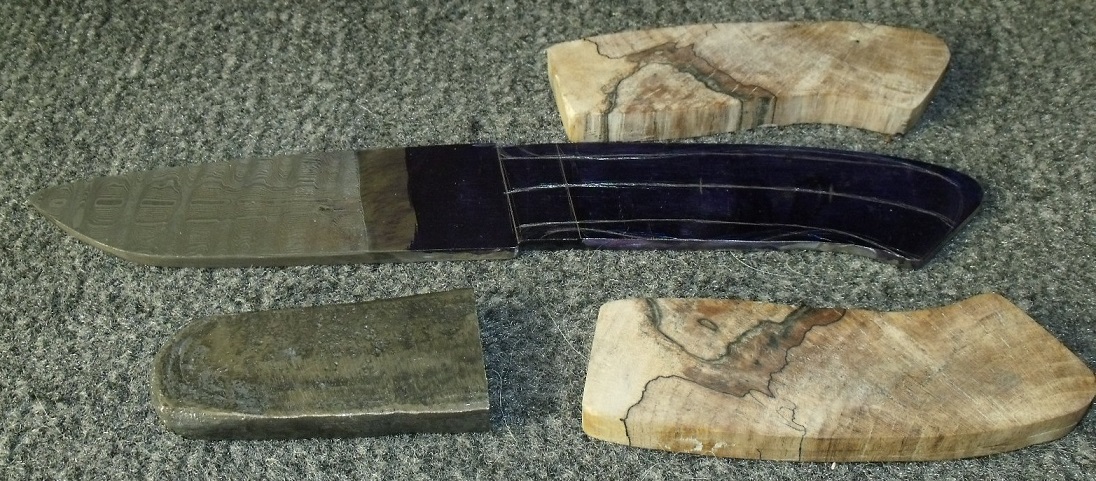

3kIfiXd.jpg
 
I'm excited to see the prigression of that! Where I'm at, it's 108 right now, I about die in the shop this time of year. That maple is very pretty, I think done right it will be a great knife! I assume your sending out for ht?
 
Very slow, sorry for that, but not much time these days...

Here's a pic of what I'm planning for handle shape and rivet positions.

JSLiKB9.jpg


A couple questions/opinions/suggestions from the more experienced of you out there. Thanks in advance:
1. Does the pin placement look good and what color pin would you suggest to go with the Damascus and maple handle? (or should I go through the trouble to forge out some pins with the leftover Damascus stock? which would entail making another spring fuller but then I'd have another tool:D)
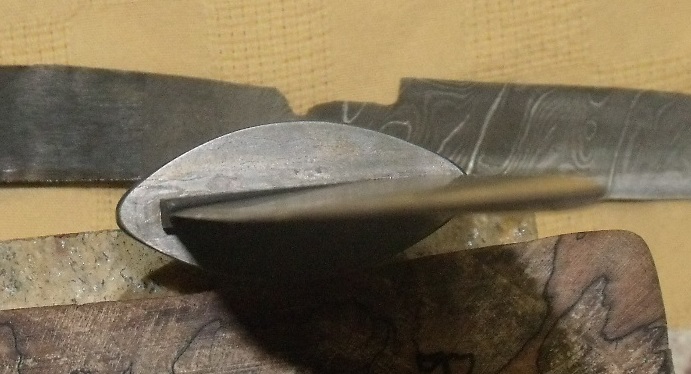
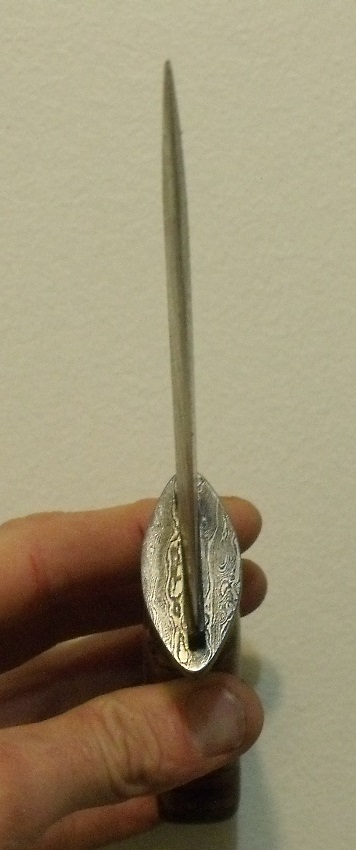
2. I was planning a full tang with the finger guard, but after thinking about this for the past 2 weeks am having trouble figuring out the best (only?) way to merge the 4 pieces of finger guard, tang and 2 handle scales without cutting the finger fuard into two pieces. Here's a pic of what I'm thinking. It's hard to see(sorry), but there's a penciled arc indicating the planned profile I will grind to at the junction of the Damascus finger guard (black) and handle scales (blue).
Is it as simple:rolleyes: as fitting the finger guard to the tang, mill the scales to fit the finger guard, fix to tang and grind to handle shape, taking extreme care at the very end to merge the 4 pieces properly?
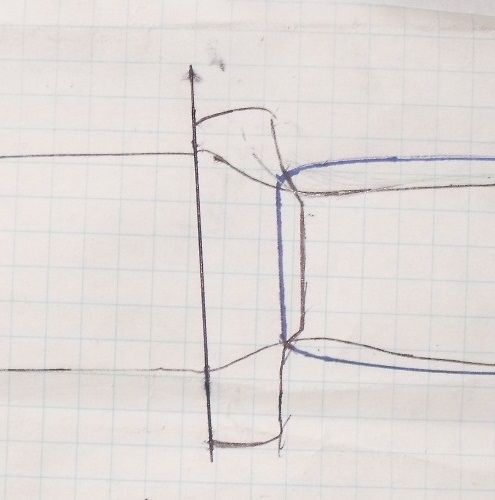
O1BtFeX.jpg


Thanks again.
 
Last edited:
Why not just make it a narrow "hidden" tang blade? That way you can do a mortised handle construction with the two scales and slot the "guard" with your mill/files to fit up to the ricasso/tang shoulders?

BTW, here's a great tutorial for making a mortised handle by Terry Primos. The website is no longer up but can be accessed with the 'Web archive Machine" site. Here ya go: :)

http://web.archive.org/web/20041204.../articles/mortised_tangs/mortised_tangs_1.htm

Click "Next" on the bottom right of each page to see more of the tutorial.

~Paul

My YT Channel Lsubslimed
 
Thanks for the link, Paul. Good read. I'm not much closer to making a decision, but I have made a little progress in the past month. Got the blade pretty much ground, filed and sanded to 800 grit and did a quick etch. Which got me thinking...does anybody etch after each grit? if the acid eats away the carbon steel, isn't that less sanding? or would that only slow the process for too little gain.

Here's where we are, and I'm having trouble deciding to go with the finger guard and a hidden tang using this other piece off my tree, or just use the 2 scales and make this one a full tang. What do you guys think?
Ork8iy5.jpg
 
Hello all, hope the holiday season is treating you well. Sorry this hasn't been much of a WIP (I probably could have used help on my first knife but with only 1/2 day a week in my forge/shop....)

Anyway, I'm almost finished, but have some questions about final etching before gluing the grip on. I polished to a near mirror finish to 1000 grit, washed the blade, air dried then soaked in vinegar for about 6 hours while at work. Got home to a nice black blade, neutralized with baking soda, rinsed oxide off while rubbing with fingers, and had a really dark, pattern like shown in the picture, only very uniform. I wanted a sharper contrast, so I gave each flat a few swipes with a hardened and polished block of 4140 and 2000 grit wet/dry paper. the pattern got really washed out and looked mottled and awful, so I re washed, re-etched for a few hours in the vinegar and after neutralizing and rinsing with mu fingers, here's where I am, afraid to go further and washing out the pattern again. Notice almost no etching on the guard..
Any suggestions?
Thank you
fD7e17P.jpg

sUtCpZH.jpg

I8evOQF.jpg
 
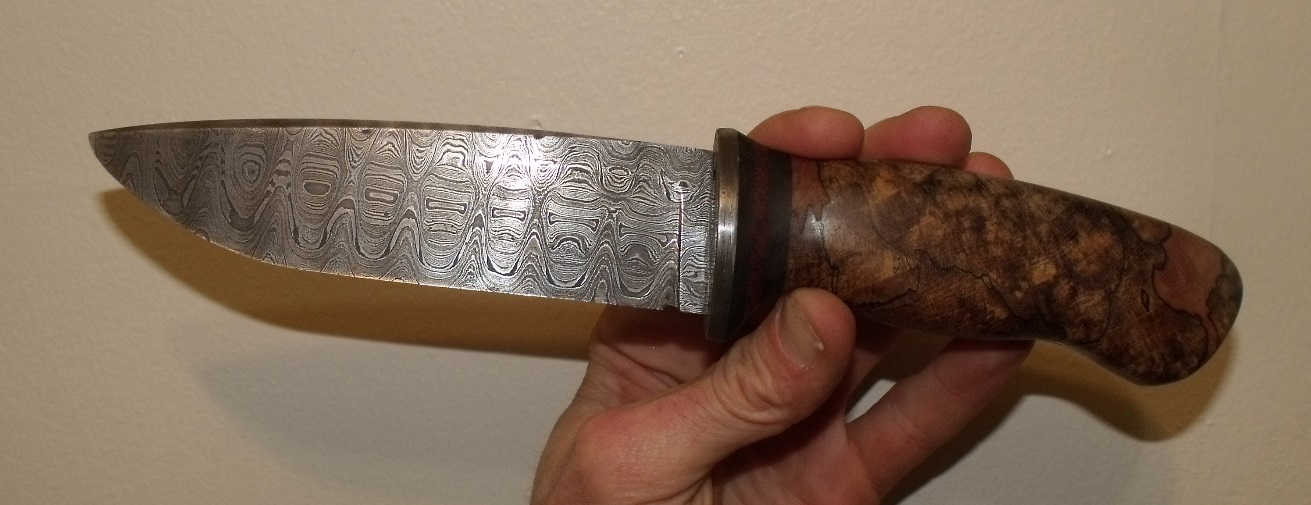
Hello all. Again, I apologize for this not being much of a WIP, but I finally finished this, my first knife, this weekend. I added some ebony and bloodwood to the handle, sanded to 5000 grit and wiped it with some citrus paste wax I had. Also, I used the 5000 grit on the blade, and that seems to work better than 2000grit. I learned a lot on this one, and hopefully the next one will go much quicker. Thanks for all the help.

gdK7uNP.jpg
 
I think that looks really nice. The handle looks good! More pictures would would be nice too. One thing with the blade I would work on on your next knife is giving it a nice pointy tip. Yours is pretty rounded over. If you bake the tip part of your knife more narrow and pointy, it will help with penetration a lot. Overall, I think you did a great job!
 
Very cool, glad to see that you followed through to the end with both the knife and this "WIP" ;) Great job! :)

I think it turned out very nice, especially for it being you first finished knife. You sure did take some pretty advanced work with the forging of the damascus and the hidden tang construction etc.

This is actually the first time I've seen this thread again since I posted in it last August!! Wow that's a long time ago lol.

The only thing I'll suggest is that when etching damascus, use Ferric Chloride for the etchant... save the vinegar for etching a hamon :cool: . A good typical ratio would be somewhere around 4:1, with four parts being distilled water and one part being Ferric Chloride. It will etch faster and deeper and it's just better for damascus, at least when using "simple" carbon steels. Your pattern did however come out pretty nicely, definitely much, MUCH better than how it was looking in the WIP pics :D ;)
Thanks for sharing! :)

~Paul

My YT Channel Lsubslimed
... (It's been quite a while since I've posted any new vids)
 
One thing with the blade I would work on on your next knife is giving it a nice pointy tip. Yours is pretty rounded over. If you bake the tip part of your knife more narrow and pointy, it will help with penetration a lot. Overall, I think you did a great job!

Thanks Nic. That was one of the learning experiences...while finishing the handle on my grinder, I loosened my grip and the grinder responded by throwing the tip into my concrete shop floor. Fortunately, I had enough foresight to not stand in the flight path, and the grinder was going at the slowest speed possible to prevent burning the wood.

I'll try to get a few more pics to include the guard, (but then you'll REALLY see all the flaws....)
 
Last edited:
Very cool, glad to see that you followed through to the end with both the knife and this "WIP" ;) Great job! :)

I think it turned out very nice, especially for it being you first finished knife. You sure did take some pretty advanced work with the forging of the damascus and the hidden tang construction etc.

This is actually the first time I've seen this thread again since I posted in it last August!! Wow that's a long time ago lol.

The only thing I'll suggest is that when etching damascus, use Ferric Chloride for the etchant... save the vinegar for etching a hamon :cool: . A good typical ratio would be somewhere around 4:1, with four parts being distilled water and one part being Ferric Chloride. It will etch faster and deeper and it's just better for damascus, at least when using "simple" carbon steels. Your pattern did however come out pretty nicely, definitely much, MUCH better than how it was looking in the WIP pics :D ;)
Thanks for sharing! :)

~Paul

Thanks, Paul. As for the Damascus, I've been forging non-knife related objects for a number of years, and was looking for a new challenge with my forge-welding. My latest 4 billets were done without flux, 2 with 1080/15N20 and 2 with O1/15N20... at this rate, I've got enough material for years of knifemaking.....
The hidden-tang construction just kinda happened because of screw-ups and not having an overall plan (another thing I learned that should help speed the process next time).

Also, for the final product, I did use ferric chloride at the ratio you mentioned, the vinegar was done as an experiment just to see how the pattern was going to look, and because I did it in the one bedroom apartment I share with my 2 dogs during the work week.

Thanks again for the encouragement.
 
Back
Top