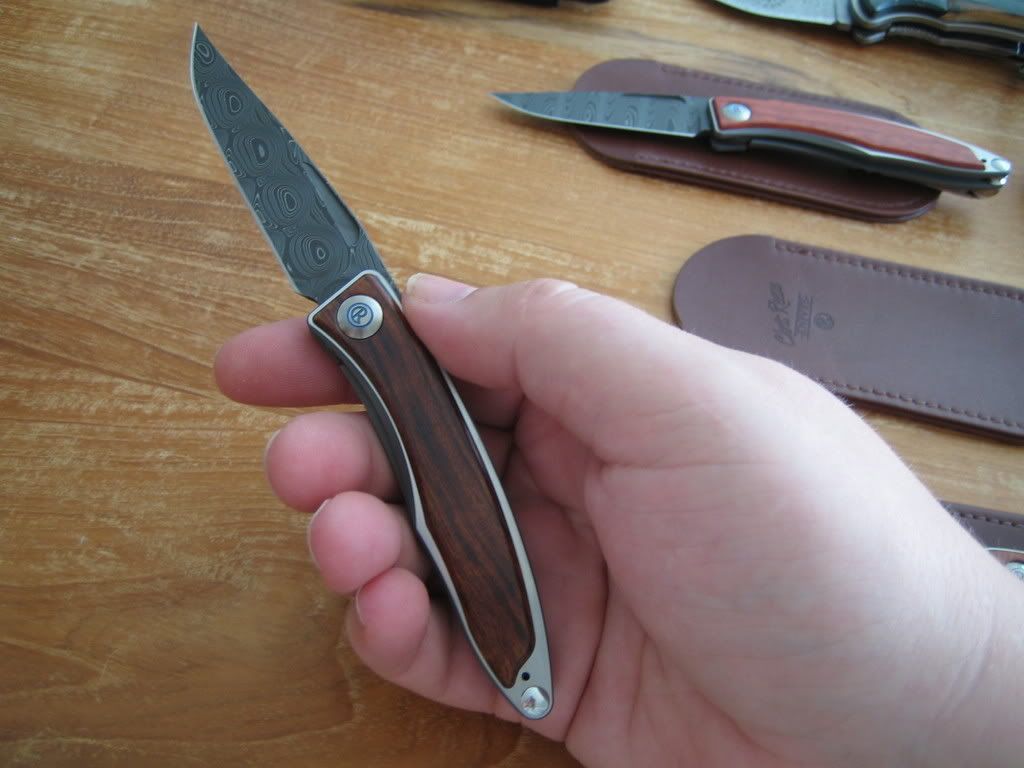
Any preference for snakewood?
http://www.wood-database.com/lumber-identification/hardwoods/snakewoood
The Wood Database
By Woodworkers, For Woodworkers.
Snakewood
Snakewood (Brosimum guianensis)
Common Name(s): Snakewood, Letterwood
Scientific Name: Brosimum guianensis
Distribution: Coastal regions of northeast South America
Tree Size: 65-80 ft (20-25 m) tall, .5-1.0 ft (.2-.3 m) trunk diameter
Average Dried Weight: 79 lbs/ft3 (1,265 kg/m3)
Basic Specific Gravity: .96
Hardness: 3,800 lbf (16,900 N)
Rupture Strength: 23,000 lbf/in2 (158,620 kPa)
Elastic Strength: 2,720,000 lbf/in2 (18,760 MPa)
Shrinkage: Radial: 6.0%, Tangential: 9.0%, Volumetric: 15.0%, T/R Ratio: 1.5
Color/Appearance: Snakewood is so called for its characteristic snakeskin patterns. Wood is typically a reddish brown, with contrasting darker brown or black patches. Color tends to darken and homogenize with age and exposure; see the article on Preventing Color Changes in Exotic Woods for more information.
Grain/Pore: Snakewood has a straight, uniform grain, with a fine texture. The wood has closed pores and a naturally high luster.
Durability: Snakewood is reported to be very durable and also resistant to insect attack, though it is seldom used in exterior applications where durability would be an issue.
Workability: Being closely related to Bloodwood, Snakewood shares many of the same working properties; namely, the wood is extremely dense, and has a pronounced blunting effect on cutters. Snakewood also tends to be quite brittle and can splinter easily while being worked. Despite the difficulties of working it, Snakewood turns well and finishes to a high polish.
Smell: Has a mild scent when being worked that is similar to Bloodwood.
Safety: Although severe reactions are quite uncommon, Snakewood has been reported as a skin and respiratory irritant. See the articles Wood Allergies and Toxicity and Wood Dust Safety for more information.
Price/Availability: As a rare and small tree, prices for surfaced and milled Snakewood that display the characteristic snakeskin pattern are perhaps the most expensive of any exotic lumber worldwide in terms of per-boardfoot cost. Less figured sections of the wood are usually sold for much lower prices. Snakewood is also commonly sold in full and half log forms, which typically include significant pith checking and areas of both figured and non-figured wood, which can result in high wastage.
Comments: One look at a highly figured piece of Brosimum guianensis and it’s easy to see why it’s called Snakewood: the dramatic specks and splotches bear a close resemblance to the skin of a snake. Such figuring can be so pronounced that it has been compared to the writing of hieroglyphics, and is sometimes called Letterwood.
In addition to its colorful figure, Snakewood is also among the densest and hardest of all wood species worldwide. Among woodworkers, it vies with Lignum Vitae as the heaviest wood in the world.
Some common uses for Snakewood include: inlay, veneer, violin bows, tool handles, and other small turned or specialty objects.
Related Species:
Bloodwood (Brosimum rubescens):



 )
)