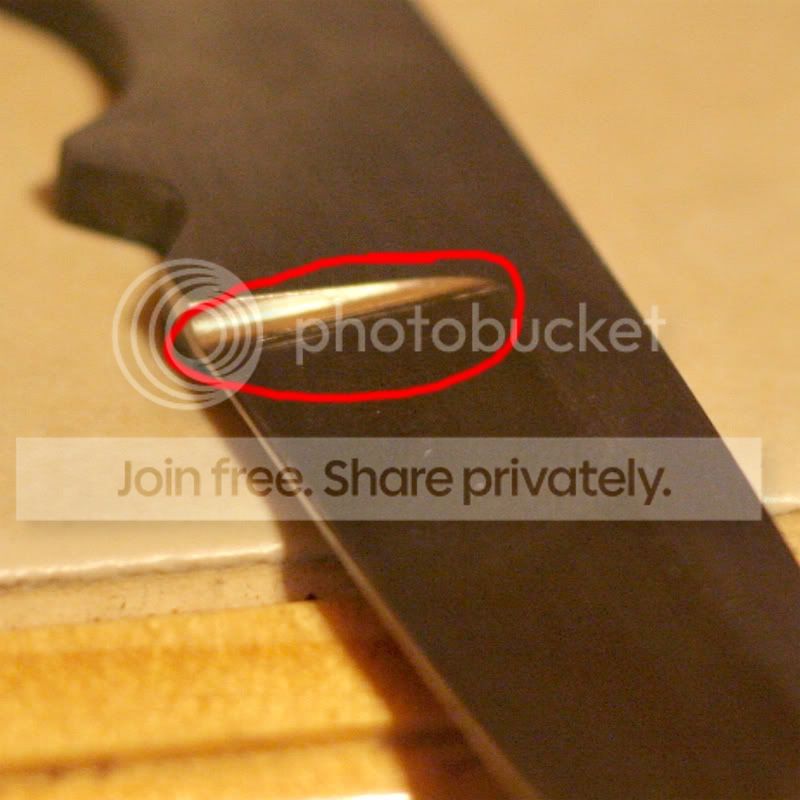
Getting scratches out near the plunge

Joined
Apr 5, 2009
Messages
169
Nathan (silver_pilate) was nice enough to show me how he does his finishing sanding with a piece of angle iron but I seem to be having trouble getting scratches out right up against the plunge. Is there some trick to this that I am missing? Thanks for any advice.

kn12.jpg
 
The tool I made myself for sanding (Not very fancy, basically just bar stock with handles cut onto each end) has one edge rounded for getting into plunges. It works pretty well.
 
Oh, the dreaded plunge scratches. This is a major PITA of me! Someone (Bruce maybe?) posted a trick a good while back that I've started using with good success. I took a palm sander (with a rectangular bottom plate, not one of the mouse shaped ones), removed the rubber contact pad on the work surface, and cut and machined a piece of micarta to fit the plate and epoxied it in place. The micarta has two edges that are ground on the belt grinder to match my typical plunge radius (if you can't match then perfectly, make the corner a bit sharper than your plunge so you can get in there). I matched the plunges by taking one of my knives, and checking the micarta to the plunge with each pass.

Once the epoxy is all set up, take the sander and mount it upside down in a sturdy vice. I wrap a towel around the sander to dampen some of the vibrations, and then clamp it down snug in the vice. Careful when you turn it on; if it's not tight, it will worm it's way out of the vice. Anyway, take some el cheapo spray adhesive and stick a 400 grit piece of paper to the micarta, wrapping over the edge that is ground to fit your plunge. Then turn the sander on, and place the knife on the micarta, and push the plunge up to the shaped corner to work out the scratches. It will swirl up your blade real good, so don't work too high in grits before you get the plunge cleaned up. Make sure you remove your paper after each time you use it so the spray adhesive doesn't permanently set up. It will eat through paper really fast at the plunge, so you can just pull up and re-stick your paper several times to get fresh paper on the plunge.

Once the plunge is clean, I use the leather cushioned sanding stick and place the corner of it in the plunge. Rotate it into the plunge with a twisting motion of the stick (from wrists flexed to extended), and this will get your scratch pattern to match the rest of the blade.

Good luck. Other people also use dowels or pin stock of the same radius as the plunge and work it to remove scratches.

--nathan

 
I'll second Nathan's suggestion of a palm (or maybe it's technically a 1/4 sheet sander, although mine will not take 1/4 of a sheet of standard sandpaper.) I haven't gotten it figured yet for cleaning up the entire bevel, but it does work absolutely beautifully for getting the plunge area. Mine has a plywood plate as that's what I had on hand, but micarta would be better.

Oh, I never got around to radiusing the edges to match my plunges...they are still square, and it doesn't seem to matter. I do have to work it around a little bit to get the whole plunge, but it's not a big deal and works fine for me.
 
I've yet to try the palm sander (one of these days) , but I do have several edm stones. I shape them to fit the plunge and work them in there. They seem to be faster because they don't have to keep having fresh paper wrapped over them like a regular sanding stick would need. Once I get the previous grit scratches out I start my normal hand rub with sanding blocks (rubber eraser).
 
Best thing for those scratches are Tool and Die Makers stones. You can get them from MSC. I use 1/2 x 1/4 x 8" silicon carbide in 400 grit. It usually only takes me 10 min a side to get rid of those marks. I shape the stone to fit the area on one end and use the other end of the stone to do the first polish on my blades. It beats the hell out of 400 grit sand paper and saves a lot of time and money. It also helps you keep a flat grind very flat.
 
Plunge scratches are a b!tch. I wrap a piece of leather around a small square block of micarta or something and then put sandpaper over that and just go at it. I don't think there's an easy way to do it unfortunately..
 
Brian, looks like that would work on the flats and bevel as well. Can you tell us a little about it?
 
Oh, snap! Brian, that tool is great! I'm definitely making one when I can. Water cooled, that's sick.
 
Back
Top