Getting them blades straight

Joined
Mar 27, 2002
Messages
407
I just spent the last 2 hours forging finishing one blade and starting and finishing another

neither are straight my anvil isnt perfectly flat im sure this adds to hinderance
so i threw a 1/2 inch plate on top that i know is flat and worked away at straightening

I worked and worked and worked but still they arent straight so i threw them back in the forge to anneal for the night

any suggestions? im thinking i can grind them flat or at least hoping for tomorrow

i will send some pictures tomorrow

im doing both stock removal and forging but i just got my new forge setup going so yesterday and today were the first times swinging the hammer in 3 months
other then my tin bashing lol
 
annealing them is a good first step... i forge close to finished shape, as straight as i can (most of mine are forged straight these days, but longer blades are still difficult) then anneal. once cool i will do a bit more straightening by lightly hammering on my smaller anvil, because its flatter than my larger one. i get down and sight across my anvil face to see if the blade is arching up and adjust accordingly. if for any reason there is twist in the blade, i throw it in the vice and get out a big crescent type wrench to correct it. all done cold and annealed. then i move on to grinding and can see if its still not straight in places after a few passes on my flat platten.
-Lou
 
As many may have noticed, there are a lot of threads about warped and not straight blades, lately. Those of us who delve in other sciences than metallurgy already were prepared for this and avoided the problem.

The planet Jupiter is at opposition right now, and is closest to earth. The moon is also at opposition right now, too ( look up in the sky tonight,and you will see them side by side). The planetary gravitational waves from the sun on one side of the earth,and the moon and Jupiter on the other don't give your poor blade a chance. You must move all your equipment to align with the apsides ( the line from apogee to perigee ).Yep, you got to move the anvil, grinder, forge/oven....everything! Hold all blades at 90 degrees to this line. It is best to do all work at midnight, to get the most accurate angle. Forget the old "align the blades to magnetic north" stuff that Mark Williams tells you. When Jupiter is at opposition, the magnetic poles shift anyway. Use of an astrolabe can be very useful in re-aligning your equipment.

Just trying to be helpful;)
Stacy
 
smarty pants. :D

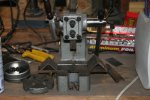
Make yourself a little straighting tool out of a cheap arbor press.

attachment.php
 

Attachments

  • ironcleaver36.jpg
    ironcleaver36.jpg
    50.8 KB · Views: 254
I've been noticing pics lately (Blade mag has one of Fogg) of Bladesmiths swinging what look to be wooden hammers.

Do the wooden hammers have application for straightening, so you don't ding and deform the geometry you've spent so much time and effort trying to create ?

Do any of you guys use wooden hammers and if so when do you break out the wood and for what ?
 
Last edited:
A good flat surface is nice for sighting off from for straightness but is not necessary for hammering on when straightening. In fact a very little bit of a dish on a surface can be handy for tapping things straight without inducing more stress than necessary. Forge larger sections hot and thinner sections cooler. At the end, forge at lower temperatures in order to tap things straight without leaving huge divots or locally deforming the metal. Keep things straight as you go, it is bad forge practice to just let the work distort as it will thinking you can do all the straighten at the end, try to leave things as straight as you can after every heat. This will also promote even forging which will help in keeping things straight.

When you are done and you have tapped things straight, normalize, this is very important. In normalizing not only will you help eliminate the distortion you may even see new distortion manifest itself, now is the best time to see it and get it fixed. Most do not normalize properly because they have been fed a line of fairy tales about the magic of low temperature forging. Make you first normalization HOT, rearrange the inside of that steel and homogenize it, then cycle it cooler to refine things. That first hot heat will result in complete recrystallization which will most effectively hit the reset switch on the issues that could cause distortion. If it warps in any of the subsequent heats now is a great time for that to happen when you have the best opportunity to fix it.

It is best not to anneal before you have the blade as straight as possible. Stored energy is what is causing the problem, if you remove it with annealing and then bend it straight afterwards you are reintroducing stress that you just went through the trouble of getting rid of. Get it as straight as possible and then set it stress free in that position with your anneal. After the anneal watch how you grind things. The heavy hogging belts will deform as much as cut and introduce all kinds of stored energy. Grind down both sides as evenly as possible and avoid turning the steel blue, I have always believed that habit to be a sloppy shop practice and I prefer to save my heat treating for the proper equipment and not do it on the grinder. When I started using height gauges to scribe center lines I noticed a marked decrease in distortion in the later heat treatments, the obvious explanation for this is that it promoted more even grinding on my part.

Sometimes you can do everything right and the darned thing will still take of in a bad direction on you, in those cases I refer you to Stacey’s post on proper planetary alignment since distortion has never been entirely eliminated in any metal work process and may never be in the future due to inconceivable number of unseen variables. Although industry has come very close and they do it with properly done pre- heat treatment, heat treatments and stress relieving operations.
 
I've been noticing pics lately (Blade mag has one of Fogg) of Bladesmiths swinging what look to be wooden hammers.

Do the wooden hammers have application for straightening, so you don't ding and deform the geometry you've spent so much time and effort trying to create ?

Do any of you guys use wooden hammers and if so when do you break out the wood and for what ?

I mainly use a wooden baton (or hammer) and wooden anvil for fine tuning and adjusting the profile, but they can also be helpful with working the blade straight, especially when you don't want to dent or ding the surface of the blade.
 
Well now I have never used a wood hammer or anvil when working on an knife but I am eager to hear more if you dont mind sharing Tai. Some questions would be; do you use the wood tools while the steel is cold? what wood is a good choice for such tools?

Just thought I would ask before I go and start bumbling around with making and trying out some wood tools.

Thanks much!
 
I use the wood tools while the steel is hot, to adjust counter bends etc,... in the profile mainly... but a nice heavy hammer is also good for straightening blades. For straightening I go to a steel anvil.

You need a good hardwood that is also tough, something like oak or hickory. It will smoke a little and char the wood a bit, but still last a long time...

I made a nice "schwocker" out of a baseball bat. I shortened it, drilled a hole in the far end, and filled it with pewter for extra weight.
 
When straightening I check for any twisting first. You can straighten that with a vice and wrench. Then straighten the back, then the edge,... just from above critical,... not too hot with nice even heats. You may have to work the back and edge alternating several times until you can get it to set up straight through the straightening and normalizing cycle or cycles.

Relatively long and thin blades will be more difficult to straighten.

Straightening in the forge can be frustrating and take some time plus some practice, but it's worth it in the long run.
 
Last edited:
As many may have noticed, there are a lot of threads about warped and not straight blades, lately. Those of us who delve in other sciences than metallurgy already were prepared for this and avoided the problem.

The planet Jupiter is at opposition right now, and is closest to earth. The moon is also at opposition right now, too ( look up in the sky tonight,and you will see them side by side). The planetary gravitational waves from the sun on one side of the earth,and the moon and Jupiter on the other don't give your poor blade a chance. You must move all your equipment to align with the apsides ( the line from apogee to perigee ).Yep, you got to move the anvil, grinder, forge/oven....everything! Hold all blades at 90 degrees to this line. It is best to do all work at midnight, to get the most accurate angle. Forget the old "align the blades to magnetic north" stuff that Mark Williams tells you. When Jupiter is at opposition, the magnetic poles shift anyway. Use of an astrolabe can be very useful in re-aligning your equipment.

Sometimes you can do everything right and the darned thing will still take of in a bad direction on you, in those cases I refer you to Stacey’s post on proper planetary alignment since distortion has never been entirely eliminated in any metal work process and may never be in the future due to inconceivable number of unseen variables. Although industry has come very close and they do it with properly done pre- heat treatment, heat treatments and stress relieving operations.

You guys sure do worry about some dang weird stuff! :D

I suggest you use your "tuning forks" to tune your quenching mediums... :)
 
hahaha will try all techniques listed :)

the side of the anvil and the press seem like good idear's tho
and i can make a wooden mallet :)

I still know best that its HOURS i need hammering to get the quality working coming out
i got this one straight today tomorrow im gonna grind it out

dsc01092dy7.jpg

dsc01088gp4.jpg
 
Back
Top