Gluing scales and peening pins

Joined
May 7, 2010
Messages
902
I received a bunch of exotic wood of many different types from my cousin who got them at an estate sale. I know what some are but most I don’t. I also know that because of higher than normal oil content many of them cannot be reliably glued with epoxy. The way I have been pinning scales to tangs is to glue them on with epoxy as well as to glue pins in the handle material also. I feel that with these exotic woods I should also be peening the pins so that I am not relying on the epoxy to hold the scales on the tang.

I have a tapered reamer to slightly enlarge the holes for peening, and have practiced a little with scrap materials.

My question is how does a person attach the scales, shape the scales, insert and peen the pins without the glue screwing things up by oozing into the pin holes negating the taper that was previously put there? If I insert and peen the pins at glue-up time I’m concerned that while shaping the scales after the glue has hardened I might file away the peened portion and I’m left with an insecure pin.

I hope that there is some slick way of doing this that will make me smack my head and say “Why didn’t I think of that?”

Tentative plans are to wipe the scales with alcohol and assemble and glue them on with temporary pins in the holes. After the scales are clamped and the epoxy still soft I pull the pins out and pray that the scales don’t slip. When the epoxy has hardened I can re-drill the holes and insert temporary pins while shaping and finishing the handle hoping that the glue will stick during this time. At the end I can taper the holes and insert and peen the final pins. I suppose I could put wooden “pins” in the holes and not worry about removing them, just drill them out after shaping the handle.

I have five other knives with the holes already drilled for pins and heat treated and it would be difficult to enlarge them to use something like corby bolts. Besides, I really want to learn how to do this correctly.

- Paul Meske, Wisconsin
 
I think you're over-thinking this, buddy. Just get the scales close to finished shape with temp pins, pull it apart, counter-sink the holes on the scale "face" slightly to allow for more peening room, then glue up, pin and peen. Any excess epoxy will be squeezed out. It's mainly there to seal out moisture, your peened pins will provide a very strong mechanical joint. You are correct that tapering the holes and making the tang holes oversize will provide room for the pins to expand. If you skip that part you can split the scales or lift them up off the tang :mad:
 
When turning wood it is common to glue together exotics to make a blank, or to be used as pieces glued to metal parts to make lathe tools, pens, letter openers, and just about anything else you could imagine. It is more exciting than I can tell you to have a piece fly apart because the epoxy didn't adhere when the piece is spinning at a 2-3 thousand rpm.

I stop that, I started cleaning off the excess oil on the wood to be adhered with lacquer thinner or toluene. They work great since they remove the top layer of oil from the wood, allowing the epoxy to bind to the lignan.

Glue your scales on, then finish as usual as described by JT. I have never had a high speed failure (!) after cleaning with those high VOC solvents, so a low speed application should be just fine.

Robert
 
Last edited:
When turning wood it is common to glue together exotics to make a blank, or to be used as pieces glued to metal parts to make lathe tools, pens, letter openers, and just about anything else you could imagine. It is more exciting than I can tell you to have a piece fly apart because the epoxy didn't adhere when the piece is spinning at a 2-3 thousand rpm.

Soooo, when life gets a little to dull I now know what to do! How cool is that!?! I have a mental image of the excitement you're alluding to. (DUCK AND COVER!!!!) Is it similar to the excitement of a buffer grabbing a blade or a belt breaking while grinding?

I stop that, I started cleaning off the excess oil on the wood to be adhered with lacquer thinner or toluene. They work great since they remove the top layer of oil from the wood, allowing the epoxy to bind to the lignan.

Glue your scales on, then finish as usual as described by JT. I have never had a high speed failure (!) after cleaning with those high VOC solvents, so a low speed application should be just fine.

Robert

You've had success with both lacquer thinner and/or toluene. I am thinking that a person has to apply it pretty liberally and probably scrub the surface a little bit? How long should it dry before gluing them?

- Paul Meske
 
Soooo, when life gets a little to dull I now know what to do! How cool is that!?! I have a mental image of the excitement you're alluding to. (DUCK AND COVER!!!!) Is it similar to the excitement of a buffer grabbing a blade or a belt breaking while grinding?

You are correct! I shot a piece of mesquite off the lathe where it broke along the grain and it hit and buried itself (a piece about the size of a golfball!) in the sheetrock of the garage.

On another panty ripper, a large piece came apart while polishing at about 3500 rpm, hit my stomach, ran up and bounced off my faceshield, and still had enough rpms to roll all the way across the street and into the neighbor's yard!

Additionally, when turning a lot, you sharpen your tools A LOT. That means a lot of grinder time, so always an opportunity for a good surprise there if you have a mental lapse!


You've had success with both lacquer thinner and/or toluene. I am thinking that a person has to apply it pretty liberally and probably scrub the surface a little bit? How long should it dry before gluing them?
- Paul Meske

Correct. One of the reason that the exotics resist wear so well is their high oil content. I have turned a lot of cocobolo, wenge, rosewood, macassar ebony, etc. and they have so much oil in some pieces you don't need a finish. I make sure the pieces match up them dip a tooth brush into a small cup of the solvent, the scrub them on the surfaces to be glued. Then I take a piece of jersey (like an old T shirt) and wipe them clean. All of your high VOC solvents should be gone in about 20 minutes. Don't get cheap and use mineral spirits or paint thinner. High VOC (lacquer thinner, xylol, toluene, etc.) are what you want.

Gluing with this prep, I have made a couple of hundred pens, and too many other projects to count and never had a failure. (Knocking on wood *tap* *tap*)

Robert
 
If you are pounding pins hard enough to expand them in the tang, you're using way too much force.
Peening should be done on the ends of the pins, with very light hammer taps, and a small hammer.
 
If you are pounding pins hard enough to expand them in the tang, you're using way too much force. Peening should be done on the ends of the pins, with very light hammer taps, and a small hammer.

I have no idea if pins expand into the tang. I didn't drill my holes with that expectation. I will be satisfied to have them expand only at the ends. Thanks for the warning. Numerous small taps with a light hammer rather than one or two blows with a heavy hammer.

- Paul Meske
 
I use materials that you just cant peen pins in (ivory, pearl, some wood etc) and the way I do it is use a quality glue and slightly bend the pin and gently hammer it in. The bend locks it in place. Never have had a failure reported in 20 yrs.
 
I peen pins in ivory, pearl, tortoise shell, and wood quite often.
All it requires is finesse. You can't use your blacksmithing hammer and anvil to do it.
 
My thoughts as a beginner would be: is glue the handles on, re-drill the pin holes then taper them (takes the glue out) and tap the pins in last.
 
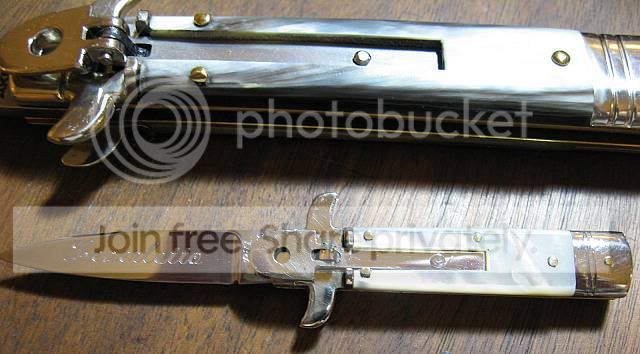
Here's a miniature Leverletto I'm just finishing with mother of pearl scales that I peened. The knife is 3-3/4" open.

IMG_2061.jpg
 
Back
Top