Good firewood axe with overstrike protection?

Joined
Apr 17, 2010
Messages
1,343
Hi, I have a relative who breaks a lot of axes chopping firewood. Since he hasn't learned anything from his mistakes, I was wondering what good firewood chopping axes are out there that actually survive multitudes of overstrikes.

I will consider any replies that do not answer my question to be insults to me and my family, because I have already considered the non-replies that many would likely want to make.

I have as my concern the family members other than this person who depend for their warmth on the firewood chopped by the person in question. It is their best interests I have at heart. Please respect me, my family, and the letter of my question in your replies.
 
might help if you get fiberglass splitting mauls, and get some of those big foamy pads that go under the head to cushion it.
 
Do you have any more information?

My gut instinct is to tell you to buy a splitting maul with a composite handle.

However, I don't know if the "person" is only splitting, or if they're processing the entire tree. ("Chopping firewood" can mean several different things.) I don't know if you're in a location to go out and buy one. What is this "person" using now?

More information would certainly allow people to help you more quickly and accurately.
 
To clarify, is the axe used for splitting firewood only? By that I mean, splitting sectioned rounds and not chopping or sectioning wood.

If the sole use is splitting wood, then a maul is the best tool for the job. Mauls come in different weights, 6 lb and 8 lb are most common. Also, mauls have two types of handles, round and axe. Axe handle mauls offer more overstrike protection than the round handled version. Regarding weight, I prefer an 8 lb and find I expend less energy with the heavier maul. I realize that it must appear somewhat counterintuitive suggesting that a heavier maul will save energy, but I find that fewer strikes are required with a heavier maul - particularly on large rounds and hardwoods.

Gransfors Bruks and Oxhead offer mauls with steel collars for overstrike protection. Both are expensive options. An alternative is a rubber collar sold at most hardware stores that can be slipped onto a handle. Such a device can be added to a maul or an axe. As mentioned above, fiberglass handles are very durable, as well.
 
To clarify, is the axe used for splitting firewood only? By that I mean, splitting sectioned rounds and not chopping or sectioning wood.

Gransfors Bruks and Oxhead offer mauls with steel collars for overstrike protection. Both are expensive options. An alternative is a rubber collar sold at most hardware stores that can be slipped onto a handle. Such a device can be added to a maul or an axe. As mentioned above, fiberglass handles are very durable, as well.

+1

A fibreglass handled splitting maul with rubber collar is the cheapest learning tool for splitting wood 'with the grain', and I'll add that IMO a saw is safer for some people when it comes to sectioning wood (across/against the grain), eg Fiskars/silky saws.

Good to see that you are taking the time to look out for your family. :thumbup:
 
Thanks for the information, I think you guys have identified the problem. Yes, he is only splitting rounds that have been cut with a chainsaw.

He has a fiberglass-handled maul, but I don't think he knows that that is what he should be using. The likely reason he doesn't know is a sore subject. Also, it does not have a synthetic overstrike protector.

the only problem I foresee is that the best overstrike protectors I have seen require the handle to be removed for installation, but the maul's fiberglass handle is epoxied in.

Is there a good way for a less-than-bright person to remove, service, and replace these epoxied fiberglass handles to install overstrike protectors? Unfortunately I live several hundred miles too far away to help with the procedure.
 
Thanks for the information, I think you guys have identified the problem. Yes, he is only splitting rounds that have been cut with a chainsaw.

He has a fiberglass-handled maul, but I don't think he knows that that is what he should be using.

the only problem I foresee is that the best overstrike protectors I have seen require the handle to be removed for installation, but the maul's fiberglass handle is epoxied in.

I cheated and pasted this from wiki (yeah, I know, you get what you pay for ;))

"Unlike an axe, maul handles are normally straight and closer to round than the elongated oval axe handles tend to be."

The reason I pasted this is that most mauls that I have used have straight handles with (at most) a slightly flared end, and installing a new protector would be as easy as hammering it up the handle. :)

Removing an epoxied handle and then refitting it does not, IMO, sound like a safe option here... so, what handle shape does his maul have and what specific overstrike protector do you have in mind (eg rubber v fitted metal, brand)? :confused:
 
I cheated and pasted this from wiki (yeah, I know, you get what you pay for ;))

"Unlike an axe, maul handles are normally straight and closer to round than the elongated oval axe handles tend to be."

The reason I pasted this is that most mauls that I have used have straight handles with (at most) a slightly flared end, and installing a new protector would be as easy as hammering it up the handle. :)

Removing an epoxied handle and then refitting it does not, IMO, sound like a safe option here... so, what handle shape does his maul have and what specific overstrike protector do you have in mind (eg rubber v fitted metal, brand)? :confused:

You're right, I was looking at the overstrike protectors for oval-handled axes. The round ones for mauls or block splitters look like the type they'll need.
 
He has a fiberglass-handled maul, but I don't think he knows that that is what he should be using.

So, he is splitting wood with an axe rather than the maul? Reason I ask is that a stock fiberglass handled maul is likely to have a poor maul head profile. At least the mauls I looked at in Lowe's and Home Depot have an overly blunt profile and would require some work to sharpen. Sharpen it or have it sharpened before use. I would not want to split wood with some of the hardware store mauls in stock form.

On another note, a couple splitting wedges are excellent additions to a maul. I use wedges for long dried out rounds that can't be split with a maul after a couple strikes. Simply insert a wedge in the area where the maul hit and drive it in with the hammer end of the maul. A second wedge is handy if the first wedge gets lodged.
 
I believe Iltis Oxhead has a splitting axe with overstrike protection.

But there again, it's an expensive option.
 
I have a thirteen pound all steel maul that i got from Bailey's Mail Order Logging Supply. I don't live too far from one of their two stores and i picked it up years ago. I'm 6' 5" and weigh 294 lbs and have struck wood with that maul every way possible. One time i split 24 inch cuts from an entire Elm tree and my uncle came by after i was done and told me you couldn't split Elm because its too stringy. I don't think you could run over it with a log truck and hurt it.

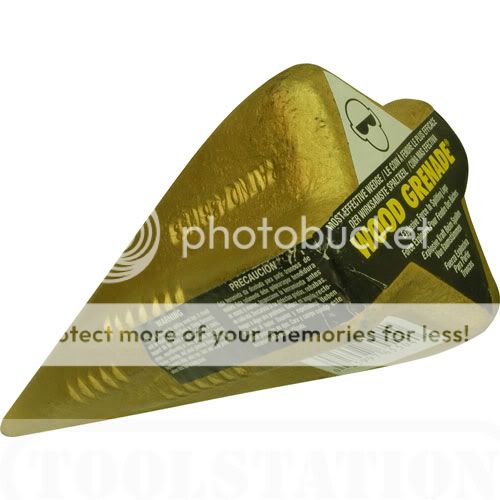
I use this

WOOD20GRENADE1.jpg


and a fifteen pound sledgehammer for back up.


Johnny
 
Last edited:
The Wood Grenade ROCKS! Just be careful, since it can come flying out of curly knotted wood pretty forcefully. The important thing is that it actually gets that stuff split! :D
 
A cheap way to protect your handle under the head is to wrap 12 or so inches with a bicycle inner tube and tape down the loose end. Cut out the section with the valve on it. Be sure to use an old tube that was already flat.
 
To protect my sledge hammer from overstrikes i followed a friend's advice and wrapped electrical tape just below the head for 6-10 inches then slipped a 6 inch piece of radiator hose over the tape.

I like that idea of using a bike inner tube instead of electrical tape then slip a radiator hose over the tubing.
 
Back
Top