Got a question about 1/4" stock

Joined
Jun 16, 2008
Messages
3,415
I am going t be getting some 1/4 inch thick 1084 from Aldo soon. Is 1/4 inch too thick for lets say a 8-9" knife. I would think adding a swedge would help a bit with the thickness where any slicing is done by the knife. What do you guys think?

I do stock removal right now, and hope one day to be able to learn how to forge. But for now I placed an order for some 1084 and want to make some knife shaped objects and learn to do my own HT on it on an outdoor forge or something. Thanks.

-frank
 
IMO, 1/4" would be ok for a heavy Bowie or heavy use camp or chopper type knife, it would be to thick for say a skinner or an all around hunting knife. I use 3/16" for my Bowies and a camp knife that I will be doing later this year, and 3/32" for skinners and 1/8"-5/32" for hunters and EDC knives. Just my 2 cents.
 
Just flat grind all the way to the spine, if you do just a hint of distal taper your edge bevel will look a bit funny being higher at the choil than out near the tip but the balance will be nice, most stock removal guys don't do a distal taper because it's more work to grind than just throwing a bevel or hollow on a flat bar, but why follow the herd?:D

-Page
 
Well - just about every knife I make has a distal taper, it's a natural occurrence when grinding a knife that comes to a point, the distance that the taper travels is another story, however.

You can make a fine cutting knife out of 1/4" stock, you may just have to remove more metal to get what you want.
 
Let's assume you're going to do a full-flat grind on 1/4" stock. The angle of the bevels will naturally depend on the width of the stock. If it's 1 1/2" wide, it will be nice and acute.

I also agree it's worthwhile to put a nice distal taper on it. Even if the taper only comes back half the blade length, it will reduce weight, improve balance and still be very strong. It does take awhile to grind off that much steel, though.
 
I used to own a Moran hunting knife that felt very nicely balanced & light, despite being around 5/16" or 3/8" thick at the ricasso. It's all in the mass distribution and how you do the tapers. So I don't think 1/4" thick would be any problem if you're doing distal tapers with it.
 
1/4" calls for a whole lot of grinding and going through a lot of belts. My choice on 1/4" is to forge it for stock removal 3/16". Just my thoughts.
 
I have not experienced any problems with 1/4" stock removal method. I use a 10" or 14" wheel and have distal tapers. Another suggestion is to bring them to a machinist shop and have surface ground to the dimensions you want. This would allow you to start with the dimensions you desire and have a perfectly flat and smooth surface to start with.
 
Just flat grind all the way to the spine, if you do just a hint of distal taper your edge bevel will look a bit funny being higher at the choil than out near the tip but the balance will be nice, most stock removal guys don't do a distal taper because it's more work to grind than just throwing a bevel or hollow on a flat bar, but why follow the herd?:D

-Page

Dang Page , this is the 2nd. post I read today where you dislike stock removal people . You don't do any ??

I agree with Cap , and the rest on the distal taper but also use it for a larger knife , doubled edge fighter , chopper and so on . I was hung up on the thick stuff for a time but have found for the everyday user's , thinner is easier and better .
 
...most stock removal guys don't do a distal taper because it's more work to grind than just throwing a bevel or hollow on a flat bar, but why follow the herd?:D

-Page

Is it really true that "most" SR guys don't build blades with distal taper?

As for me, I'm struggling to learn to fit my techniques to the knives I want to build, not the other way around.

I agree with Jack that 1/4" stock is kind of silly for a hunter or EDC, but it's great for a 8"+ blade like Pancho originally described.
 
1/4" at the ricasso isn't a bad thing. But 1/4" halfway out in the blade is a bad thing for a blade that size.

Re: stock removal, taper etc.

taper.jpg


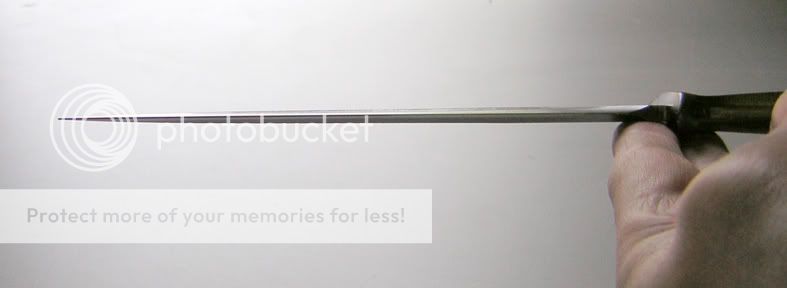
This is (stock removal) ground with a very intentional gradual taper the entire length. It is close to 1/4" at the ricasso, but doesn't feel heavy or poorly balanced. It is a deep hollow grind, so that removes a lot of weight.
 
Is it really true that "most" SR guys don't build blades with distal taper?

As for me, I'm struggling to learn to fit my techniques to the knives I want to build, not the other way around.

I agree with Jack that 1/4" stock is kind of silly for a hunter or EDC, but it's great for a 8"+ blade like Pancho originally described.

James , for stock removal doing a distal taper is just like doing a tapered tang depending on the bevel grind of choice . For my flat grinds all the way up to the spine will have that taper , if the bevel grind is lower than the width of the blade , then a taper is needed , if that is what one is looking for . The gut hook I started on today does not have that taper , but the tip is being thinned down 1/2" back . I could be wrong here on my approach but we ( I ) shall see .
 
1/4" at the ricasso isn't a bad thing. But 1/4" halfway out in the blade is a bad thing for a blade that size.

Re: stock removal, taper etc.

taper.jpg


This is (stock removal) ground with a very intentional gradual taper the entire length. It is close to 1/4" at the ricasso, but doesn't feel heavy or poorly balanced. It is a deep hollow grind, so that removes a lot of weight.

I think I love you Nathan :jerkit: ;) :D
 
Warning: Newb Comment Follows:

I used 1/4" bar stock on my first knife. Full flat grind. I noticed that the full flat began to reach the spine sooner toward the tip so the distal taper happened automatically. I did try hard to focus pressure on the blade toward the spine when grinding the flats to avoid running the flat past the center line (towards the tip of the knife). Hope that makes some sense. I doubt a had a perfect flat grind as a result... I did manage to run the plunge cuts into the spine as well (noobish for sure).

With 1/4 barstock, you will wreck a lot of belts. They are still tough to throw away since they still eat up wooden things pretty well. Onward through the noob fog hehe.
 
Jack, I'll tell you this: I find it reasonably simple to grind full- or near-full distal tapers on blades. Because it doesn't matter much if the taper is slightly convex. I have yet to finish or sell a knife with a tapered tang because, dang it, the tapers have to be VERY flat otherwise the scales won't fit worth a damn. Only practice and lots of it will help me achieve that.

I agree, Nathan's example of distal taper is really nice. That's pretty much what I aim for, almost regardless of blade length/stock thickness.

Edro20, currently I'm tapering my blades after profiling, but before setting the bevels. The taper you described will come about simply because the tip is narrower than the "body" of the blade. It's a geometry thing...

For goodness sakes, don't get me started on compound-radius guitar necks.... :D
 
Last edited:
The taper that I described had a radius (more toward the tip). The pic that Nathan posted appears to have a radius albeit a much larger one (looks great BTW). James, are you grinding in a straight line distal taper to the tip? Just wondering.
 
I would love to see the side view of that knife Nathan so I can get a better idea of what you did.
 
Pancho, you will find Aldo's 1084 will cut like butter with a new blaze belt. In fact I grind three blades with one belt before I notice a difference in cutting time due to the belt getting a mite dull. Most all blades are drop-point hunters approx. 8.5" and 1/4" thickness. Don't worry about the bridge before you get there....you will find it was not worth worrying about.:D
Let me know how it worked out,
Charley
 
James, are you grinding in a straight line distal taper to the tip? Just wondering.

I attempt to get a reasonably straight taper from plunge to tip. I haven't gotten one perfectly straight yet but I will continue to try. As I said earlier, that's why I can't yet offer a tapered tang. Maybe it's just me, but it's harder than it looks. I suspect the missing component is skill and practice on my part.
 
Back
Top