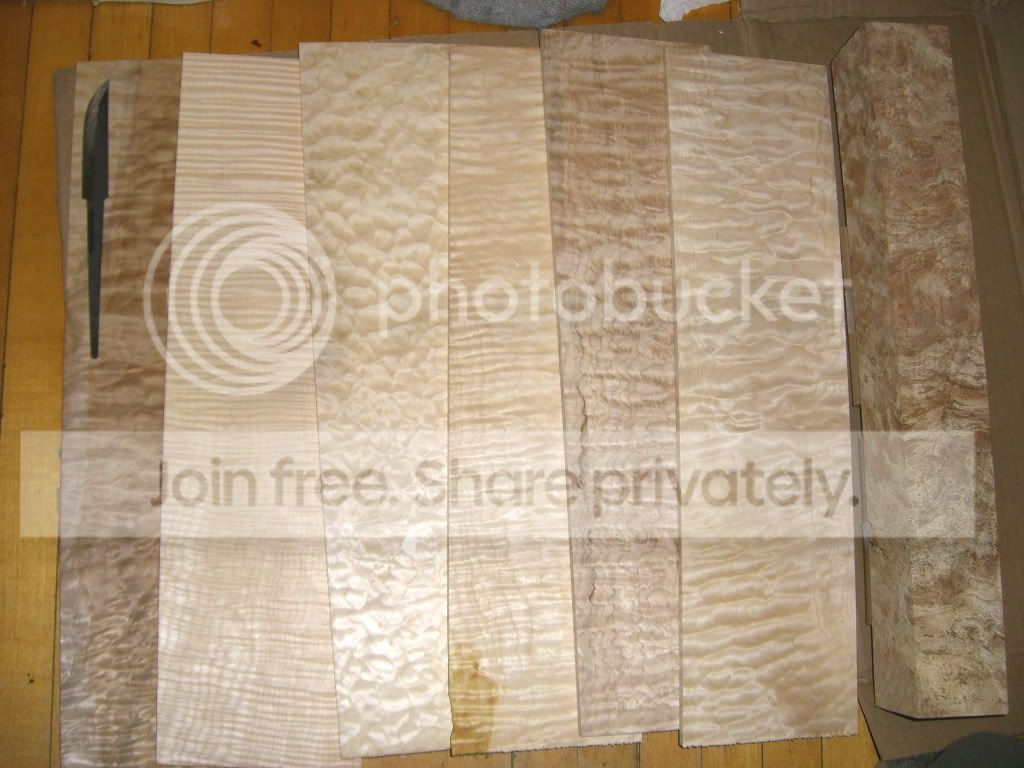
Got some beautiful Maple, do I need to stabilize it?

Joined
Dec 5, 2008
Messages
596
I got boards and a block of very nice burl maple thats dried to about 10% moisture content.

Does maple require stabilization? If so, is there a poor mans method? (read lazy mans method, I don't want to have to go salvage vacuum pumps and make all sorts of contraptions)


Or can I just seal it with a wood finisher? If so, what product would you recommend? I have some tung oil and linseed oil, also Minwax products that stain and seal.

Help much appreciated.

Thanks,
Ankar
 
The best way is to have the burl professionally stabilized. That will eliminate warp, cracks,shrink.
 
If it is really nice, it is worth having WSSI do the whole batch. You could sell enough to pay for the job, and keep a bunch of the best pieces for yourself.
Stacy
 
Well, I think it's pretty nice but I don't know if it's worth having done professionally.

I got about 7lb of it, WSSI would charge almost $90USD to stabilize it, plus the freight charges from Canada to the US and back again, probably another $50, which is a lot more than I was looking to spend on a few hobby projects.

Here's a picture of what I've got, I'll let you judge if it's nice enough to warrant the cost.

The boards are 0.282" thick and the block is a little over 2.5"x2.5"x20"

CIMG2266-1.jpg
 
You could have it stabilized and then sell some (cut to scale size) to defray the cost of the stabilization.
 
The block looks like it would definately be worth stabilizing. Are the boards bookmatched? If not, it'll be hard to sell as scales.

You should be able to get about 8 normal knife blocks from that big block.
 
Does anyone know of a place to get it done in Canada?

Excuse my ignorance, bookmatched means the grain lines up on when you put the boards together? These boards look to be a mix, some has tiger stripes, others quilting, some light some dark, ect.

Given how thin the scales are, would a good soak in a drying oil like tung oil (aka wood oil, china wood oil) followed by further applications do the trick? I know it wouldnt make it a strong as stabilized but it would seal out water and give it some scratch resistance.
 
Just my opinion but .282 is fairly thin and the stabilizing process can cause wood to warp. It is more likely to warp when it is thin. All the curly and quilted maple would be fine to use with an oil finish. Not as good as if it was stabilized but O.K. The burl on the other hand is going to be much more prone to twisting warping and cracking because of all the stress that is in it. I would recomend you have that stabilized.

Nice wood by the way! In the future you may want to buy wood that is at least 3/4" thick so that it can be cut into book matched scales.
 
Last edited:
The block looks like it would definately be worth stabilizing. Are the boards bookmatched? If not, it'll be hard to sell as scales.

You should be able to get about 8 normal knife blocks from that big block.

Or if he's really careful he can get 5" lengths of 1.25" x 1.25" minus half of the blade width, which would equal 16 pieces.
 
That looks like nice wood.
The slabs are too thin to stabilize. Use them as they are. Once sanded to final shape and 120 grit,stain the handles to bring out the character,sand to final grit, and use an oil finish. I really do not like super glue as a finish (It does a good job as a stabilizer for ivory, though). You should get some superb looking curl and quilt from those.

The block should be stabilized in one piece. After stabilization, cut one face to a straight surface (trim just enough to get a flat surface....no more). Use this face to cut the other faces clean. Cut this long block exactly in half (lengthwise), and then cut each piece in half again.You will now have four slabs that are approx 2X1/2X20". Mark the slabs as they come off the saw (1-2-3-4) The sets are book-matched (1&2, 3&4), meaning ,if you opened them like a book the facing sides will be mirror images of each other. Cut the sets up into 5" long scales.Tape one 5" edge together, on each set, with clear packing tape to make a hinge (to open the book and view the book-match). You will get eight supreme sets done this way. Each set will be worth $20-30.

Stacy

69 knives: I've cut a lot of stabilized wood. I doubt he could get 16 sets, unless he wanted them 1X5X.25.
 
69 knives: I've cut a lot of stabilized wood. I doubt he could get 16 sets, unless he wanted them 1X5X.25.

I was thinking solid blocks for hidden tang handles but I guess 1.25 x 1.25 x 5 is a bit small, doesn't leave much room for error.
 
I'm going to give this method a shot
http://www.northcoastknives.com/northcoast_knives_tutorials_hints_tips3.htm

The author of the tutorial has gotten good results.

As for thin scales warping, well these boards do have a tiny bit of bow to them already, once they soak in the wood hardener I'll clamp the scales between two boards while it sets, should leave them straight, no?

I was planning on cutting some of this block into 1.25x1.25x4.5" pieces for puukko's. I like simple barrel shaped handles just fine, and even with loosing 1/16" to the saw blade it should still be sufficient.

I'll give the aforementioned stabilizing method a shot with the 1.25x1.25" pieces, maybe they'll be small enough for the hardener to fully penetrate.

Will a jig saw do for sectioning this block up? I don't know anyone who has a band saw.

In the mean time I'll make a set of scales with stain/oil finish as Stacy suggests.

Thanks!
 
You will not need the heat with maple. Pour enough wood hardener in a jar so that your piece(s) can completely submerge. Put your piece(s) in the vessel, cover, and leave it to sit. When the wood sinks, penetration is complete.
 
I agree the boards are (very nice but) too thin to stabilize. Finish them with a nice tung oil and they will be awesome. There is a chemical that will give the grain a little more contrast and darken it up overall but I can't recall what it is. Some one here can pipe in with that. The block by itself isn't big enough to ship/stabilize/ship again. It's all very nice looking stuff though. I'd like to get a couple hundred pounds of blocks like that...
 
I've been using a 20% weight/volume mixture of Acryloid B-72 to acetone with good results. Not like professionally stabilized, but good enough for me, and I'm real picky about things like this. Much cheaper than sending it out.
Acryloid B-72 (Paraloid) is what museums use to preserve bones and stuff.

http://apps.webcreate.com/ecom/catalog/product_specific.cfm?ClientID=15&ProductID=17018

http://www.sha.org/research_resources/conservation_faqs/process.htm

If you can afford it, send it out.
- Mitch
 
ankar that just some killer maple ive worked a fair amount with maple i would sand it then glue it to the knife finish sanding and then try boiling in linseed might turn out pretty nice or just use a minwax jell rub and youll be amazed. maple like your shouing is really getting kinda thin but you can work with it on smaller knives. pretty stuff. kellyw
 
Back
Top