Graham Forge update, what do you think?

Joined
Feb 16, 2010
Messages
3,668
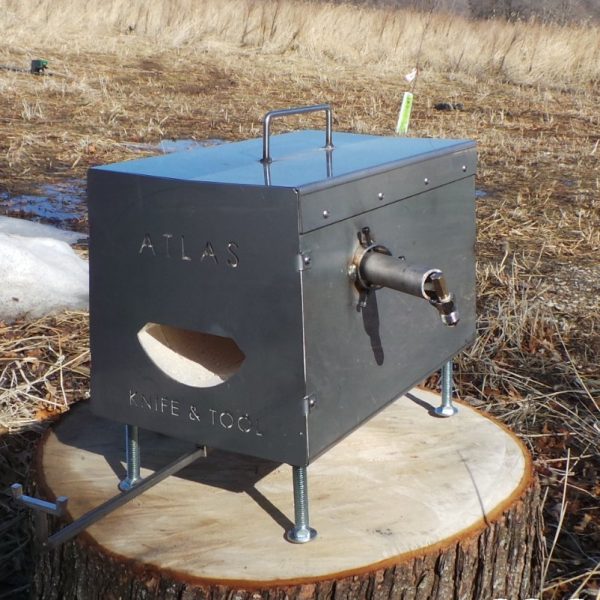
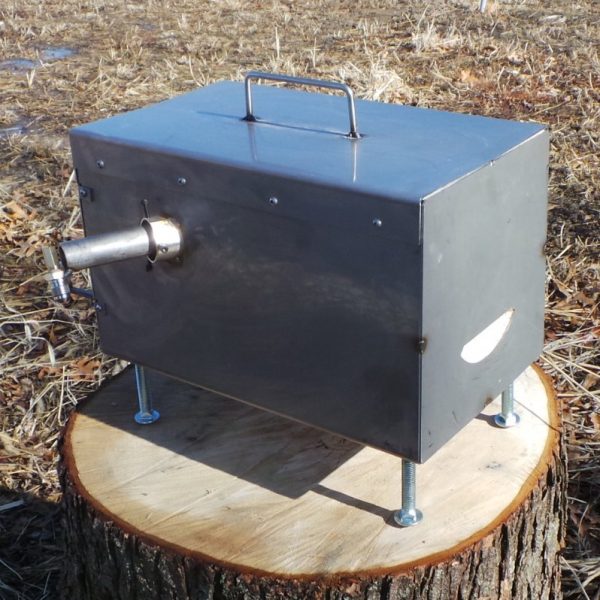
Well, it's been a long time coming, and there are still a few more tweaks to implement, but I've finally got a working prototype of stainless Graham Forge.

The two biggest changes:
1. I've changed to a thread leg post. I just love being able to adjust the legs so it sits flat on my stump by the anvil.
2. It's stainless. It's a bolt together top and bottom shell, similar to the recent Atlas minis.

Otherwise, it keeps the same 5"x12" round chamber and the front plate is still removable so you can install your Kao-lite LI-30 flux resistant floor. It's still got a handle(I'm NOT giving that up)
Graham_Front-600x600.jpg


GRaham_Back-600x600.jpg
 
I think it looks very professional, well/built from the photos, except for the "legs". At a minimum, if you really want to use bolts, I'd get some black oxide socket head bolts for the feet, and they probably won't cost you more from an industrial fastener supplier, than the galvanized ones do from a big box store. If you're trying to go all stainless, it really wouldn't be hard to thread some cheap round stainless, especially if you did it yourself (assuming you have the gear) or get a thousand made at once, and you can make them look much nicer.

It's a minor thing of course, but IMO it detracts from the overall package. Maybe it's just me though, because I do a lot of machining and fabricating, any galvanized hardware just screams "cheap" to me.
 
That looks like a real winner.
 
I'll give you another point of view... the legs (bolts) don't bother me, especially if it keeps costs down. They certainly aren't the most professional nor would they be my first choice but I think they look far from amateurish... Whatever you decide to do, the whole forge looks like a winner to me!
 
I definitely didn't mean to imply they "look like crap" or anything like that, I just meant they don't (IMO) perpetuate the appearance of quality that the rest of the new design has, which is IMO, very nice. I mean, I've done much worse on my stuff, because I simply don't care usually, how professional a shop built tool is, but I figured in this case, the OP is going for something different. ;)
 
First, I don't take it as an insult, it's the most obvious flaw in the aesthetics of the forge. It's constructive criticism and I appreciate it. The reason for zinc plated bolts in this prototype are simple: cost. Levelling legs are around $8-10 each, stainless shoulder bolts are $40 each. When you start considering $40-150 to the material cost just for the legs, you aren't taking the customer into consideration.
 
Personally if it was me, I'd sooner forgo adjustability and just tack weld pieces of stainless bar on, than use bolts. Maybe it's just my background, but it sticks out like a sore thumb to me.
 
Maybe four 4" long legs of 3/4" pipe. Weld a 1/2" or 3/8" nut in/on the end of each, and the other end to the forge. A 1" long "foot" bolt goes in and only a tiny bit would show ... even when one or two are run out a few turns.
 
Alright, legs aside, what do you think? Chamber size? Front opening size? It's got almost 2" insulation around the chamber and comes with a bag of KaoLite LI-30 to build a flux resistant bottom. My math tells me around 400 BTU per inch, which should be good enough for welding, but I'm concerned that this might be at the upper limit of single burner venturi.
 
I love my current generation Graham. The only thing that I sometimes wish was different is the front opening. Occasionally it is just a bit too short. Those times are railroad spikes (yeah I know, but they are fun to fool around with) and sometimes when rotating a blade around to get even heating during heat treat. It feels like if the opening was just a complete oval rather than flattened across the top it would give that “just enough” more height. I’ve thought about trying to open mine up a bit, but I’ve been too nervous not knowing if there would be negative impact on the the flow and level of heat.

Is it possible to add that kaolite stuff to a current gen? I’ve been trying to work out dry welding because I haven’t dared allow flux near my baby.
 
Alright, legs aside, what do you think? Chamber size? Front opening size? It's got almost 2" insulation around the chamber and comes with a bag of KaoLite LI-30 to build a flux resistant bottom. My math tells me around 400 BTU per inch, which should be good enough for welding, but I'm concerned that this might be at the upper limit of single burner venturi.

I'd make the rear opening adjustable in size, honestly, the front opening also, with a slider of some type. Otherwise, I wouldn't worry about it doing much welding, it'll never be an optimal design for that, I'd focus on making it the best small/medium sized "forging" forge you can. I think people worry way to much about trying to make "one forge to rule them all", which is frankly, impossible.

I run a few large (huge by most knifemaker standards) forges, but still have a 2 brick (well, new one is really 4 brick, but still) forge, for forging blades, and consider them to be the optimal size for general bladesmithing, balancing speed, and fuel efficiency. Know a lot of other bladesmiths that feel the same.

Personally, I consider multi-venturi forges to be a bit useless, usually really hogging fuel and not being that great at welding or small forging, compared to either a small single venturi (for blade forging), or a big blown (of some type, of which I include ribbon burners and the like), or vertical, for welding. The only case they make a lot of sense to me is in the modular, side-opening style ornamental forges, for doing large, odd-shaped work, where you need to be able to reconfigure the forge for the work, and utilize however many burners is necessary.


All that to say, I think it's pretty great, assuming the efficiency is good, but make the openings adjustable for say fitting a kukri or something else curved in.

The thing with a single burner small forge is, you need to be able to get any piece of the work, in the hot spot easily, and for HT, you've gotta be able to easily move the entire piece, in-and-out of the hotspot quickly, without banging up the forge body or hitting any obstructions, to get an even heat along the length of the piece. My concern, just looking at it, is that the openings may make that tricky. Otherwise, I dig it.
 
The front opening is 4" x 2", and as you said it's tough to build a forge that can do everything. I'm just opposed to sliding metal doors that aren't insulated. I did that on my very first batch of 10 forges and hated them. That said, if someone found a need for a different door shape, it can easily be cut since the front plate is held on by 4 screws. You'll just need a 3/32 allen wrench. You can also brick up the front if you need more heat.

Lanternnate: Yes, you can easily add Kaolite LI-30 to your forge. Just mix it with some water and put 1/2" on the bottom. This can done on an Atlas, but you have to remove 1/2" of the firebrick at the bottom of the chamber as shown in the picture. Kaolite isn't mortar, it needs to be thick to stay together. At temperatures above 60F, air cure, keeping surfaces damp and/or covered, for 16-24 hours typically or until a hard set has developed
 

Attachments

  • image1.jpg
    image1.jpg
    13.6 KB · Views: 9
The front opening is 4" x 2", and as you said it's tough to build a forge that can do everything. I'm just opposed to sliding metal doors that aren't insulated. I did that on my very first batch of 10 forges and hated them. That said, if someone found a need for a different door shape, it can easily be cut since the front plate is held on by 4 screws. You'll just need a 3/32 allen wrench. You can also brick up the front if you need more heat.

Lanternnate: Yes, you can easily add Kaolite LI-30 to your forge. Just mix it with some water and put 1/2" on the bottom. This can done on an Atlas, but you have to remove 1/2" of the firebrick at the bottom of the chamber as shown in the picture. Kaolite isn't mortar, it needs to be thick to stay together. At temperatures above 60F, air cure, keeping surfaces damp and/or covered, for 16-24 hours typically or until a hard set has developed

The front is probably fine then, and yeah of course, anybody can cut the opening larger. Why didn't you make the rear opening the same size?
 
The rear opening serves as both a pass through, and a way to reduce turbulence in the forge. As the rear gets larger you begin to lose too much heat out the rear. Ideally, just enough flame out the rear to toast marshmallows.
 
The rear opening serves as both a pass through, and a way to reduce turbulence in the forge. As the rear gets larger you begin to lose too much heat out the rear. Ideally, just enough flame out the rear to toast marshmallows.


Yeah, I understand the reason for it being there. I was just asking why you kept it smaller, I assumed because of "efficiency", but I was gently suggesting it could be larger. :P

You've made way more of these small forges than me, and I'm used to blowing through 100lbs of propane every couple of days, so maybe my perspective is off, but in my little forges (2-4 brick ones), I have the rear opening the same as the front, and they still sip gas so long I have no idea how often I have to change out the little 20lb tanks. On the other hand, for working larger pieces, the rear opening is mandatory for me, and I don't even typically make super large knives.

You have to be able to "feather" the entire work piece in-and-out of the front and rear openings to get totally even heat for normalizing and/or austenizing though, and it's really cumbersome if you can't do that with the tongs on the bare end of the tang without having to turn it around.


That's just my experience/opinion, based on the way I do it. As you say though, someone can always cut the rear opening larger, I was just responding to the request for feedback. I'm basing this all on my "perception of size" from the photos. Hard to really give objective opinions without actually using the forge. If you decide to send one out at some point for real evaluation, and feedback, let me know, I've done the same for a few other tools in our field, and have had a lot of design input that were well received with those items.

Either way, as I said before, I'm just nit-picking, because you asked, it's a great looking forge.
 
Back
Top