
-
The BladeForums.com 2024 Traditional Knife is available! Price is $250 ea (shipped within CONUS).
Order here: https://www.bladeforums.com/help/2024-traditional/
You are using an out of date browser. It may not display this or other websites correctly.
You should upgrade or use an alternative browser.
You should upgrade or use an alternative browser.
Grain Growth due to Overheating???
- Thread starter kelsil
- Start date

- Joined
- Nov 27, 2002
- Messages
- 2,088
What steel..? ans how overheated..?
In plain carbon steels and low alloy steels, some growth
can be easily reversed by normalizing and quenching from just above
critical (decalescence...not just nonmagnetic)...
In plain carbon steels and low alloy steels, some growth
can be easily reversed by normalizing and quenching from just above
critical (decalescence...not just nonmagnetic)...
yes knowing the steel is 90% of the battle when i first started heat treating i was using a brick forge and over heated the blade and had some bad grain growth but i normalized it 3 times and reheat treated it and it was just fine after words. but i was using 5160 steel which is very forgiving. some other steels not so much. if it is a carbon steel you should be good. i dont know about stainless and grain growth.
Just curious, but how did you determine the condition of the grain, before and after normalizing ?
when you heat treat a knife and it has grain growth you will see a bubbling like affect on the surface of the steel when you sand it. that goes away if you normaliz it right.
To my understanding, grain growth is a bad effect from overheating regardless of the source of the heat applied(accetylene torch or malfunctioned elec oven temp. gauge). From the above responses, I'm hearing that grain growth on simple steels(carbon steels) are reversible by normilizing while grain growth on complex steels are irreversible. Is this a sensible understanding at all?
when you heat treat a knife and it has grain growth you will see a bubbling like affect on the surface of the steel when you sand it. that goes away if you normaliz it right.
Are you sure about that? Got any pics? I think you might be talking about scale (high temp. oxide).
To the OP, no it will not damage the steel permanently. Yes it can be fixed with heat treatment. The more comlicated the alloy, the more difficult it is to fix. On the bright side, complicated alloys have mechanisms in place to prevent it as well.

- Joined
- Jan 6, 2005
- Messages
- 9,680
Chad2... Not meant as an offence, but can you quantify your experience level? (Yrs/Knives)
- Joined
- Jan 6, 2005
- Messages
- 9,680
Thanks Chad... Surface anomolies can happen for a number of reasons. It is not necessarily a signpost for grain growth. As you accumulate experience(especially with only a few steels) you will begin to make connections between what you see and what is actually happening within the steel(or more often than not... reasons will forever evade you... lol). 20knives is not even scratchng the surface(no pun intended) yet, brother. I admire your intent to share experiences but with only a few isolated observations, it is dangerous to draw conclusions and even more so, to present them as fact. I hope you understand where I am coming from and that there is no malicious intent in my statements.

Stacy E. Apelt - Bladesmith
ilmarinen - MODERATOR
Moderator
Knifemaker / Craftsman / Service Provider
- Joined
- Aug 20, 2004
- Messages
- 38,731
Grain is observed in two main ways.
1) By Examination - Break the knife in half and use a magnifier or microscope to examine the grain size. (It should not show on the surface unless there is something terribly wrong.) The break will look like a knocked down brick wall if the grains are very large. It will look "gravelly" if they are large. It will look "sandy" if the grain is fine.And it will look "matte" if the grain is very fine.
2) By Observation - Sharpen the knife and see how it cuts, if despite all sharpening attempts the edge remains toothy, or chips out easily, it probably has large grain size. If , on the other hand, it sharpens well and takes a hair popping, paper slicing edge, the grains are most likely small and well arranged.
1) By Examination - Break the knife in half and use a magnifier or microscope to examine the grain size. (It should not show on the surface unless there is something terribly wrong.) The break will look like a knocked down brick wall if the grains are very large. It will look "gravelly" if they are large. It will look "sandy" if the grain is fine.And it will look "matte" if the grain is very fine.
2) By Observation - Sharpen the knife and see how it cuts, if despite all sharpening attempts the edge remains toothy, or chips out easily, it probably has large grain size. If , on the other hand, it sharpens well and takes a hair popping, paper slicing edge, the grains are most likely small and well arranged.
- Joined
- Jan 6, 2005
- Messages
- 9,680
Here are a 1000 words.
Fine vs. Coarse grain...
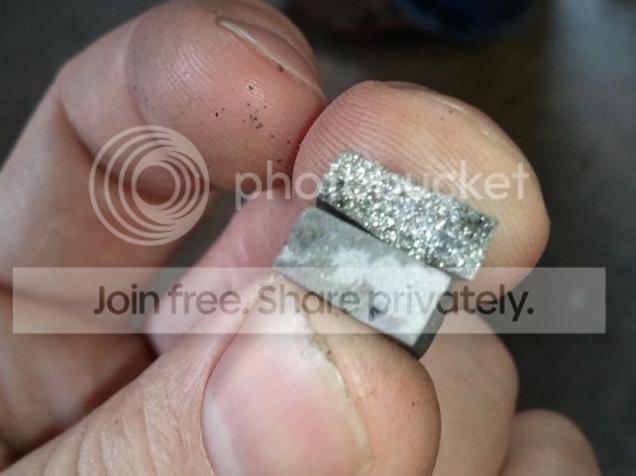
Fine vs. Coarse grain...

- Joined
- Jun 10, 2003
- Messages
- 15,288
Rick , thanks for posting those .The coarse grained one is going to be brittle which is the biggest problem with large grain.
Overheating ? A little just gives you large grain and is correctable. More gives you grain boundary problems as elements , good and bad , will diffuse into the grain boundaries and sometimes can be correctable. Even higher overheating starts to oxidize the grain boundaries => scrap !!
Overheating ? A little just gives you large grain and is correctable. More gives you grain boundary problems as elements , good and bad , will diffuse into the grain boundaries and sometimes can be correctable. Even higher overheating starts to oxidize the grain boundaries => scrap !!
Here are a 1000 words.
Fine vs. Coarse grain...
* *******************************************************************************************************************************
Grain is observed in two main ways.
1) By Examination - Break the knife in half and use a magnifier or microscope to examine the grain size. (It should not show on the surface unless there is something terribly wrong.) The break will look like a knocked down brick wall if the grains are very large. It will look "gravelly" if they are large. It will look "sandy" if the grain is fine.And it will look "matte" if the grain is very fine.
2) By Observation - Sharpen the knife and see how it cuts, if despite all sharpening attempts the edge remains toothy, or chips out easily, it probably has large grain size. If , on the other hand, it sharpens well and takes a hair popping, paper slicing edge, the grains are most likely small and well arranged.
Stacy E.Apelt
It is better to die fighting evil than to live under it.
+++ Thanks Chad and Stacy for these responses. My question if I may is; After grain growth is determined by the methods you described ,or even suspected due to overheating, could it be reversed or brought back to normal grain sizes by normalizing? I've learned from the other responses above that it depends on the kind of steel being worked on. Some are forgiving and could be corrected back to normal, but some are unforgiving and would be scrap if overheated. Would you guys agree to this summary of thoughts?
- Joined
- Nov 30, 2005
- Messages
- 1,023
kelsil, so I can learn from this thread...could you please specify which steel(s) you are asking about as Mr. Andrews has requested earlier?
Thanks,
Jim
Thanks,
Jim
- Joined
- Jan 6, 2005
- Messages
- 9,680
Thanks Chad and Stacy for these responses. My question if I may is; After grain growth is determined by the methods you described ,or even suspected due to overheating, could it be reversed or brought back to normal grain sizes by normalizing? I've learned from the other responses above that it depends on the kind of steel being worked on. Some are forgiving and could be corrected back to normal, but some are unforgiving and would be scrap if overheated. Would you guys agree to this summary of thoughts?
I would agree to what you posted but there are more factors involved. Mete knows his stuff. Temperature, time and alloying all play a part. It is like a crime scene... you can piece together what happened if there is enough evidence... otherwise, you do what you can and hope for the best. Severe overheating can ruin even the most forgiving steel. For example... lately, I've been hearing folks calling 5160 and 52100 "forgiving" steels. I don't see 5160 and 52100 in that light... common? Yes. Doable with simple means? Yes. Forgiving/beginner steels? No. 5160 is picky about forging temperatures and it's low carbon/alloying does require some attention when heat treating. 52100 is hypereutectiod and carries with it all the "fun" involved with that. Read the "working the three steel types" sticky.
If you suspect slight overheating during the quench, run a couple descending thermal cycles and HT again. If you suspect severe overheating, run the cycles, HT and be sure to run some hardness and basic task-oriented tests.