Grain Refinement

O.K.
Here's few things you can try...

#1. At the end of the welding, check the surface for hot fractures. If there are hot fractures from "overheating", go back and fold it a few more times at a lower temperatures or until they are gone.

#2. Spark test the billet for carbon, in comparison to the steels used.

#3. Thermal cycle the billet in such a way as to establish a refined grain structure.

#4. Use a quenching medium suited for the slower hardening steel first and test the results. If you are not satisfied try the faster quenching medium.
 
What HT and/or physical characteristics of O1 and W2 make them incompatible? And on the other side of that coin, what is the allowable range in the "important characteristics" that constitutes "compatible"?

Mike Krall

These two steels are one of the easiest mixes to see that you will have to make some huge compromises in heat treating since it is right there in the names- W2 (W= water hardening), O1 (O= oil hardening). This discussion quite often spawns comments on how folks have made plenty of knives from whatever mix is in question, the point is not that it can’t be done, almost anything is possible, just one needs to ask is it worth it when there are much easier options that will yield better results. Already with this mix you will have to choose between shocking and possibly microfracturing one steel or under hardening the other. In the process there will be added issues for distortion and other stresses as one steel sets up entirely differently than the other.

In view of all of this, in my shop I would ask what advantage would such a mix have over something like 15n20 and W2, which would be a fantastic mix for final performance and would be quite compatible in the heat treatment, and my answer would be none, So why make life harder on myself for nothing?
 
W2 and O1 overlap on heat-treating temperatures around 1450. What is it about the chemistry of O1 that causes it to need a slower quench or risk cracking? And what things does a person look for when comparing steel for damascus compatibility? I know compatible steels need a similar austenizing temperature but incompatible steels can have similar HT temps.

Mike Krall
 
I think we're losing site of what it is we are trying to do...

If you just want to make a knife that cuts, why mix any steels together?

Pattern welded blades can make great cutting knives, but the outstanding feature is the pattern.

In a mix of O1 and W2, both steels will make a good blade. The heat treating is different but, I recommended to quench for the slower hardening steel first as the lesser of the evils there. Shocking the slower hardening steel in a faster quench would be more risky. I also wonder if a bit of differential hardening between layers would necessarily be a bad thing? It would seem like this mix could produce a very hard and tough blade. I guess it just depends on all the variables and what it is you are trying to do,… what theories you are working with.

I think we've hammered on the grain refinement issue so much, that we've lost the meaning and purpose of the normalizing step.

We hear over and over that normalizing is done to refine the grain, but if this procedure is done for grain refinement alone, then it's really a form a "thermal packing". The normalizing procedure will refine the grain, but the reason it's done is to stress relieve and soften the steel as a preliminary step to stock reduction and the hardening cycle. The grain refinement is more of a byproduct of the process.

The way I approach the overall bladesmithing process is such that the grain is already refined going into the normalizing cycle or cycles. This is accomplished in the final stages of the forging process, low temperature hammer finishing and straightening. In the normalizing step, I'm looking for a nice even heat to stress relieve the steel, and to cool it just slowly enough so that no martensite or hard spots are formed,... a nice even, homogenous, stress relieved soft structure. If the blade is thin and warps in the normalizing process, I re-straighten it and repeat the normalizing step until it sets up straight, with no hard spots. Then I’m ready to go on to the next steps of stock reduction and/or hardening. I’m trying to get from point A to point B in a straight line as efficiently as possible.
 
W2 and O1 overlap on heat-treating temperatures around 1450. What is it about the chemistry of O1 that causes it to need a slower quench or risk cracking? And what things does a person look for when comparing steel for damascus compatibility? I know compatible steels need a similar austenizing temperature but incompatible steels can have similar HT temps.

Mike Krall

The austenitizing temp only becomes a concern when there is not that overlap window you refer to, but for the most part many of the steels we work with will fall in the same 100F range. Two other concerns that should be more critical are the required quench speeds and rate of movement under the hammer.

W2 is basically 1095 with vanadium added so it has a very quick cooling requirement in order to avoid forming pearlite at around 1000F. It was designed and used in a time when water or brine were common quenches in industry; W2 is getting rather scarce these days.

O1 is an entirely different beast, it is a specialized tool steel designed to reach maximum hardness with less intensive quenches in order to minimize stress and distortion in tools, dies, and other more involved applications. It is full of chromium, manganese with additions of vanadium and tungsten. On an I-T curve it has around 10 seconds to avoid pearlite, while W2 has less than 2.

For years I have encountered bladesmiths that just combine any steels they get their hands on willy nilly with no consideration to the heat treatment or other compatibility issues. These are bladesmiths that entirely understand the folly of trying to get the most out of a piece of mystery scrap steel instead of buying a fresh piece of a known alloy, only to turn around and throw the same logic out the window in combining steels in damascus.

Countless times I have suggested common sense should dictate that 1095 and L6 may not be the best combination, only to be piled on by any maker in ear shot that ever made a knife out of it to defend that it is possible. Once again anything is "possible" but is it practical? When I feel this debate coming on I now simply appeal to logic by putting it in the easiest to see terms- If you are making a blade out of 1095 and need to farm out the heat treating are you going to send it to a guy who only heat treats L6? When heat treating a blade out of L6 yourself do you flip to the page for 1095 in the Heat Treater's Guide? If making a mono-steel from either of these steels would you willingly compromise the heat treatment? Why do any of this with your damascus? This is how we end up with public conceptions like "damascus is just for show", or "damascus is pretty but it won't hold an edge like XXXX". And indeed the most common reason given when asking a maker about his choice of steel is the mix is that he wanted a certain look or color, I have yet to hear heat treat mentioned in such an answer, pretty has indeed trumped performance.

The tragic thing is that it doesn't have to. The reason I suggested 15n20 for W2 is that it is basically 1075 with some nickel added, this makes a contrast every bit as good if not better than L6 for steels like 1095, or W2 while still being very well partnered in the heat treatment- there will be no compromises. Often a quick look at the steels chemistry will tell you most of what you need to know about what other steels you should combine it with.

Folks don’t realize how often cold shuts, delaminations, cracking or distortion can be traced to the choice of steels to combine; instead they are too quick to blame it on their poor welding skills. Their welding may be good while just their judgment in materials choices may be lacking. I have seen certain combinations literally pull themselves apart from little more than air cooling, and it almost never happens at the weld seems, instead one steel will just split right down the middle in order to accommodate it ornery partner.

 
What I'm saying is, grain refinement should come naturally as a byproduct of the overall processing from bar to blade. If it isn't,... then one or more of the steps isn't being done right.

And... I agree with Kevin that one should consider which combination of materials in a pattern welded billet, would best suit their blade concept, skill level, shop setup etc...

The "concept" is really what dictates the process, and may vary from smith to smith or blade to blade. It doen't always have to be the same.
 
What I'm saying is, grain refinement should come naturally as a byproduct of the overall processing from bar to blade. If it isn't,... then one or more of the steps isn't being done right.

And... I agree with Kevin that one should consider which combination of materials in a pattern welded billet, would best suit their blade concept, skill level, shop setup etc...

The "concept" is really what dictates the process, and may vary from smith to smith or blade to blade. It doen't always have to be the same.

As I agree with you Tai, on the almost obsessive fever pitch that the pursuit of perfect grain refinement has reached. We are knifemakers and we are artisans, the goal is plain to see- a fine cutting tool that is aesthetically pleasing. When any one facet of the operation becomes more important than the obvious goal we have lost our way. If a knife will only ever need a level of 5 in a given property to perform perfectly, and we are single mindedly focused on pushing that one property to 10 just to say we did, couldn’t that effort have been better spend on other factors in the overall package? Sure it makes a great story, but does it make a great knife?
 
Folks don’t realize how often cold shuts, delaminations, cracking or distortion can be traced to the choice of steels to combine; instead they are too quick to blame it on their poor welding skills. Their welding may be good while just their judgment in materials choices may be lacking. I have seen certain combinations literally pull themselves apart from little more than air cooling, and it almost never happens at the weld seems, instead one steel will just split right down the middle in order to accommodate it ornery partner.

I had had a discussion awhile ago about laminating a steel like A2 in between mild steel or wrought iron, and that was the same answer i had been given. Plus i always wondered where that "this damascus doesn't cut for XXXX" saying came from:D.
 
Kevin, I think you and I are really just trying to help, but we also run the risk of imposing our own personal concepts and ideals onto others. What is better or best is subjective, individual, a matter of opinion and can vary from smith to smith or blade to blade. So, folks need to digest all the information, and determine what it is that they are trying to accomplish. If any of this information is useful, then that is good. If not,... because they have a different "concept", then that's O.K. too.

It takes all kinds. :)
 
I can see that in certain instances a smith may decide to sacrifice some on the performance side in favor of character, appearance or aesthetics, and in other instances may decide to sacrifice on the aesthetics in favor of pure performance. I also don't see anything wrong with a nice balance between the two. :)
 
The austenitizing temp only becomes a concern when there is not that overlap window you refer to, but for the most part many of the steels we work with will fall in the same 100F range. Two other concerns that should be more critical are the required quench speeds and rate of movement under the hammer.
So the differences in steel-for-damascus have incompatibility show as one steel starting to harden at a significantly different temperature than the other(s) (an Ms of 390F with an Ms of 445F ~ W2/O1)... along with differences in expansion ratio and softness at a given temperature... all of which cause one steel to be moving against the other? Adding on top of that, the potential of not getting maximum hardness in one or more steels plus not getting "ideal" ending-hardness tempering (too brittle or too soft)? Is that about right and/or all?

Often a quick look at the steels chemistry will tell you most of what you need to know about what other steels you should combine it with.

What are you looking at in the chemistry?

Mike Krall
 
This is going to sound more philosophical than anything else but…

What’s really the most important is how successful the smith is at accomplishing what he set out to accomplish. I’ve seen where it can all backfire! It happens quite a bit. The smith may set out to make a great looking art knife and wind up with a knife that looks absolutely ridicules, or he may set out the make the ultimate performance knife, and totally destroy the steel in the process, or wind up with a knife that wouldn‘t slice cheese.

A smith may set out to make a great looking knife that also performs great, and wind up with a blade that does neither.

However, If you don't know what it is that you are trying to accomplish,... then you are just spitting is the dark.
I'm a firm believer that in order to get the "best" results, you need to start off with a good solid "concept", and a basic understanding of the craft...
 
As a teacher of the craft, I find it very difficult and frustrating to try help someone,... who doesn't know what it is that he is trying to do.

Concept,.. concept,.. concept!
 
However, If you don't know what it is that you are trying to accomplish,... then you are just spitting is the dark.
I'm a firm believer that in order to get the "best" results, you need to start off with a good solid "concept", and a basic understanding of the craft...

A light into a world...

Mike Krall
 
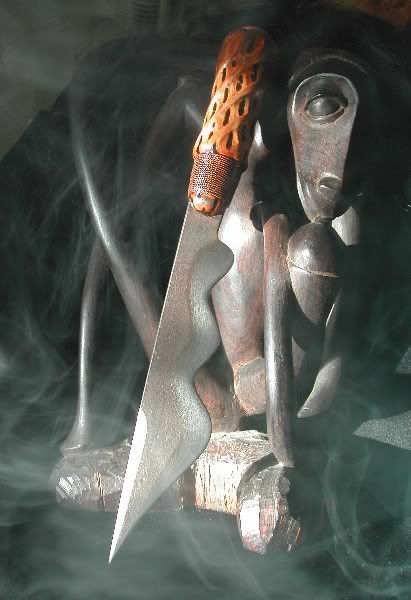
Let me use this last piece I did as an example,... "The Ripper".

The concept was to create a peculiar, unusual looking knife, with a lot of raw energy, character, Voodoo, and wickedness,... one that would suggest both the past, and the future... neo-tribal. On the performance side, I wanted a springy, pointy blade with a razor sharp edge. I wanted it to be good for light duty chores and to make that one "special cut" (or stab) if ever called upon to do so.

Although not everyone is going to like this knife, from within the parameters of it's "concept", it's a reasonably successful piece. I don’t know if I’ll ever do another one like it or not, because I like working with a variety of concepts,… and “change” is part of my nature.

TheRipper1-4.jpg
 
Anyway, so much for that.

Back to what Kevin was saying, because I think I really like what he’s trying to say…

Grain refinement isn’t everything. An abnormally grown grain is easy to fix. There are other equally important, if not more important ,considerations that you need to make. Things can go wrong that are harder to fix, if not impossible or “impractical” to fix.

Things can go wrong that are totally unexpected.

Maybe it’s just us,… but, being “practical” and efficient, making the best use of, and getting the most out of the resourses we have at hand,…. making sense, having some logic, reasoning and “concept” behind our work,… is part of this art/craft.
 
That's a wonderful knife Tai... I read the "concept" then looked at the picture and thought "holy s***", that's it!

Not to disavow, but I get into yaps about steels and grain refinement because I don't really get it. Because if I'm going to learn about this aspect, I may as well go down a true path to start. So there's 3 normalize, a grind, a HT or three normalize, a quench, a spheroidize, a grind, a stress relieve, a HT, or two normalize, a quench, a spheroidize, a grind, a third normalize, a HT... to start. Yup, it's just a process... function in a concept with concept driving, and I'm happy to have that pointed out. I spent my afternoon in the shop staring at a knife with no concept other than "I want to make one of these" (historical thing). I'll not go further without a concept (can't, now). But nothing but knowledge will suffice for process... understanding allows concept to process.

And it was a nice rant...

Mike Krall
 
I think it all needs to make sense first.

If no one can explain it to you to where it makes sense, if you can't figure out why no matter how much you study on it or think about it,... then don't worry about it. Forget it!

Don't take anyone's word for anything,... unless it makes sense to you, and you clearly understand the reasoning, dynamics and mechanics behind it.

If it sounds like a bunch of gibberish,... it probably is.

On the other hand, if you have thought though it and it does make sense, (at least to you), if you have a clear mental path of logic and purpose for it,... then go for it!
 
Back
Top