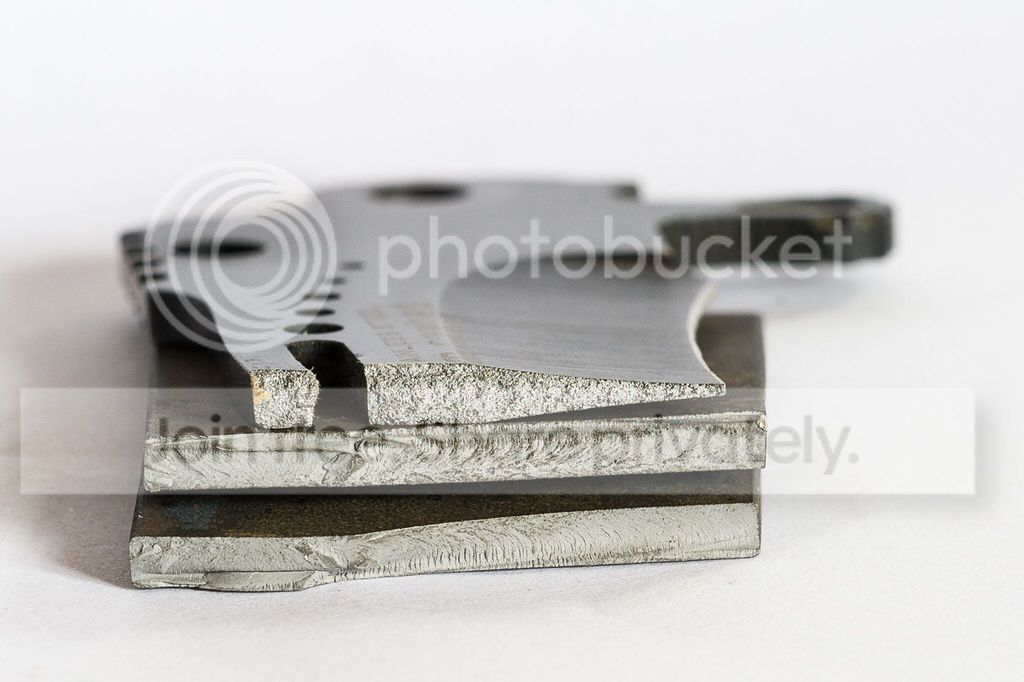
Grain size

Joined
Jan 1, 2013
Messages
80
my first attempt at hardening stainless. It's AEB-L i didn't use foil and i didn't temper it.I wasn't sure it got to full hardness after the plate quench (also my first try with aluminium plates )the sample broke with 2 light taps with a hammer. does it look good to you guys?

Sent from my GT-I9301I using Tapatalk
 
It's kinda hard to tell from the pictures, but the knife in the bottom picture has huge grain. This is a good exzample what a minor tweak to heat treat will do to grain size. Same material but slightly different heat treat.
Photo%20Dec%2027%2C%2020%2026%2039.jpg
 
A good reference for grain size is a file. Break one and look at it. It should look like the bottom picture of JT's pic. What was your recipe?
 
It was awhile ago and I was playing with quench temps as well as quench oil as well as oil temps. The steel was 15n20 as I was trying to get the finest grain possible. This was back when I was using a forge for heat treating so the numbers are kinda moot. I am now starting over with the oven and looking for the same results. I quickly relized that no mater how you heat the steel all that maters is results. My oven could tell me one thing but could be getting results that don't match up and I go with the steel. In the end that's all that maters, how the steel preforms.
 
my first attempt at hardening stainless. It's AEB-L i didn't use foil and i didn't temper it.I wasn't sure it got to full hardness after the plate quench (also my first try with aluminium plates )the sample broke with 2 light taps with a hammer. does it look good to you guys? Sent from my GT-I9301I using Tapatalk

wait you didnt foil wrap a blade at 1900f + soak time you likely burned out a pile of carbon so its not likely that you even came close to hardening the balde
 
My experience is that you can tell not only by how the grain looks but by the shade.\, at lest with carbon steel. Big grain looks like gray beach sand, whereas fine grain looks, well, fine and silvery gray.
 
Just finished the new oven build and have been testing it out. Let oven slowly heat up to 1950c then put in the sample for a 15 min. Soak quenched in aluminum plate while blowing air between the plates and checked with hardness testing files. I'm trying to find foil here in Austria that isn't going to break the bank .

Sent from my GT-I9301I using Tapatalk
 
I don't know how much carbon you toasted out of it. How was the scale, was it super thick? I anealed some D2 a little while ago and it sat at high temps for what 15hrs. It had scale but honestly I thought it was going to be a lot worse then it was.
 
I didn't grind the scale of in the picture. It was nothing compared to the old propane forge I was using for carbon steel. The scale also seems to be less where it had good contact with the quench plates. Next time I'm going to put a few clamps on for better surface contact.

Sent from my GT-I9301I using Tapatalk
 
First off I would get some stainless foil. I would send you some but I see you live in Austria! Next, get your oven up to 1560 and then put the blades in for 10 mins or so to equalize. Then ramp to 1940 and soak for 15 mins. Plate quench still in the foil. I put the plates between my drill press to get good pressure. Then ramp the oven to 1975 and soak for 5 mins and plate quench again while in the foil. Then when cool to touch remove the foil and put in dry ice/denatured alcohol mix. Then temper. Try another coupon and see how it looks.
 
For stainless steel and other high tech steels it's not worth the trouble unless you have proper equipment !
 
321 is sufficient....But @mete give you a good advice...and my 2c , In Austria you have lots of places for HT and price is 10-15EU / blank :thumbup:
 
How I look at this probably different than others, so fwiw.

After 15m at 1066C/1950F and quenched (to room temp), RA is probably more than 25%. First hammer tap likely converted some ra to mart, then fractured/severed on 2nd tap. Grain size looks good based on highly irregular & small details of broken surface. As grain size increase, also increase tendency of fracture path to follow grain boundaries. Bright surface and bumpy like beach-sand (as Jim posted) is example of fracture follow cluster of grains, since many facets are facing you, so more light reflection, therefore brighter look.

Look to me there is a burned-layer (decarb & possibly scale) about 0.25mm thick. Compensating on the safe side, grind 0.3mm off all surface of blade (faces & edges). *note - to check hardness via filing, grind 0.3mm off the edge creating a bevel angle about 120 degrees. This way, if not hardened correctly, you can re-ht while the blade has a thick decarb layer to minimize additional decarb. Also keep in mind, drilled holes surface will have decarb (soft layer).

When I need to rapid liquid quench aebl and others, I use a thin layer of clay and compensate for decarburized surface layer.

You can even grind decarb off just only for the cutting edge. Your blade has decarb jacket (san-mai feature :D).


Just finished the new oven build and have been testing it out. Let oven slowly heat up to 1950c then put in the sample for a 15 min. Soak quenched in aluminum plate while blowing air between the plates and checked with hardness testing files. I'm trying to find foil here in Austria that isn't going to break the bank .

Sent from my GT-I9301I using Tapatalk
 
321 is sufficient....But @mete give you a good advice...and my 2c , In Austria you have lots of places for HT and price is 10-15EU / blank [emoji106]
I sent one out so far it cost me 28 euro with return postage.

Sent from my GT-I9301I using Tapatalk
 
Thanks for all the advice guy's. I was reading a post about heat treating aeb-l without foil here on BF and decided to try it out because I don't have any at the moment. I need to get some pics of my shop on here with a proper introduction. I have been lurking for a few years building more tools than knives.

Sent from my GT-I9301I using Tapatalk
 
Gobec?SteirerEisen? or Slovakia etc....321 foil is available in EU 'but' 10-13 eu/m and shipping ....and its very different depend where you buy it...belive I try,309 is difficult to find in EU , if you find any give me info( I get only in USA for elmax,M390) :p
Finaly , here is lot of fine magicmaker like Bluntcut (Respect Sir) and 'few' others ....but @mete was dito...precise ALL link in HT chain is only answer :thumbup:
 
First off I would get some stainless foil. I would send you some but I see you live in Austria! Next, get your oven up to 1560 and then put the blades in for 10 mins or so to equalize. Then ramp to 1940 and soak for 15 mins. Plate quench still in the foil. I put the plates between my drill press to get good pressure. Then ramp the oven to 1975 and soak for 5 mins and plate quench again while in the foil. Then when cool to touch remove the foil and put in dry ice/denatured alcohol mix. Then temper. Try another coupon and see how it looks.

Wait what, double plate quench?
 
That's what AKS shows and I believe that's what Hoss recommend in his posts a while back. I got it from someone as I'm not smart enough to figure it out on my own!

I think you might of mis read the data at AKS. Here is a screen shot of it and it does not say to do both it says if you use the 1940° austenitize temp then you soak for 15min. BUT if you use the higher 1975° austenitize then you only soak for 5min. It is not saying to do both its two separate heat treat formulas.

Photo%20Oct%2023%2C%2006%2035%2002.png
 
Back
Top