grain structure / edge quench question

Joined
Jan 3, 2007
Messages
26
When edge quenching, how far up the blade should there be fine grain structure??

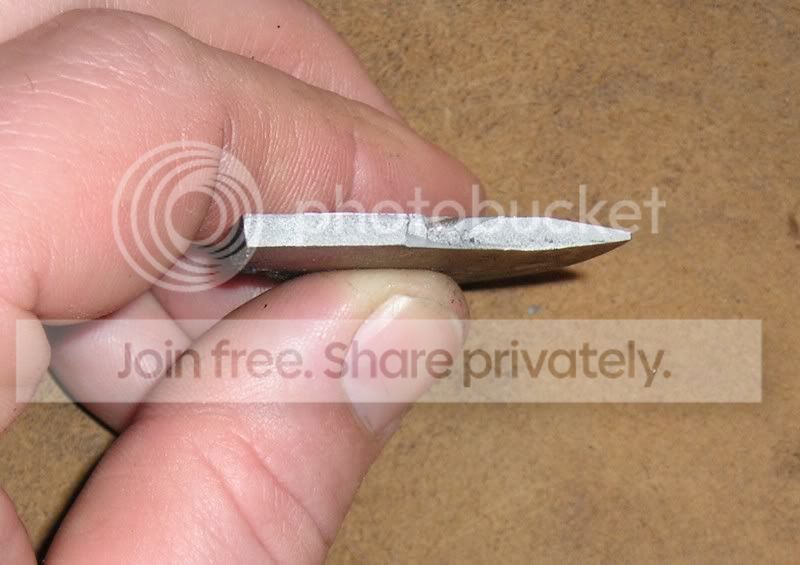
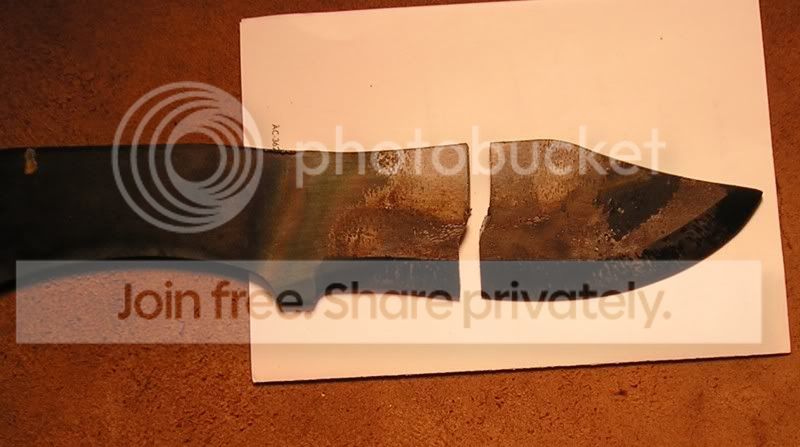
I was testing a blade to see how far it would bend before breaking, and when it broke it was finely grained only about 3/16" from the edge....

The blade was 1095, quenched in oil.
 
I dont know much about that steel.
I know I try to dunk my 52100 in oil about 1/2 the way up the sides of my blades...sometimes a bit more.
But this is just because I think the blade looks cool that way when Im done.
It would be interesting to see the different ways steel will form up when dunked to different depths


There are lots of guys whop use that type of steel and with luck they will be able to answer your question.
 
I have no idea one way or another, but perhaps you should asked some of the experienced smiths if 1095 is the most suitable steel for edge quenching. I do know that it requires a very quick quench. I don't edge quench my W2 blades. I either totally quench them or use clay. I can make this comment. I'm pretty sure that you want a blade hardened up higher than 3/16.......that is unless is it only 3/8 wide.....lol
 
The higher up the blade you can get the quench line, the more likely you will have a fully hardened edge. 1095 has to cool FAST, keeping any part of the blade above the oil will slow down the effectiveness of the quench, and may lead to pockets of pearlite in the edge. Another thing to think about is when you are looking at a quench line, you are looking at the sides only, the unhardened portion extends further down in the center of the blade.

How wide was the blade you were quenching? If you wanted to edge quench say a 1"wide hunter with a 1/8"thick blade, aim for a visible quench line at least 2/3rds of the way up the blade (but I would quench the entire blade). If you are looking at a 2"wide chopper 1/4"thick, try to get the line halfway up the blade.
 
It was ground from 1 1/4" bar stock... so a little less than that....
test1.jpg


The grain....
test2.jpg


I guess this all part of being a newbie... figuring out what causes what!!
 
When edge quenching, how far up the blade should there be fine grain structure??

I was testing a blade to see how far it would bend before breaking, and when it broke it was finely grained only about 3/16" from the edge....

The blade was 1095, quenched in oil.
With proper normalization the grain structure should be fine through out blade. Edge quinching shoul only convert the cutting edge to martensite (hopefully tempered to remove the brittleness).

Jim Arbuckle
 
I really have no room to give commentary, but doesn't that looks kinda thick for 1095 in oil for edge quenching?
 
1095 has to drop from 1450F (775C)to below 950F (500C) in less than one second. If you are edge quenching it ( I never edge quench) the retained heat in the spine will keep the edge from dropping that fast. The very edge may make it, but the rest will become pearlite. You would be better off to clay coat the spine and do a full quench. The results will be the same as an edge quench, but with far more control over where the transition will happen.
I agree with hardheart that the blade you show is a bit thick for an edge quench in 1095.
Stacy
 
I'm using an oxy/act torch... not the best method but it's what i have.... i'm working on building a forge, but untill then....

After the quench I use a toaster oven to draw it out. Two cycles of 400 degrees for an hour each. I have a additional temp gauge, and am not relying on the toaster thermostat....;)

I realize that my methods may not be the perfect practices to get the job done, but it's the best i can do with the money/equipment I can devote to this hobby...

Why 1095? it seems to be the most common (read less expensive) material to work with, and being a newbie, I figured I screw up a lot before making something worthwhile... I can work it ( although not perfectly ) with the tools that I already have/is available to me...... And there is just something about carbon steels... old school?? I don't know, I just has a fondness for blades that will rust :D
 
I'm using an oxy/act torch... not the best method but it's what i have.... i'm working on building a forge, but untill then....

After the quench I use a toaster oven to draw it out. Two cycles of 400 degrees for an hour each. I have a additional temp gauge, and am not relying on the toaster thermostat....;)

I realize that my methods may not be the perfect practices to get the job done, but it's the best i can do with the money/equipment I can devote to this hobby...

Why 1095? it seems to be the most common (read less expensive) material to work with, and being a newbie, I figured I screw up a lot before making something worthwhile... I can work it ( although not perfectly ) with the tools that I already have/is available to me...... And there is just something about carbon steels... old school?? I don't know, I just has a fondness for blades that will rust :D

You can get 1/4 x 1 1/2 5160 spring stock at pretty much any steel supplier.
 
With proper normalization the grain structure should be fine through out blade. Edge quinching shoul only convert the cutting edge to martensite (hopefully tempered to remove the brittleness).

Jim Arbuckle
Multiple quenches (austenitizing and quenching) actually does refine the grain. The metallurgical reasons are covered in Verhoeven's book on metallurgy, but it is unavailable at this time, as it used to be available for free on the internet but the copyright was purchased, so now we have a waiting period where it is no longer free but isn't yet published. There is probably a place or two that is hosting it still, but giving you that link might be somewhat illegal.
 
I'm using an oxy/act torch..
I use an O/A torch too when I edge-quench 52100 or 5160 steels and it works ok most of the time.
I just wish I knew more about your steel to tell you something to try next time, but I dont.

If this were 5160 that snapped like this I would suggest a higher temper temp. I have learned to bump it up to 450 on my blades.
 
1095-001.jpg


1095-002.jpg


1095-ttt-point-89.jpg


1095-ttt-113-percent.jpg


Above are the pages from the Heat Treater’s Guide that deal with 1095. If you look at the Isothermal Transformation charts (3rd and 4th images) you will see one chart is for 1095 with .89 Carbon content, and the other show a 1.13 Carbon content. To properly heat treat your 1095 blade, you have to heat it to approx. 1475 to transform everything to austenite. Then you need to quench your blade rapidly to temperature below approx. 900 to 825 degrees F (depending on the carbon content). If you have a piece of 1095 at the low end of the allowable carbon content, the chart shows that you have less than 1 second to accomplish your task. If your steel is on the high end of the carbon content, you cannot avoid the pearlite nose (the leftmost curved line in the graphs).

As you can see, 1095 doesn’t give you much room for errors. You need quick hand and a fast quenching oil, like Park Metallurgical’s #50 oil (now available from Ellis Custom Knifeworks). Therefore, I wouldn’t recommend trying to edge quench your 1095. If you are looking for a hamon, you would probably be better off clay coating the back of the blade. I quench strait down in my oil and agitate the blade from edge to spine.

1095 is a good blade steel, but because it is such a pain to quench properly, I prefer to use 1084. You may have trouble getting some these days (Mace may still have some), but 1075 or 1080 should give you similar results and be much easier to heat treat properly.

Or so it seems to me…
 
Chris, thanks for posting that information.... I've been getting my steel from admiralsteel in chicago.... I don't know the exact carbon content.... I'm just getting started in all of this, I've read wayne goddards books, and that is what i've been going off of... I'm not exactly a rocket scientist either!! :eek:

I'm going to take a bit and ponder on this information...:cool:
 
When starting off, especially when using a torch to heat the blade, do full quenches. With 1095, you are really inviting trouble with a torch and an edge quench. Get a gallon or two of peanut oil, canola oil, or olive oil and do full quenches. Also try 1080 or 5160 steel.
Stacy
 
Doing a quick check of the net using Yahoo shopping, the cheapest I found peanut oil was $12 per gallon, Canola $13.30, and Olive oil $19.99. Darren Ellis is selling is selling real Heat Treating Oil for $18 per gallon. At those prices, and now that you don't have to deal with the jerks at Park Metallurgical, why would anyone even considering using anything other than the real, honest to goodness, scientifically formulated, heat treating oil?!
 
Doing a quick check of the net using Yahoo shopping, the cheapest I found peanut oil was $12 per gallon, Canola $13.30, and Olive oil $19.99. Darren Ellis is selling is selling real Heat Treating Oil for $18 per gallon. At those prices, and now that you don't have to deal with the jerks at Park Metallurgical, why would anyone even considering using anything other than the real, honest to goodness, scientifically formulated, heat treating oil?!


Can I get an AMEN!;) :D
 
Back
Top