Grind height question?

Joined
Mar 27, 2015
Messages
247
What factors do you consider when deciding on how high to grind a bevel.
For me its when I get tired of hand grinding
But I am sure there are practical reasons for full height or not full height.
I just dont know what they are
 
If it's a flat grind then the higher the grind, the better it will slice. A short grind, like a scandi, is strong but doesn't slice as well. Look at kitchen knives for example, they are all full flats for slicing. So, it depends on the task. I like the look of a high flat because I like seeing the grind but a full flat definitely cuts better.
 
If you use very thin stock you could get away with a sabre grind and still have a nice cutter. But you may ask yourself why you should put extra material inside your cut when you can minimize the wedge effect with a full ground bevel.
 
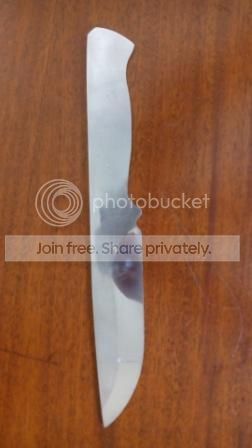
Right so I am grinding a 1/8th thick knife with a 41/4 long blade. If I plan on using it for food prep then grind full flat. I plan on using it for food prep,hiking,in the garden and in the bush etc. So I was going to leave 1/3 of the spine full 1/8th inch. Am I over building it?
Here is another project with a 5inch blade. I had no reason to stop other than I liked the way it looked
Bravo_zpstozaueke.jpg
 
Last edited:
At 1/8" I would do a full flat.
Right so I am grinding a 1/8th thick knife with a 41/4 long blade. If I plan on using it for food prep then grind full flat. I plan on using it for food prep,hiking,in the garden and in the bush etc. So I was going to leave 1/3 of the spine full 1/8th inch. Am I over building it?
Here is another project with a 5inch blade. I had no reason to stop other than I liked the way it looked
Bravo_zpstozaueke.jpg
 
With a grind that goes 2/3 the way up the blade you will only get 2/3 the potential performance out of the blade. Go full flat.
 
A lot of people underestimate the strength of 1/8" steel. I remember a thread a while back where someone was questioning whether 5/32" was going to be strong enough for w 3" neck knife...

Chris
 
The full flat will not only be more efficient now but also thoughout the life of the knife. We've all seen older knives that have been sharpened alot and no longer have their original geometry. Some of them get real thick pretty quick and can no longer be sharpened effectively. A 2/3rds saber grind will suffer from this pretty darn quickly compared to a FFG. I use to do some saber grinds years ago now all grinds (FFG or hollow) stop just before I run out of steel. They cut better and they cut better longer.
 
Actually, the scandi grinds apparently work quite well for their intended purpose and many higher end and particularly custom kitchen knives are not fully flat ground.
If it's a flat grind then the higher the grind, the better it will slice. A short grind, like a scandi, is strong but doesn't slice as well. Look at kitchen knives for example, they are all full flats for slicing. So, it depends on the task. I like the look of a high flat because I like seeing the grind but a full flat definitely cuts better.
 
If they are not full flat then what kind of grind do they have? I am sure I've seen one but I can't think of anything off the top of my head. A scandi grind does work well for it intended use but won't slice as well as a full flat. My understanding of a scandi is to be strong and good for chopping, batoning....Food prep was a chore the op mentioned and didn't figure a scandi would be as good as a full flat.
Actually, the scandi grinds apparently work quite well for their intended purpose and many higher end and particularly custom kitchen knives are not fully flat ground.
 
Full convex, partial convex, flat with a convexed edge section, S grind, blended compound flat, slight hollow, etc. Of course, that doesn't count the tractional Japanese single bevel grinds, As for the scandi, i don't think that it was originally intended for atoning and chopping, but for woodcarving and general use. Batoning is a recent thing.
If they are not full flat then what kind of grind do they have? I am sure I've seen one but I can't think of anything off the top of my head. A scandi grind does work well for it intended use but won't slice as well as a full flat. My understanding of a scandi is to be strong and good for chopping, batoning....Food prep was a chore the op mentioned and didn't figure a scandi would be as good as a full flat.
 
Dang, I'm not even sure what some of those grinds are. I see how the scandi would be good for wood carving. Learn something new everyday!
Full convex, partial convex, flat with a convexed edge section, S grind, blended compound flat, slight hollow, etc. Of course, that doesn't count the tractional Japanese single bevel grinds, As for the scandi, i don't think that it was originally intended for atoning and chopping, but for woodcarving and general use. Batoning is a recent thing.
 
Then there's the Yanagi, designed for very fine, smooth, efficient slicing, with a bevel grind on the offside of perhaps 5/8 to 3/4 inch.
One side full flat, one side Scandi, works like crazy.
So, no, there's no one right answer for this one, IMO.
 
Full convex, partial convex, flat with a convexed edge section, S grind, blended compound flat, slight hollow, etc. Of course, that doesn't count the tractional Japanese single bevel grinds, As for the scandi, i don't think that it was originally intended for atoning and chopping, but for woodcarving and general use. Batoning is a recent thing.

Preach it. I've rehandled a ton of highend custom knives and never saw one that was ffg.
 
Then there's the Yanagi, designed for very fine, smooth, efficient slicing, with a bevel grind on the offside of perhaps 5/8 to 3/4 inch.
One side full flat, one side Scandi, works like crazy.
So, no, there's no one right answer for this one, IMO.

There is no full flat on a Yanagi-ba, there is a slight concave. But point taken.
 
Actually, a properly ground yanagi supposedly has the slight convex on the "flat' side with flats at the very edge and spine and down at the tip and the typical Japanese blended multi faceted grind on the bevel side. If you watch a video from say Korin on how to sharpen a yanagi, you will see that they do the "flat. from the middle of the blade rode/bevel up to the shinogi line first and then raise the spine knife VERY slightly on the stone to do from the middle of the rode to the edge second and then blend. Those two facets are so subtle that they do this merely by where the place their fingers on the blade and apply downward pressure when they are sharpening. Some folks may also put a microbevel on the flat side to give the edge a bit more beef. Grinds on kitchen knives are very subtle because you typically don't have a lot of material thickness to work with.
There is no full flat on a Yanagi-ba, there is a slight concave. But point taken.
 
Back
Top