Grind help? (what am I doing wrong?)

Joined
Sep 5, 2010
Messages
876
Alright guys, trying my hand at a few knives, got a pattern I really like. Even bought a kmg ;)

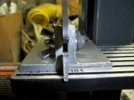
I had an idea to set the platen at a certain angle, then clamp the blade to a 1x1 piece of oak about 12" long. Keeping pressure the same, the angle is the same, however the grinds are completely different.

Pictures are better

this was one side, and sort of the goal right now
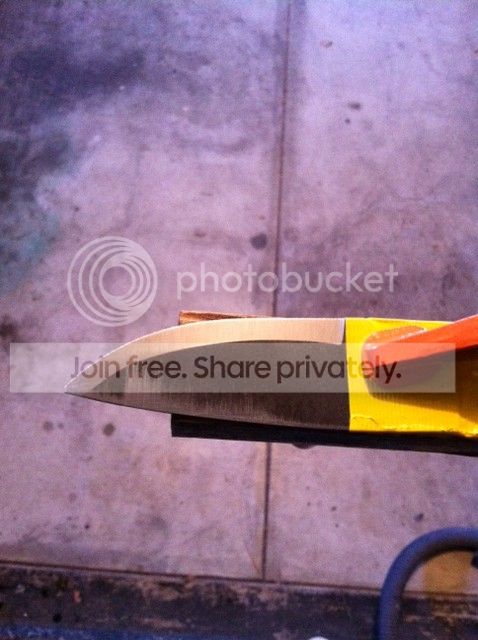
grind1.jpg


This is the other side, and what I would eventually like to accomplish, but dont know how to replicate it.
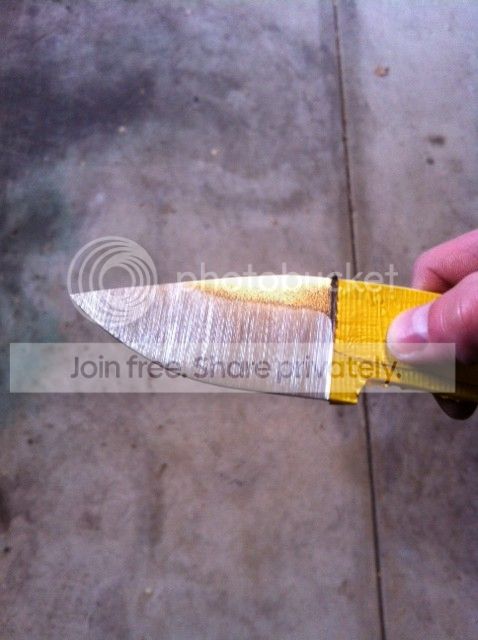
grind2.jpg


What am I doing wrong guys, I eliminated all variables, and two different grinds.

Thanks for your time
 
Well. not to be nasty but think of this. If you had eliminated all the variables both sides would have ended up being the same. No after saying that, I see you have a very even grind on both sides but the angle is just a bit less on the short side. Try for an adjustment . Not much is needed. If it was that simple, anyone could buy a machine, and you did get a good one, and make great knives right to begin with. The very small changes that are sometimes needed can be very dificult to know without lots of practical repetition. Staty with it. I believe you have made a fine start ! Frank
 
Last edited:
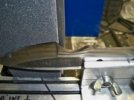
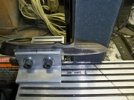
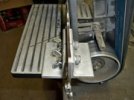
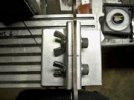
I would say get rid of the oak and make a steel or aluminum clamp. I made one from two pieces of aluminum angle each three inches long. Drilled holes in one for clamping bolts and used the first one to make the holes in the second. They have to be matched up as close as possible or the angles won't match. With this type of jig you clamp the blade and a scrap piece of stock the same thickness with the blade on top, just sitting on the bolts and the scrap on bottom. Make sure the scrap does not stick out the bottom as you want the jig only to ride on your rest. To use it I set my rest with an angle gauge and all is good. You do not have to remove the blade to do the other side, just grind one side right to left then the other left to right working your way to the scribed center line. Also, I use ceramic belts and dip the whole fixture in water after each pass. I can probably get away with every other pass but don't want to gamble on overheating the edge. Especially the tip. There are other many other jigs out there and videos for some but for me this has worked best. Here are a few crappy pics, you can see the scrap stock in the first one.medium.jpgmedium.jpgmedium.jpgmedium.jpg Check my visitor messages for bigger pics.
 

Attachments

  • medium.jpg
    medium.jpg
    5.9 KB · Views: 53
Last edited:
Your Oak just insn't perfectly flat and square I would guess. The other possibility is that your stock isn't flat and straight. Check the stock on the table of one of your tools, or on a surface plate. The Oak needs to be squared flatened, and have the side you're using squared up. Then you have to be sure to put the flat side down and the clamp the blade to the square side. Keep at it. If the jig isn't working, give freehanding the bad side a shot. Then, chock it up to learning and try again.
 
If you want to learn this skill its fairly easy if you have a good teacher.

bubble+jig+first+time+001_001.jpg
 
If you want to use a jig to grind (which is perfectly fine). I would suggest Fred's Bubble Jig ^^^. It's really an awesome thing to have if you want to get respectable grinds without wasting a lot of steel learning how to do it freehand.
 
You are on the learning curve, we all have a strong and weak side when grinding and with practice and lots of patients your work will improve. Check your grind often, look at the grind and compare it to the other side and make adjustments as you go. Keep the blade moving fluidly with each pass on the grinder to prevent uneven grinds and dimples from developing. Like others have said, and from what your pics are showing you should try grinding freehand. Grinding freehand gives you more latitude in making adjustments to the angle of your grind.
 
Tin.Man, your post confuses me. You say of the first picture it is "sort of the goal". And you say of the second picture it is "what I would eventually like to accomplish, but dont know how to replicate". So which is the goal and which is deemed not the goal?
 
I would guess that either something moved slightly. Or your wood block is slightly warped or out of square. Also I second the support for Fred's bubble jig. Currently using it for a full flat grind chopper that has a 10 inch blade, 2 inches tall, and 1/4 thick. Grinds are looking super even so far.
 
Definitely what Fletch and Fred said!!!! I got one and its awesome!!
If you want to use a jig to grind (which is perfectly fine). I would suggest Fred's Bubble Jig ^^^. It's really an awesome thing to have if you want to get respectable grinds without wasting a lot of steel learning how to do it freehand.
 
Guys thank you for all the help!

Sorry for the confusion, right now I want to work on thin scandis with a convex micro bevels sort of a thin saber so to speak. Buuuuut eventually I would love to make knives with full flat grinds. Honestly I have the bubble jig, and I grew up around machine shops and I love free handing my grinds, just love efficiency and like consistent edges. My tips go to hell when using the bubble jig.

I have a meticulous math mind, so the bubble jig really appeals to me, love the 10 degrees each side, then 7, 6 5, etc until its a full flat grind. Where I run into problems with the bubble jig is when I get to the curve/tip area.

Ill try the clamp jig idea for now.
 
Try walking the grind up the blade.

Mark a center line on the edge or mark it about a dimes thickness

Blue the blade and scribe were you want the grind to stop

Grind about a 45 degree small angle on both sides of the edge leaving it thick enough for heat treat. This will make grinding easier without taking to much off the edge.

Now when you start to grind your angle do not try to do it in just a couple of passes. Start at an angle that will take a bit off one side, check and see how high it went on the blade and then repeat it on the other side. Keep decreasing your grind angle and check how the grind moves up the blade to the height you have marked on your blade. Stop short of the line on both sides and be sure not to have ground your edge past the thickness of a dime.

Heat treat

And then remark your blade and finish grinding to the lines and get all the scratches out with progressive grits.

Here is a nice tutorial video on the subject http://www.youtube.com/watch?v=f_CuQkKb2bQ
 
Tinman,

Having a math based mind can serve you well in many things but in others it can be a hindrance. It gets in the way. I understand, my background is in engineering and surveying and I approach many problems with this in mind.
You will agree that if the blades you are grinding were blunt, there would be no issue; like putting the edge on a chisel or a planer blade. Thats what makes knives so challenging; there are a multitude of radii just forward of the "point on tangent" of most blades.
What ever technique you are using the blade has to be manipulated when working on these areas of the blade.
Develop the bevels first leave the tip finishing until the bevels are set. once the bevels are set, use them as the starting point to work the tip. Its easy to grind the tip off when first starting to grind blades. Remove the tip from the belt when making passes, save the tip until later. I think this will help your results.
There is a constant mantra on this and other forums, practice, practice, practice, there is no magic tool or technique that I know of for grinding knives; it takes practice.
I know no one that was great at grinding from the start, but you do have an advantage with your background, just don't over analyze it.
Give me a call on my 800 number; we can put two math minds together and become really confused. ;)
Happy grinding, Fred
 
Fred that settles it I'm going to have to pick up one of your jigs...

Since I've started I've only done freehand, matter of fact my first knife was a scandi grind freehand.. although looked good to the eye it wasn't perfectly flat as you can imagine...

the only jig I use now is for scandi everything else is freehand other then using the rest as needed, and since I'm just getting back into it after a 5 month void I think your jig would help me improve dramatically freehand...
 
Fred that settles it I'm going to have to pick up one of your jigs...

Since I've started I've only done freehand, matter of fact my first knife was a scandi grind freehand.. although looked good to the eye it wasn't perfectly flat as you can imagine...

the only jig I use now is for scandi everything else is freehand other then using the rest as needed, and since I'm just getting back into it after a 5 month void I think your jig would help me improve dramatically freehand...

PM sent!
 
Fred your response speaks volumes about you man. Really appreciate all the help.

So say use the bubble jig and just do straight passes till I get the straights all done, say going from 15 degrees all the way up to 3-5 to get the full flat(example) then turn my attention to the curve and the tip?
 
Fred your response speaks volumes about you man. Really appreciate all the help.

So say use the bubble jig and just do straight passes till I get the straights all done, say going from 15 degrees all the way up to 3-5 to get the full flat(example) then turn my attention to the curve and the tip?

Thats a good beginning. Once you get this part down, a lot of other things will fall into place. Start with a 5 degree setting on the next knife of this size, you will be surprised at the difference in how the blade takes shape.

Like I said, give me a call or mail me anytime; I enjoy peoples success, Fred
 
Back
Top