Grinder- Weld it or Bolt it?

Joined
Jul 20, 2007
Messages
3,121
I have been working all year in my high school shop class on a kmg clone, all seems to be going well, but I made a mistake in drilling the bolt holes for the receiver. I could buy new metal and remake all the pieces, or I could just stitch it together with welds.

Is there a clear advantage to bolting it?

It is a good exercise in machining, but it is getting pretty frustrating fiddling with this thing. The clear disadvantages to welding that I see is: getting the "I told you so" from my shop teacher, It would be harder to align the tracking arm mount to the receiver and my welds are not the best.

I was thinking of oxy-acetylene welding it together as opposed to mig (I am a pretty awful stick welder and have never tried the tig) How does that sound?

Thanks!
 
Hello Keith,

My KMG clone is completely welded without bolts. I used a TIG welder and was very careful not to overheat sections that might create warping. If you are not very confident in your welding, I'd stick to bolting. So, short answer is yes, welding can work but, be careful if you go with this path.

Eric
 
If your welding isn't great, oxy isn't the best route to take. Pretty much anyone can get decent results with a wire feed, even a cheapy hobby welder. Plus the amount of heat the oxy puts out is going to warp the heck out of your rig.

Make sure everything is really clean and wire weld it. Short stitches and move around a lot so it doesn't warp. The parts that can be bolted and easily adjusted, leave bolted.

And MIG and stick (arc) are 2 totally different things.
 
One more thing... If welding the receiver, make sure the tool arm can still move in the receiver when you have it clamped up before welding. If you clamp your receiver too tight, then weld, your tool arm will not slide freely as needed.

Eric
 
I would weld it and use a mig myself and I did with my #2 grinder a KMG like unit. Only bolts on it are to hold the tool rest, the platen and the tracking adjustment arm. Set the mig up and take a few practice runs. Remember that you will get a bit of shrinkage so as the weld cools and sucks everything tight. But, hey,on your mistake, can't you plug you mistake holes and redo them. Don't let a bit of frustration beat you.
 
Thanks. I am pretty good at mig, not up to any industrial standards but I think that they look pretty. I meant that I would not use stick or tig for those reasons.

I have had pretty neat results welding scrap together with the torch and like the look of it.
 
Do it this way. clamp 2 pieces of your plate to the receiver bar to form piece of angle and tack it up well while clamped. Then repeat with the other 2 pieces. Now take your 2 angles and clamp them to the bar and tack up. MAKE SURE the receiver slides in and out easily after you tack it up. If not break the tacks and put a couple piece of very thin wood on the bar, one on top and on on one side, do this on each end as shims and retack weld. Burn the wood out and see if the bar will slide. then weld up your receiver. No need to weld it 100%. an inch of good weld is as strong as one of the bolts. If your bar is a little sticky after the welding polish it down a bit with the flat of a disk grinder. I made mine a bit loose, but the bolt that tightens the arm in place takes care of the side to side and bolt in a threaded hole on top of the receiver near the head end takes care of the little bit of up and down slop.
 
As they already told you, too much heat will warp it, so OA is out. And it is hard to get good penetration with OA on thick stuff.

I think Jim's advice is right on. I'll reiterate something, you don't need full welds. A big strong weld on both sides at the open end and a few small tacks along the length will do it. I'd suggest using an angle grinder to cut short chamfers on both pieces and fill those roots with weld. And if you think it looks sloppy, you can grind it flush because the weld in the root is enough.
 
When I made my receiver I used 2 pieces of 1 1/2" and 2 pieces of 2", all 1/2" thick. When I set it up, I then had a 1/4" ledge where the 2" pieces sat on the 1 1/2" pieces. This made for a nice fillet weld landing. I did weld mine all the way out. I did it in small runns and moved around on the reciever as I did so. There was no real need for this. I just wanted to round all the corners off. If I were to use 1 1/2" and 2 1/2" pieces I would grind in a groove for my filler metal in the weld areas as Nathan suggests. Welding over 2 butted up pieces makes a poor weld joint if there is no place for the filler to go unless the pieces are so thin that the weld penetration goes most of the way thru. Say 1/8 material or less
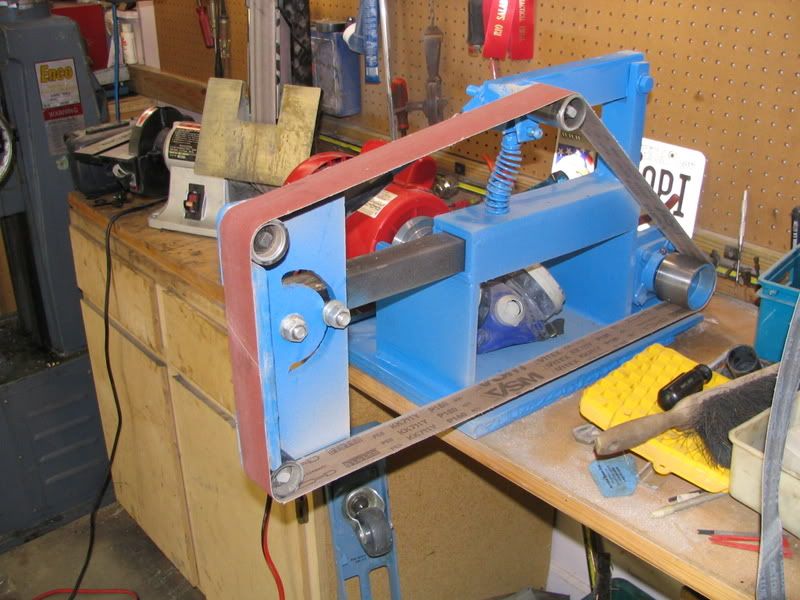
Here is a picture of mine. The tracking mechanism was from a home made 2x48" grinder my brother gave me. I know is a bit unpolished, but, hey, I threw it together in an afternoon and it works as well as my KMG. The reason the belt is on inside out is I was using it to burnish the edges of a sheath using a 1 1/4" small wheel. Works well BTW

grinder.jpg
 
Perhaps you can do what I did when I made this mistake....I just counter bored the thru holes in the bottom and put a nut in them....Worked for me!


Bill
 
..... I'd suggest using an angle grinder to cut short chamfers on both pieces and fill those roots with weld. And if you think it looks sloppy, you can grind it flush because the weld in the root is enough.
Nathan, pretty much hit the nail right on the head. The root pass is the most important bead that you will burn in there.
 
I will have to think about it. When I get back to school I will get some pictures on here.
 
Mig is the way to go if you're welding is not the best, all the other processes require a reasonable ammount of operator skill. When i built my KMG clone i stuffed up a few of the tapped holes, all i did was weld these holes up with a mig at work and carefully re-drillled the holes in the right place. Be aware that any weld metal that you have to drill through will be harder than the surrounding base metal due to a more refined grain structure, this is not such a problem if you take your time and use plenty of cutting fluid whilst drilling and tapping. hope this helps:thumbup:

Also if you choose to weld up the reciever, bevel the joins as other people have stated, though i wouldn't get too fussy as the reciever will not be under that much pressure while in operation.

Keetha.
 
Nathan, pretty much hit the nail right on the head. The root pass is the most important bead that you will burn in there.

Listen to T Blade! He's forgotten more about welding then most of us will ever know! :)

-d
 
I don't know what I was thinking when I drilled it together, I drilled the two wide plates together with the 1/4" holes in each corner, drilled a 1/4" hole through the end of each narrow plate. I then put it together with the arm in there with masking tape on the sides for clearance. I drilled through the narrow plates on the other end and it was perfectly fine.
Here is where I messed up: I drilled through the first 2" of the receiver so that the bit would leave a divot for my #7 bit. Didn't quite work out and now the holes don't line up. One thing is that I was using hot rolled steel for the narrow bars and the bit caused it to shift because they do not have square edges. I was just going to remake the bottom piece from rusty hot rolled steel bar but the holes going through the narrow side plates are not all on the centre line of it.

I also messed up one of the threaded holes in the rear support, which convinces me to just weld it.
 
The reason the belt is inside out is I was using an old belt to burnish the edges of a sheath I just made. I use an cheap 180 grit belt to smooth out the edges then I run my beveler on the corners and then with my small wheel running a 1 1/4 wheel I use an inside out belt to run up and down the edges to get a good finish on the leather. Try it, you'll like it
 
My advice, for what it's worth, is to get comfortable stick welding first. It's the easiest method by far, IMO, and well suited for thicker and less-than-perfectly clean materials.
There are so many different machines and fixtures that will require this skill to build, just make a point of getting it working for you.
If your rods are fresh/dry, you have a decent welder and you turn the knob anywhere near where it should be, you should be good to go.
Good luck.
 
Back
Top