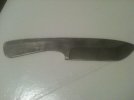
Grinding and belt sander help.

Joined
Aug 7, 2013
Messages
405
My first thread post! Really excited to find a likeminded community that can help a novice in the craft out.

Down to business: I've made about 11 knives now, I have a 1x30 belt sander and a 4x36 belt sander along with a drill press etc. My first couple knives, as expected weren't the most beautiful, but in the end got the hang of it. After the first knife I did freehand, I came up with a decent jig made up of a 2x4 and some hardware and that improved my knives a lot. My problem is I'm just not too happy with the plunge cuts, and the neatness of the grinds. Im only 16 and am too cheap to buy a better belt sander as the 4x36's platen is a piece of garbage, are there any modifications to the platen I could try? Should I stop using a grinding jig and go strict freehand? My monthly budget for spending cash is around $150 depending on commission work.

Any tips or videos would help. =)
 
I am in the same boat, I have a 1x30 and the transition of the heel is terrible. I have noticed that since I put away the jig to force myself to learn freehand grinding the transition has gotten better. I think inexperience is my biggest issue since I'm about a dozen knife shaped objects under my belt. Come spring time I will blame my equipment and talk the decision maker into letting me get a better sander. ARKnives, your monthly budget is similar, except I'm a full grown man! I could go into a when I was 16 ramble but I'll avoid it at this time.
 
youtube the type of equipment you have, someone will have changed or improved it. There are countless knife making vids on youtube, watching them is like going to school. It is an excellent source of information, I use it for everything. Anything you have a question about, youtube it !!
 
When doing the plunge cuts, and even flat grinding in general, I have found that grinding on the edge of the belt has helped tremendously. Hold the knife at an angle and make sure the knife is only touching the edge, pressed up against the front/side of the platen.
 
I'm also new at knife making and have ground the bevels of only about 10 knives. With my first few, I really wanted a jig to clean up my lines and I researched them extensively. I fought the urge to buy a jig and, honestly, I'm glad I did. I can now make and even shape some nice lines on both sides of the blade...I will say this about the plunge lines though - a file guide really helped me out there. I'm not too sure about others as I suspect many folks clean up their plunges toward the end of beveling, but I begin the process with the guide and use it until I get the plunge cut as high on the blade as I want it on each side. I also create my flats at the same time, but I don't fully finish them with the guide on. Then, after the plunges are cut, the guide comes off and I work the flats, being careful not to let the belt reshape the plunges...

I suspect my method is unusual and, it might change over time, but right now it is working well for me...

Bottom line is that a file guide can really help clean up the plunge lines. I'm guessing more experienced makers would agree as well - even if they don't need the tool.
 
You can get decent grinds on the HF. Make sure your platen and table are straight and go slow. I actually start my plunge in the middle of the blade and then work toward the handle. This one was done on the HF with a homemade jig.knife bevel.jpg
 
You can always clamp the blade where you want your plunge to start and precut the plunge with a chain saw file. This gives you an equal groove on each side to work up to.
Hand sanding to even everything out makes it look better.
 
I used to use a 4x36 to grind knives. Here is what I did to get a decent plunge line. 1 track the belt all the way over to whatever side you are comfortable grinding on
2 use that small slack belt area between the wheel and the platen to cut the plunge
3. I have found thay most of the platens on those 4x36 are not flat so I would drag the blade off the
edge of the platen .
This is what worked for me at the time but there are many ways to do the same thing. Hope this helps. And yes grind free hand,it is more fun and you will be a lot less likely to make the same knife over and over .
 
What belts are you guys using on the 4x36? I have one and can't get it to remove much metal. Hand filing is almost as fast. I believe it's a 1/3 horse delta.
 
Last edited:
I have used the 1x30 for a while now. I usually start off the plunge lines with a chainsaw file and then start grinding and that usually helps. To grind in the plunge frack the belt off the platen to either side. I don't really know how to describe this but the belt will hang off about an 1/8th in.
 
What belts are you guys using on the 4x36? I have one and can't get it to remove much metal. Hand filing is almost as fast. I believe it's a 1/3 horse delta.
The 4x36 I used was a Craftsman 2/3 hp. I used Craftsman belts at first AO 36# and 80# They did the job but wore out fast. I was gifted some DEER brand belts that worked nice.
 
When I used to use my HF 1X30 to make my knives, I cut a piece of 5/32" O1 (any thickness will do, just not under 3/32" and not over 1/4") to match to size of the platen, then I heat treated it and tempered it at a lower temp than I would a blade, then I JB welded it on. To make up for the extra thickness the steel adds the the platen, all you have to do is loosen the screws that fasten the platen down, and slide it back some. This helps a lot because it adds rigidness to the platen as well as nice, sharp edges... not to mention being able to get cleaner grinds with the hardened flat surface. Even If you don't have O1 tool steel you could do the same with any blade steel and get better results than you can with the way the platen comes. just my 2 pennies :)

-Paul
www.youtube.com/Lsubslimed
 
Back
Top