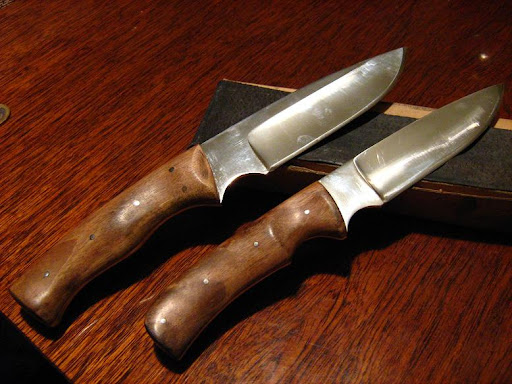
Grinding help. I am puzzled!

Joined
Oct 1, 2007
Messages
37
I need some help. Sometimes when I try to match a hollw grind on one side of the blade to the other I end up with a nice radius grind line on one side, the way it should be, and then I have a straight grind line on the other. How come?? It doesn't happen all of the time. Sometimes if I grind at 60 grit both sides are the same and then when I continue with 120 grit I get one straight grind line and one proper curved line. AArrrrgghhh. :mad: I can't figure it out. Can anyone help me please?? Thank you. krg
 
Ambidexterity problem, I have that also on flat grinds. My right hand is at the tang and left at the blade pressing behind when grinding the blade's right side. Right hand just keeps the back and forth action at same level. But when I switch the sides my left hand cannot cope good enough to keep the blade at same level and right hand pressure is not same as left (I'm left handed). To cope with it I used to lift the left hand to help right hand, but then belt tends to dive to the tip, hence there is a curve to the tip. I struggled to defeat the problem I finally I somewhat managed to move my hands same way. To go real slow and work standing up and lean to the belt with all the body and keep the elbows locked to the sides of the body does help a lot....

Sorry for my english, maybe I couldnt explain what I meant...
Emre
 
I need some help. Sometimes when I try to match a hollw grind on one side of the blade to the other I end up with a nice radius grind line on one side, the way it should be, and then I have a straight grind line on the other. How come?? It doesn't happen all of the time. Sometimes if I grind at 60 grit both sides are the same and then when I continue with 120 grit I get one straight grind line and one proper curved line. AArrrrgghhh. :mad: I can't figure it out. Can anyone help me please?? Thank you. krg

I believe you will find, it is in your hands. Each side is different as you hold the blade and this produces the unbalance in grinding.

Grind 50 knives and then check again. I think you will find your answer in the experience.

Have fun, Fred
 
What Fred and Emre said. It's technique and practice. Just keep practicing and it will come to you. It's all about control of your hands and the motions. I've had a few very experienced makers look at my knives and tell me that they know that I'm right handed, just from looking at the grind lines. Even though the grind lines are really close and an inexperienced eye can't see it, the difference is there in the fine detail.

Practice, practice and then more practice.
 
I am not very silled grind maker, but I discover one method (maybe discovered the warm water :D ) to make more straight grinds. When I pull the blade from ricasso to the tip I don't use my hands to do the pulling motion. (Legs dont work too, I tried :D) Instead of it I hold the blade still and I hold my elbows beside my body and I shake right-left. It is more accurate and only thing to do is to control the twist motion. Definitely I improve more equal grind lines each side. For finer grids I use less preasure, because it is more difficult to feel the wheel (I do hollows). Hope I was helpfull, TheCivilman. :)
IMG_0071sm.JPG
 
Last edited:
I am working on my first knives and couldn't get a good flat grind. I swayed my whole body back and forth and got better results. Its just my first knives so its not a perfect technique but it worked this time.
-frank
 
This is a problem I suffer from as well. With each blade, it's taking me longer and longer before I screw up. That's progress, right?
 
Upon close inspection, I discovered a machining error in my contact wheel. Being a flexible polyurethane the wheel deflects from the cutter during the cut. The material on the edges of the wheel are only supported on one side, and thus deflect more than material towards the center. This leaves a slightly concave surface that should be flat. And in my case the problem was more pronounced on one side than the other, causing an asymmetry similar to the one you describe when using more flexible belts that conformed to the defect. I redressed my grinding wheel and the asymmetry went away and the 2" bump mark also improved. Put a straightedge on your wheel and look for a gap in the middle indicating a concave surface. If it is, that can give you trouble.
 
If your radius is at the plunge then I agree with Nathan that it may be your wheel. If you have a crisp edge on one side and a rounded on the other you will see this difference. Otherwise, I agree with the others that you position or movement are affecting the grind. I also agree that you should lock your elbows at your sides and grind with your hips, you'll have a much more stable grinding platform.
 
I'm leaning towards Nathan's suggestion. You need to check the outside edges of the contact wheel. If the surface is not exactly the same on both sides, your grind won't be either. :)
 
Back
Top