grinding kitchen knives

Joined
May 3, 2008
Messages
1,436
I'm doing a few stock removal knives that are kind of wide, 2 1/2 inches, and realize that I'm not at all satisfied with my current technique.

Right now I have a sort of "square U-shaped" piece of micarta on the tool rest that goes around the sides of my 2x72 belt, and I draw the knife edge up across the belt, pushing against it with a hardwood stick.

That's a lot of metal to remove, and while a bit of convex is fine for what I'm doing I'd like to go closer to a zero grind, at least down past .020.

Does anyone on this forum feel they have a really good technique for this?

Thanks!
Andy G.
 
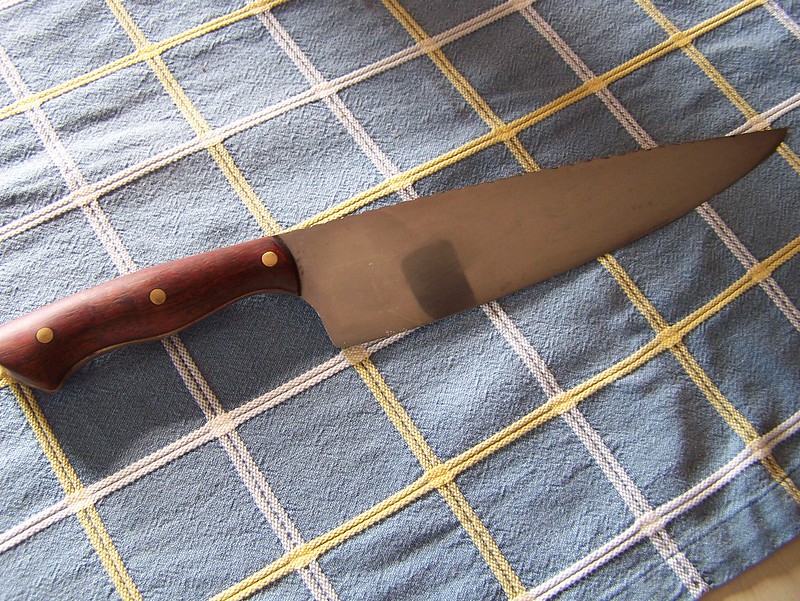
I struggled with this until I got a flat ceramic glass platten ( thanx Frank!!) If the platten isn't flat, or flexes, you won't get an even grind. I would scribble over the sides of the blade with a sharpie, and see that I was grinding even. Kitchen knives are a lot harder than they look.

9374894732_73c886d02a_c.jpg
 
Thanks, Willie- I do have one of Gene Martin's excellent Pyrex platens, and wouldn't be able to do this without it!
Maybe this is already the best way to do it and I just need to suck it up and be patient. :)

edit: BTW, that's a beautiful knife
 
Using one of Nathans 36" radius platen is really fun. Its just enough of a hollow grind to "feel" your way into it. You can get a nice zero grind without too much trouble.
 
If you rotate your knife around 45º on the platen, you will see pretty quickly how flat your grind is (be careful not to run over your plunge line, though).
For most kitchen knives, you'll want to grind your edges down to 0.01" max.
What kind of steel are you using?

- Chris
 
Use a jig and a huge magnum sized sharpie. I imagine there are folks out there that are really good freehand. But for a series run of blades, use a jig. Something as simple as an L bracket or U-channel helps. Along with dunking in a bucket of water, as a bonus, a metal jig well help act like a heatsink. Getting a .02" edge requires a good, dead-hand, something better than what a sign painter has from what I gather.

As said, cover the face of the blade with sharpie (better than dy-kem, as far as application goes, imho). This will give you a rather obvious indication of where your belt is working. Also as a bonus, the sharpie prevents rust should you want to take a break.

Here is a rather simple and recent one i made using an aluminum L-bracket for a Takobiki. This is a 12" blade. I could be high on Diazepam and still would never get an even grind freehand.
1093840_10151763176899708_334044647_o.jpg
 
Last edited:
I hog off the steel horizontally like you do (sans work rest), then turn the blade vertical and flatten the bevel from spine to edge and tang to tip. It is amazing how un-flat the blade is until you place it against 10" of flat surface. I have a grinding magnet with a handle on it that works perfect for holding the blade against the platen while my other hand holds the tip or tang and directs the force to get the bevel to walk the desired direction.

Another way is to use a disc grinder to true things up.
 
There are almost as many ways to accomlish a full flat grind as there are makers.
The Ceramic platen can help. The one thing we all seem to forget is to take our steel flat Platen out and true it up on a 6 x 48 sander or disc grinder etc. It only takes a couple of knives to start getting a dish in the center of the steel Platen.

One of my favs when there is a lot of metal to remove is to work the profiled blade length ways tip in on the contact wheel until I have a distal taper, then go across the platen starting at the plunge line and working out to the tip. working with the blade tip up.

Laurence
 
Thanks all! As always, lots of great info.

Stacy, I'll try that, have never used magnets but that makes a ton of sense.

I guess it's mostly about flat platens and sharp belts, at least til my disk set arrives- got in on that great group buy from Nielson.

Oh, and Timos- Loving my 36" Nathan platen! I was a little reluctant to use it on kitchen knives, but it's the same technique as hogging on an 8" wheel for a flat ground hunting knife, isn't it?
Did a few file knives for the farm market with it and was very pleased with the result- the way the light goes on that bevel is just awesome. Can't wait to try some lockback blades....
 
Hesparus, the last few were 15n20, since I had it and it's cheap and I can nail the HT. Next one will be Alpha's 1080+.
 
20130329_114617.jpg I really am liking this type of setup ...it allows you to get in close and "rest" the blade on the belt. Just use your fingers to apply pressure and stay in the grind. Use your thumb to support the spine. No work rest needed.
 
Personally, I use a center scribe to mark two parallel lines on the edge of my blank, and then a grind a 45 degree (or so) bevel into the outer edge of each line. That establishes close to the final thicknes of my blade at the primary edge. I'll then reduce the ange of my blade to 35 or 40 degrees and grind to the outer edge of my scribe line again (this time removing material farther down from the edge than before).

I keep doing that until I've established the bevel I'm looking for, whether full flat, 1/2, 3/4 or what have you.

The nice thing about taking "incremental" passes, is that you quickly see if your angle and/or flatness is changing, as you have the prior grind to show you where you're at.

Kind of hart to explain, but hopefully that makes sense.
 
Knife to a G, that's what I should do- I was taking successive passes all down the side, then doing it again, but it makes more sense to finish one pass or bevel and then start the next, much more efficient that way. That's the way I grind everything else, for some reason I thought I'd reinvent the wheel for kitchen knives.
My method made for a much more convex edge than I really wanted.
Thanks.
 
Personally I would like to get one of those big stone wheels that pass thru water while grinding. Maybe not as efficient but keeps the blade cool. Ofcourse the price over here is pretty high when I have found them.
 
Timos, where did you get the work arm release handle on your grinder? I've looked everywhere for one.
 
Personally I would like to get one of those big stone wheels that pass thru water while grinding. Maybe not as efficient but keeps the blade cool. Ofcourse the price over here is pretty high when I have found them.

Called a "Kaiten Toshi".
 
medicivans, mcmaster carr stocks them you can search the term "handle" and have many different varieties to choose from.
 
For kitchen knives without a plunge line (never seen much purpose for them and much of the kitchen knife world could care less, unlike the collectors and knife crowd who like the look of it) you can do most of the flat platen grinding at a 45ish degree angle which gives you a lot of platen contact and helps prevent overgrinds and keep things even. A disk grinder is very helpful as well. we forge as close as possible, so edge scribes and incremental passes are useless as we're starting with something that's not perfectly straight, evenly thick, etc and already quite thin. Practicing finding and taking down high spots, changing the angle of the blade to platen (horizontal, 45deg, even vertical occasionally) you can correct and grind the blade very nicely. The disk grinder is nice when you're almost there and you want to ensure there are no overgrinds and take the blade down to a few thousandths or full zero grind- that gets pretty darn risky with a belt grinder as it's really tough to avoid even tiny overgrinds that will be detrimental to sharpening and even at 400 grit you can overgrind when there's that little metal behind the edge.
 
Back
Top