Grinding something flat and/or cleanup of forged blank?

Joined
Sep 16, 2002
Messages
1,577
I've tried twice now grinding something flat on my crummy Sears belt/disc grinder...I guess I forgot what went wrong the first time I tried it. It ends up being tapered (I forget if it's top to bottom or bottom to top) rather than flat.

The first attempt was a tang, last night it was the ricasso area of a forged blank. I think I tried the tang on both the disc and the belt platen, but that was a long time ago. The ricasso I tried on the platen.

What's the trick to getting something flat?

How do the guys who forge cleanup all the scale and hammer marks from their blanks without screwing up everything they did at the anvil?

Thanks!
 
First "trick" is to not put the hammer marks in there. :p Radius and polish your hammer face to 400, keep your hammer blows level and when you get tired STOP hammering, that's when the marks come, or you could be using too big a hammer.


Next, scale, keep it off the anvil and brush it off your blade before you hit it. Soak your blade overnight in vinegar to pop scale off before grinding.

Are you using some layout fluid or marker to show where you're sanding? That helps.

What I do is get one plane, usually ricasso, flat. Everything else is based off of that one flat surface.

Practice also helps a lot. But remember, knives don't have to be paralell, they have to be symetrical.
 
Hi Will,

Thanks for the tips! I'm using a 3 lb. rounding hammer (mostly the flat face) that I removed the edges from lightly on my belt. I may need to dress it a bit more, but likely the hammer marks are more from inexperience and poor technique at this point. They really weren't all that bad though, but they were there and the pitting/scale was in full force. I did not have a wire brush, but have one now that I will use in the future.

I soaked the blank overnight in vinegar, then rubbed it with some coarse sandpaper to get the big chunks off. Not knowing where to start next, I decided I would grind the ricasso clean and flat. I pretty much stayed on the ricasso, and I had to remove quite a bit of material to get all the pitting and marks out. This caused the rest of the blade to be thicker...how do you deal with is issue? I put marker on the ricasso a few times, and it seemed to be grinding flat, but after I had removed quite a bit of material I eye balled it then caliper'd it, and saw that it was tapering from top to bottom (not flat after all.)

Next I started grinding in the bevels, and had two issues. This was my first forged blank that I've ground on (and probably 5th or so blank period), and I didn't really know where to start here either. I started at a bit steeper angle than the bevel, and ended up with the edge very thin, sharpened in a couple of spots. When grinding a forged blank, do you just start with the angle of the bevel that you had at the anvil? Next, the thickness issue mentioned above where the rest of the blade was thicker and still had scale, etc. on it compared to the ricasso gave me all sorts of trouble.

I guess I'm just not sure of what sort of overall strategy to employ when starting with a forged blank. I have the concepts down, although certainly not the skill, for a stock removal piece but am really starting at ground zero with the forged piece.

Thanks much!
 
I'm guessing you mean that the you wound up with a "wasp waist" where the ricasso was? The spine is wider than the ricasso? What I do then it grind edge down to bring the spine to the same width as the ricasso, you're going to wind up with a Scandi looking thing but at least everything is nice and clean.

I leave "sacrificial" steel when I forge because of my fears of decarb. I do try to follow the angles forged in though. If you get thin spots on the edge as you flat grind you're going to reprofile the blade by grinding the cutting edge up closer to the spine, this will "thicken" the edge.

I really recommend getting the scale off of the blade before you really get into grinding it. It resists grinding a lot more than the steel.

Ever wonder about when we talk about making bowies into hunters? :p for most of us knifemaking is an exercise in fixing mistakes. :D
 
Hi Will,

I hope I'm using the right terminology, by ricasso I'm referring to the flat expanse between the guard and the blade as shown in this link on Mr. Cashen's site:

http://www.cashenblades.com/hunters1.jpg

I'm holding the blade perpendicular to the belt flat on the platen, and a taper develops from the spine to the edge vertically as opposed to how a tapered tang would be from butt to blade in the horizontal plane.

Do you just grind all over the contours of the blade on the wheel or something to remove the scale (it doesn't seem to all come off for me in the vinegar soak) before you start cleaning up the profile, ricasso, and then bevels?

I'm really in the dark about this, so if anyone has an overall strategy or approach they take when grinding a blank from the forge, I'd appreciate the advice. I don't recall any tutorials on this in the newbie section.
 
Hi Will,

I hope I'm using the right terminology, by ricasso I'm referring to the flat expanse between the guard and the blade as shown in this link on Mr. Cashen's site:

http://www.cashenblades.com/hunters1.jpg

I'm holding the blade perpendicular to the belt flat on the platen, and a taper develops from the spine to the edge vertically as opposed to how a tapered tang would be from butt to blade in the horizontal plane.

Do you just grind all over the contours of the blade on the wheel or something to remove the scale (it doesn't seem to all come off for me in the vinegar soak) before you start cleaning up the profile, ricasso, and then bevels?

I'm really in the dark about this, so if anyone has an overall strategy or approach they take when grinding a blank from the forge, I'd appreciate the advice. I don't recall any tutorials on this in the newbie section.
 
Yes we're talking about the same ricasso.

I do most of my scale removal using the contact wheel, I gently run the blade tip to butt against the contact wheel to knock off most of the scale before I get to flat grinding.

I'll try to describe how I do it. This is assuming that I didn't mess up too much forging :p

Vinegar soak to remove scale
Grind most of the scale off by running blade tip to butt against the contact wheel
Clean up and flat grind the ricasso to set my "zero" for the whole knife
Straighten up the rest of the knife in relation to the ricasso
Flat grind with 60x (get the plunge in the general area)
Flat grind with 120x X flex belt
Set plunges with chainsaw file and file guide
Set shoulders with files and file guide
Set plunges and final grind with 220x J flex

Anti-scale (ATP 641) and normalize 3X
Clay, heat treat and temper

Clean up with 220 Jflex
400x gator
400x gator with rouge
Hand rub
 
Hi Friend,

I have had the same problem, and then some. For me all that scale you're talking about seemed to be from getting and working the steel too hot and in too oxidizing a fire. When I dropped back the heat and oxygen a bit I had way less scale. Wire brushing to keep the anvil and blade clean between heats helps a lot too. My first blades were so burned (scaled) the vinegar thing only worked so so too. I went and got some muriatic acid (substitute) from Home Depot. It thoroughly stripped a blade in a few hours, but then there were huge craters (pits) where I had really "burned" and driven the scale into the blade. Again, not over heating the stell has helped reduce that quite a bit.

The hammer thing is an issue too. I am fairly dismal trying to move serious amounts of metal with a flat face. I almost exclusively use more of a rounding face and can still get pretty flat work. There are a lot less hammer marks this way, in fact, not really any at all.

As for grinding, can't help you there. I'm a mess. I can't get the bevel angle right and the top line isn't straight, it ripples or waves. I get too thin and eventually toss the blade out. And considering the cost of belts and the seeming volume of blades and practice I'll need to get probably no good at all...it's quite discouraging really. Since I have a lot more fun forging I'll probably practice that more, hopefully get a lot closer to a finished product there and then have a lot less grinding I have to do before I ruin the blade, thus be able to get a little more milage out of my belts....ha ha ha!!!

Good luck. I look forward to reading more.

All th best, Phil
 
Will,

That's awesome help, I really appreciate it and I will follow your lead on the next one. If you don't mind one question, what technique specifically are you using to grind the ricasso flat, and do you have the problem of it ending up tapered from spine to edge (or vice versa?)

Phil,

When I got into this, I would have never guess how complicated and frustrating it possibly could be. Seems like such a simple thing, making a knife. I've been going at this since early this year, and have yet to actually finish a blade yet, although I'm finally getting close. I started with stock removal with files, then I bought the Crapsman grinder, then I took a couple of forging classes, then it got to be Arizona summer, then...

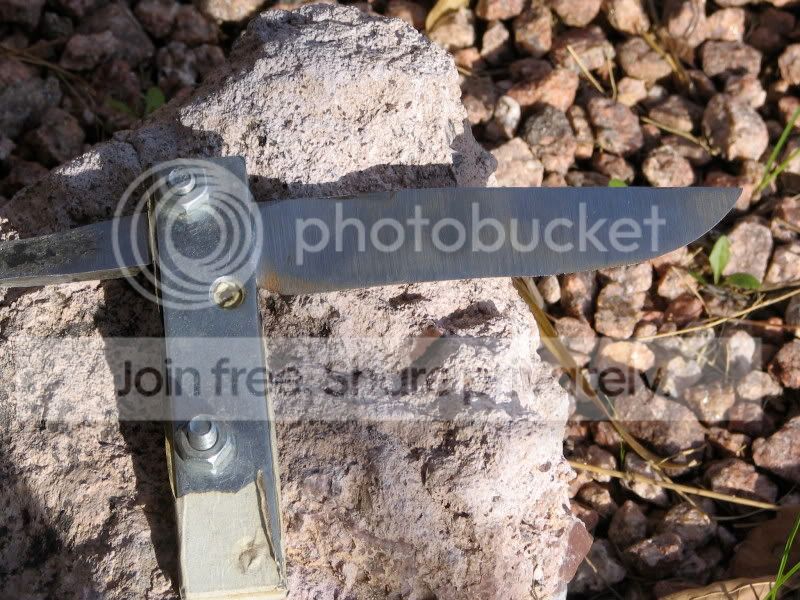
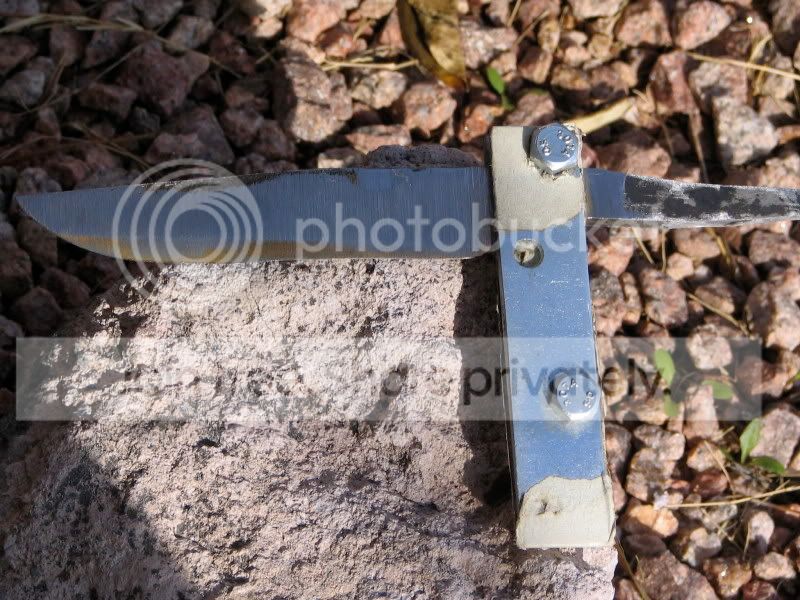
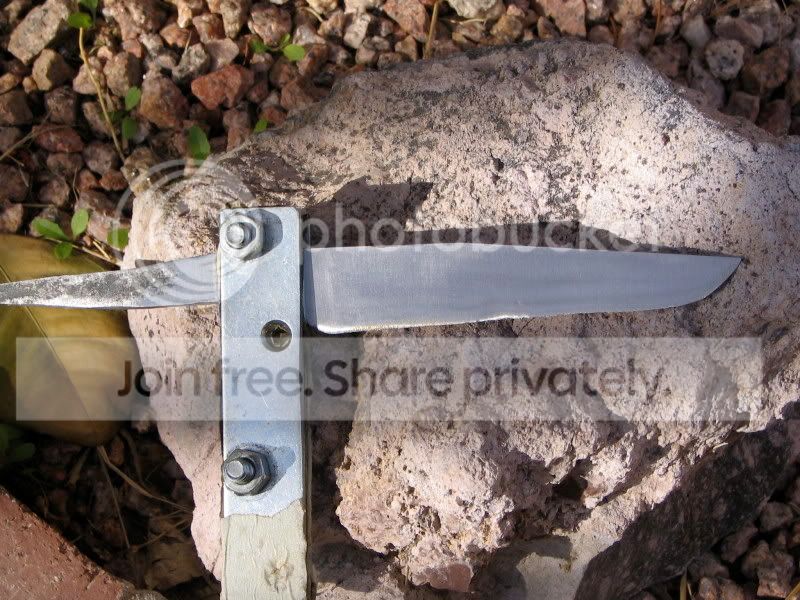
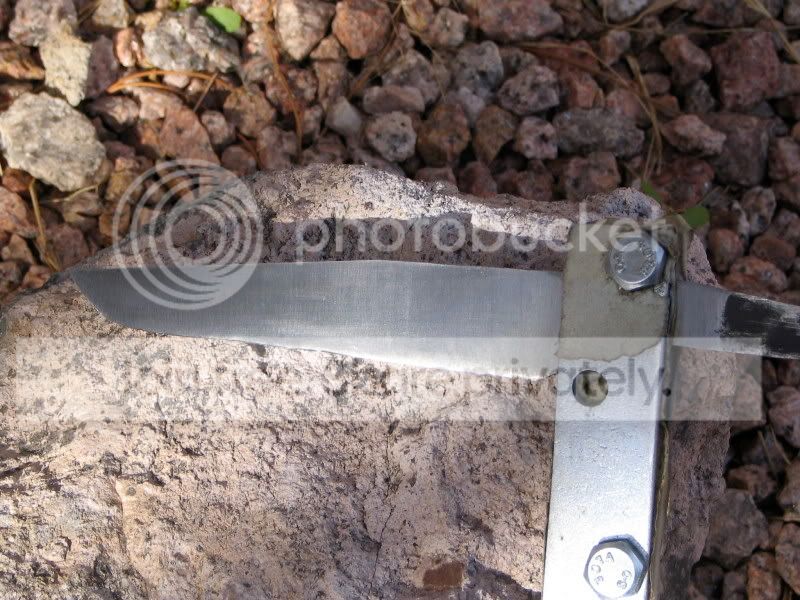
My bevel grinding is far from perfect, but I feel like I'm actually making some progress with flat grinding thankfully. I kind of have the whole stock removal grinding process down in my head (but not my hands unfortunately), but I didn't know where to start with this style of forged blank. Here are some pics...unfortunately I ground away quite a bit of the blade from the edge in the process by getting it way too thin there. I don't know if I can salvage this one to finish or not; I'll have to see what it looks like when I grind back the edge to get back some thickness.

Here is what I started with:

IMG_1213.jpg


This is from last night...this side isn't too bad:

IMG_1244.jpg


This side is more of a mess, both grind-wise and hammer mark-wise:

IMG_1245.jpg


Here it is 'fixed' from this morning (and I haven't even ground the edge back yet, so you can see I've lost quite a bit of the blade):

IMG_1247.jpg


other side for posterity:

IMG_1246.jpg
 
Pj,
I'm with Phil on this one. I think you might be getting to much heat and for to long. It looks like you have a lot of decarb going on and you're having to grind way to deep to get the scale and pitting out.
Unfortunately I can't help you on the grinds because I convex grind.
As for your surface grinding coming out tapered: It sounds like you might be putting uneven pressure on the grind area. Maybe try using less pressure, or using two hands (pressure points) to even out the pressure.
Another way , and it's the pain in the butt way, is to get a flat surface (thick plexiglass works) , lay out sandpaper on it and then "draw grind" the knife on the paper. Make sure you have even pressure. This will be a huge pain in the butt if you have a lot of decarb though.
The only other thing that I can think might be happening is that you're coming off the platen and digging the trailing or leading edge into a slack belt and it's tapering unintentionally.
Just my two cents.
God bless my friend and don't give up, it'll come with time.
later,
Iz
 
PJ,
I use layout fluid to and a 120x belt running slow to get one side flat, then when I'm bringing the other side to flat I grind with the widest end at the bottom. For me it's a feel thing. I worked in a hobby store making giant scale model airplane kits and we used to have to sand stacks of ribs and stuff like this.

People grind better with one side than the other, probably the same for hammering. I really don't flip the blade over much when I'm hammering. I hold the blade at double the angle I want then hammer the flats. The smooth faced hammer and the smooth anvil face help to keep dings out of the blade.

That blade looks like you overheated it a few times and had an oxidizing atmosphere. You want flames licking/curling out of the doors, not a blast of fire but just some wisps. As you get closer to final shape heat the knife edge up and start to reduce the temps you're forging at. When I get close to final shape the blade will take almost 2x as long to heat to forging temps as when I first started with a bar.
 
Thanks for the additional tips, fellas. I'll keep working at the grinding, perhaps it's too much pressure or I need to flip it around the other way and learn the feel of it. I laid my platen down to horizontal this time, and pressed down right in the center of the ricasso, which is not very large, onto the platen.

I'm a little more perplexed about the overheating issue though, as I'm working with propane and I had the assumption that overheating wasn't too much of an issue. I'm forging at an orange heat more or less, which I thought to be about right for most carbon steels.

Anyway, thanks again for the tips and advice.
 
Hey PJ, I'm a newby too, but I'd keep in mind the old saying, forge it thick grind it thin. Whatever you want your rough ground blade to look like, make sure there's extra all the way around after you're done forging.

Thanks for showing the project, Craig
 
Good advise, Craig! I thought I left some extra but apparently not enough. I think the larger issue with loosing the edge is that rather than just start grinding at the angle of the forged bevels, I started at a shallower angle (thinking I might end up with the opposite problem at the end...come to think of it, maybe I still would have?)

Someday I might actually figure out how to make one of these knives instead of turning things into dust and other miscellaneous unrecognizable shapes!
 
Back
Top