
Grizzly G0530 Buffing Wheel...

Joined
Sep 29, 2015
Messages
714
Hey guys,

So before I go run out and buy this buffing wheel (like i did with the bandsaw that can only cut wood :p) I'd like to check with you guys and make sure it's good to go. Obviously the big name in industrial 10 inch buffing wheels is Baldor, but I've always seen Grizzly be respected for their machines also (besides their fixed speed 2x72. ). Anyway, found this on craigslist... the G0530, in what looks to be good working order. I'm having a hard time finding an MSRP or original sales price to know if it's a good deal or not... but it seems like one considering it comes with the stand. What do you guys think? Here are some pics and stats, including a link to the full owners manual:
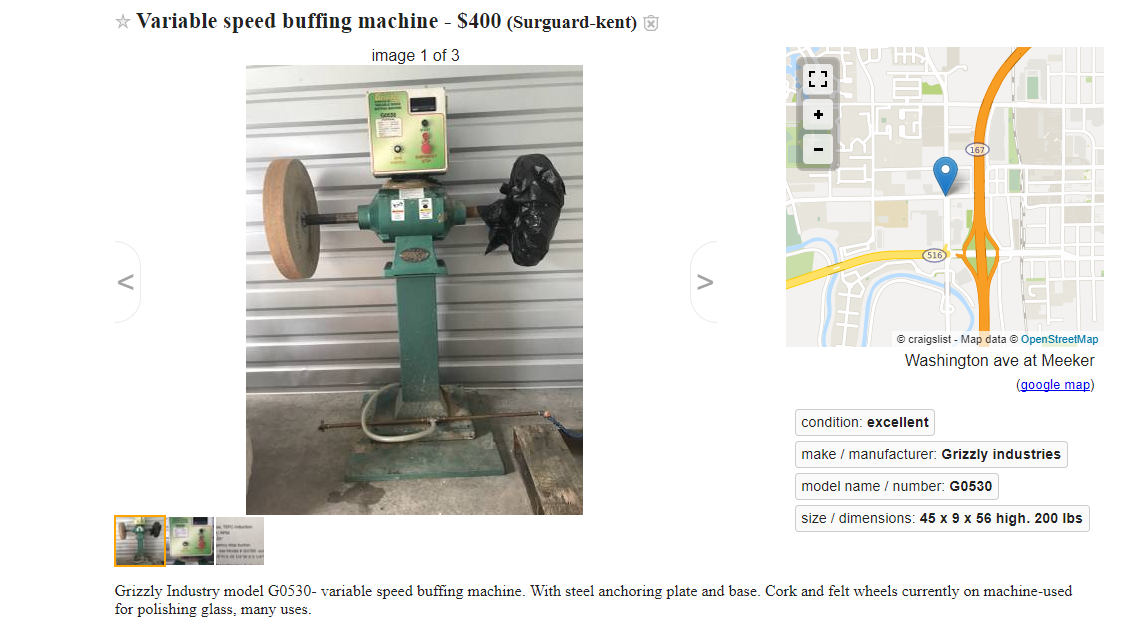
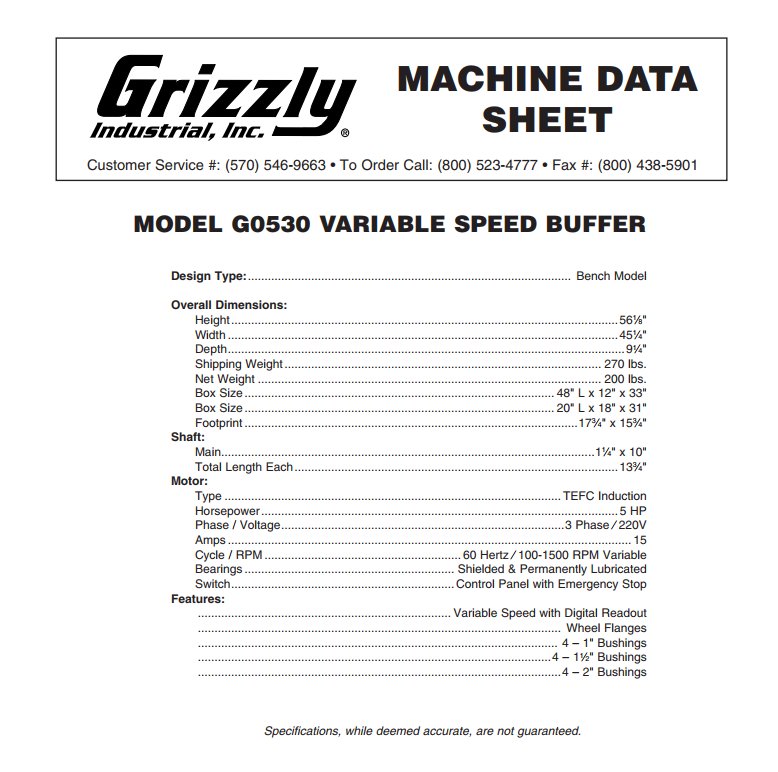
GabjQoU.png


w5dD9ov.png


http://cdn0.grizzly.com/manuals/g0530_m.pdf

So what do you think, should i ask if I can show up with $350 cash and come pick it up today? :cool:
 
Note that it is a variable speed from 100-1500... is this enough? I've seen most Baldors list either 1850 or 3500ish
 
Actually I think that's a heck of a deal. And the reason most smaller buffers are faster is they're running smaller wheels and therefore need more RPM for higher surface speeds, and many guys think they're too fast at that.

It appears to have a VFD that's 3 phase in, 3 phase out however. Which means you likely can't run it as is.
 
Thanks for responding so quickly as always, Kuraki. Can you explain to me what the problem is in laymans terms? From setting up my vfd on the grinder I can see the difference is a 1 phase in and 3 phase in... Does this mean it would need to be plugged into an outlet running off a 3-pole breaker? I asked the seller what kind of plug she had it wired to and she said a standard 3 plug 220v... I currently have that kind of plug wired to a 2-pole breaker and could probable rewire it without too much trouble...
 
Last edited:
No. It would likely mean replacing the VFD with one that's like the one on your grinder. I say likely because for some reason I think there are some VFDs that can manage single phase in or three phase in, and the difference is just how you wire them. But it would take the manual or someone more knowledgeable than me to say whether that's the case with the one on that buffer. I assume it's not capable of that, since the data sheet you posted lists the machine as three phase only.
 
Although I agree with Stan that it would be a heck of a lot easier to just by the new one and be done with it, I know that I would LOVE to own a massive 5hp monster like that one. As these guys have said, though, it's ain't exactly plug and play, for you. A static phase converter would be required, at minimum, to make this run. You need to ask yourself how much buffing you plan on doing - I'll wager most guys on here don't even OWN a buffer.

Not to dissuade you from using one, either, but the simple fact is that there aren't any other machines that are quite as dangerous in a knifemaker shop. A single instance of your attention slipping could mean death. Seriously. Still, I feel it's an indispensable machine for many processes. YOUR workflow has to determine its necessity, though. As you haven't even started making, buying a heap of tools is a little bit like putting the cart before the horse. Need to make a few and determine HOW you work.
 
I'd be a bit torn on that myself. On one hand a 5hp buffer would be really nice. On the other hand even a 3/4hp Baldor is pretty damn hard to slow down for most knife work. Once you factored in replacing the VFD, a new 3/4hp Baldor would probably be cheaper.


As for speed, that's somewhat of a contentious issue. A common argument is that 3400 rpm buffers are too fast and too dangerous. That isn't really the case though. In practice the "speed" of a buffer is determined by wheel size in addition to just rpm. A 12" buff at 1750 rpm will have the same practical speed as a 6" buff at 3500.
Surface speed plays into buffing effectiveness quite a bit as well. Slower speeds are okay for brass and handle materials, but if you want to usefully do a good job on mirroring blades, the equivalent of a 12" wheel at 1750 is about the minimum. You can do it with something slower, but the finish will never be as crisp or nice looking, and it will take FAR longer. On that buffer I wouldn't want anything less than 16-18" buffs for working on blades.

Another aspect of speed to keep in mind is safety, but not in the way it's usually looked at. At lower surface speeds, buffs tend to grab things a lot easier, as they aren't spinning fast enough for centrifugal force to make them act as hard. Yes if you manage to stick a blade on a high speed buff it can do more damage, but it's far more difficult to do. On my 1750 rpm buffer, the 12" wheel is damn near impossible to have grab something unless you do something real stupid like sticking the tip into it. The 8" wheels are far more grabby and require much more care and attention to use safely.

Getting down to it, I'd really recommend a 3/4-1.5hp 3500 rpm buffer.
I bought the 3/4hp 1750 rpm Baldor after reading everything I could find on knifemaking forums, and have regretted it ever since I really took the time to learn about buffing and how to do it right. I'm replacing it with the 1.5hp 3500 rpm version soon.

You can always put a tiny buff on a big fast buffer, but you can't put a giant buff on a tiny slow one. And if you ever do mirrored hollow grinds, you'll especially wish you had a high speed buffer
 
Well the the lady just reached out and beat the number in my head before I could ask... $275 out the door if I can get it before the end of the month so she can get rid of the storage unit. She said she also has a kiln but I'm assuming it's for glass... I've done some preliminary research on HT ovens and have seen that companies like evenheat make both smaller knife and larger glass/clay kilns... wondering if a big one would work for knives also? I asked her what kiln it is...

Anyway, I do plan on doing a good amount of buffing for my handle finishing. I'm a big fan of the way bark river polishes their micarta and their process is to hit it with blue white and pink on the wheel.

Getting down to it, I'd really recommend a 3/4-1.5hp 3500 rpm buffer.
I bought the 3/4hp 1750 rpm Baldor after reading everything I could find on knifemaking forums, and have regretted it ever since I really took the time to learn about buffing and how to do it right. I'm replacing it with the 1.5hp 3500 rpm version soon.

Thanks for your thought out reply, Geoff. It's funny, I've heard all the same things about 1600 being safer than 3600, but got a call from the guys over at trugrit one afternoon because there was an issue with my order (they ended up replacing the belts i wanted which were out of stock with another brand of the same grit, slightly more expensive. and since it was my first order and a large one they threw in a free t-shirt :D) and ended up asking them a bit about the baldors they carried and he said that their buffer expert has the exact same opinion as you do. So I was really on the fence between the 1800 and 3600 thing but now I think I will listen to both of you and go 36.
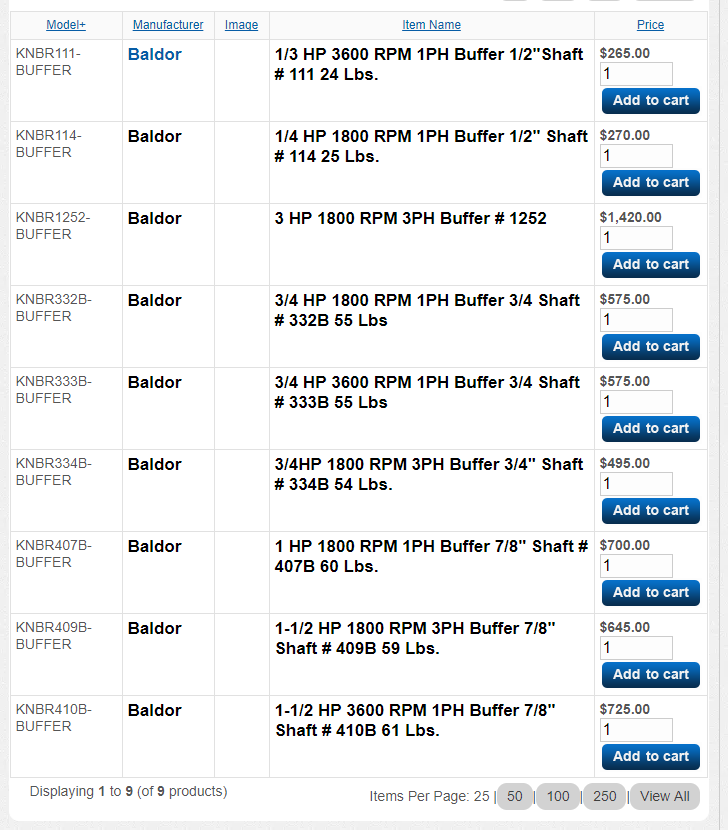
Speaking of trugrit, here are the selections they have:

8v5Hmuf.png


I see the 1.5hp 3600 you mentioned there at the bottom for $725... I think 3/4hp 3600 for $575 is a bit more in my budget considering I still need to get the stand and wheels. Hoping I don't regret the 3/4 hp choice... talk me into spending the extra couple of hundred if I will really regret it! LOL! While I'd love to give trugrit more of my business as they have been great so far, I'm working on a budget, so if anyone knows of a retailer with better prices on buffers I'm all ears!

Thanks again, all!
 
Trugrit is great, I deal with them a ton. It's cheaper for me to order a Baldor from them and get it shipped up than to buy one in Canada...
The 333b would probably be my recommendation. I really don't have a need for the 410 over it, I just like tools and want a bigger one. I have the 332b right now, and about the only time I slow it down is taking the 12" wheel. For what it's worth I was talking to Mike Stewart (bark River) the other day, and he has nothing but 3/4hp baldors for his buffers.

Also if you're wanting to mirror blades, I'd highly recommend the 1/8" spiral sewn wheels Tru grit sells. I haven't seen wheels that hard elsewhere, and they do a great job. They require more frequent raking, but they are much better at preserving your grind lines.

Another thing I'd recommend is buying one of the tapered/spiral buffing points. I keep main blade finishing wheel (1/8" spiral sewn with jacksonlea green compound) on one side, stacked two wheels thick to give a nice wide work surface. On the other side I have a spiral point to quickly change out every other wheel I use.
Compound wise I've tried at least a dozen, and settled on 4 that'll cover everything. Jacksonlea green compound for my initial buffing on blade steel and guard/bolster material, Zam for final finishing on blades, brass, and micarta, and lustrebar for a final finish on all other handle materials.

I've used pink, blue, ect ect and hate them all. They tend to make a real mess and leave lots of compound residue behind. Zam and lustrebar will both wipe out 600 grit scratches on handle materials in a hurry, leave a finish as fine as jewelers rouge would, and are very dry without much residue.
The 4th is a bar of solid carnauba wax from Lee Valley which I use with a loose sewn buff for the final shine on everything. It gives the same result as Renaissance wax, but is about 10x faster
 
Also for the stand I wouldn't buy what Baldor sells. They look nice and I rather want one due to that, but building a plywood cabinet is more practical. I'll take a picture of mine when I get to the shop. Basically it's about 14-16" wide, 24" deep, and as tall as necessary to put the center of the buffing wheel just above your belt buckle. I have a drawer to keep my compound in, a top shelf that holds all my buffing wheels and keeps them clean, and a bottom shelf where I have a couple cases of the jacksonlea green and a pile of lead blocks. That's just to give it some weight so it's rock solid but at least somewhat movable. Screwing it to the wall would work too.
It cost about $20 an a few hours to make, and gives you storage in what would otherwise be wasted space
 
For $275 that's getting hard to refuse...
It is still on the slow side though. It'd be great for flat grinds, but very limited for hollow grinds
 
I would buy that for $275 and throw a $150 5hp Chinese VFD on it and buff everything into oblivion.
I think I'm going to do just this :)

Also, Geoff, thanks for the further advice on hp and the zam vs compound... I will look into those. For reference, I'm a satin guy, not mirror :p
 
For $275 that's getting hard to refuse...
It is still on the slow side though. It'd be great for flat grinds, but very limited for hollow grinds
I almost forgot it's only 1500 rpm... Decisions... I think I've got all the info I need now. Big thanks to all of you. Now to bite the bullet and decide!

And to further add to myself, I'm more into flat and convex grinds than hollow anyway so that might not be the worst... ?
 
At that point if you mostly want to do flat grinds, and aren't much for mirrors I'd say go for it. And for mirroring flat grinds that thing would be hard to beat with an 18" buff.
 
You guys are forgetting you could run the thing at 120 hz and make it almost as fast as you want.

That machine, with an aftermarket VFD and 5hp on tap will do anything you could reasonably ask a buffer to do in a knife shop, IMO.
 
The deal is on... I am feeling very confident about this option as I just spent the past 2 weeks wiring and troubleshooting the VFD for my grinder. There is no set of poorly translated chinese instructions that can stop me now!!
 
Back
Top