

- Joined
- Feb 7, 2011
- Messages
- 427
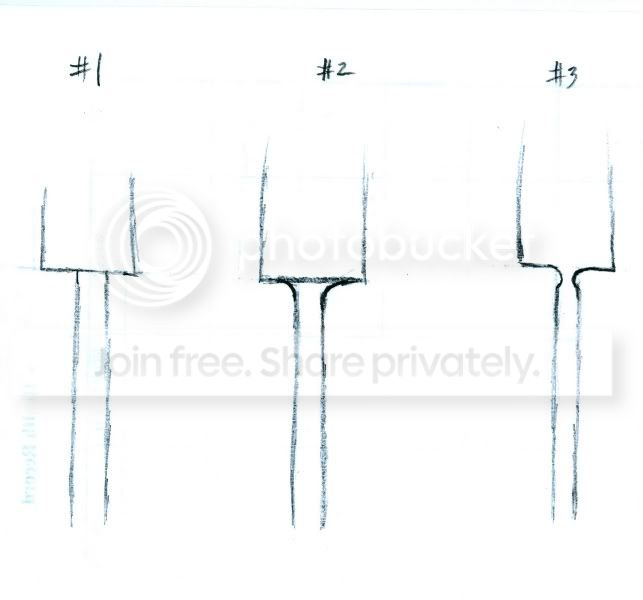
Note: Please realize that my drawing is not exact, I purposfully emphazised the radiuses to make them obvious, I'm not implying they would actually be made that extreme on a knife.
Okay, recently my blue print reading instructor was telling us about thread reliefs, and as he was explaining, it seemed really similar to knife tangs. He explained that to have a sharp corner at a shoulder would weaken the area, just like diagram #1.
So, machinists would put in a radius to strengthen the area, just like #2. But, when they needed something to butt up to the shoulder completely, and still retaing the strength of the radius, they would inset it some, like picture #3.
So, my question, I know that my drawings aren't exactly to scale, but disregarding that, would it work better to make the radius more like #3, with a relief, that way the guard can butt up closer and you don't have to file in a curve?
I'm sure someone has tried this, so I'm curious as to why it's not used, is there something inherently wrong with it in our projects that wouldn't work? I realize it makes it somewhat smaller in that area, but unlike my rough drawing it would have to go in that deep, and it doesn't seem like it would weaken it that much. What am I missing?
Okay, recently my blue print reading instructor was telling us about thread reliefs, and as he was explaining, it seemed really similar to knife tangs. He explained that to have a sharp corner at a shoulder would weaken the area, just like diagram #1.
So, machinists would put in a radius to strengthen the area, just like #2. But, when they needed something to butt up to the shoulder completely, and still retaing the strength of the radius, they would inset it some, like picture #3.
So, my question, I know that my drawings aren't exactly to scale, but disregarding that, would it work better to make the radius more like #3, with a relief, that way the guard can butt up closer and you don't have to file in a curve?
I'm sure someone has tried this, so I'm curious as to why it's not used, is there something inherently wrong with it in our projects that wouldn't work? I realize it makes it somewhat smaller in that area, but unlike my rough drawing it would have to go in that deep, and it doesn't seem like it would weaken it that much. What am I missing?
Last edited:


